
Signs of Water Damage Behind Your Siding: 9 Red Flags
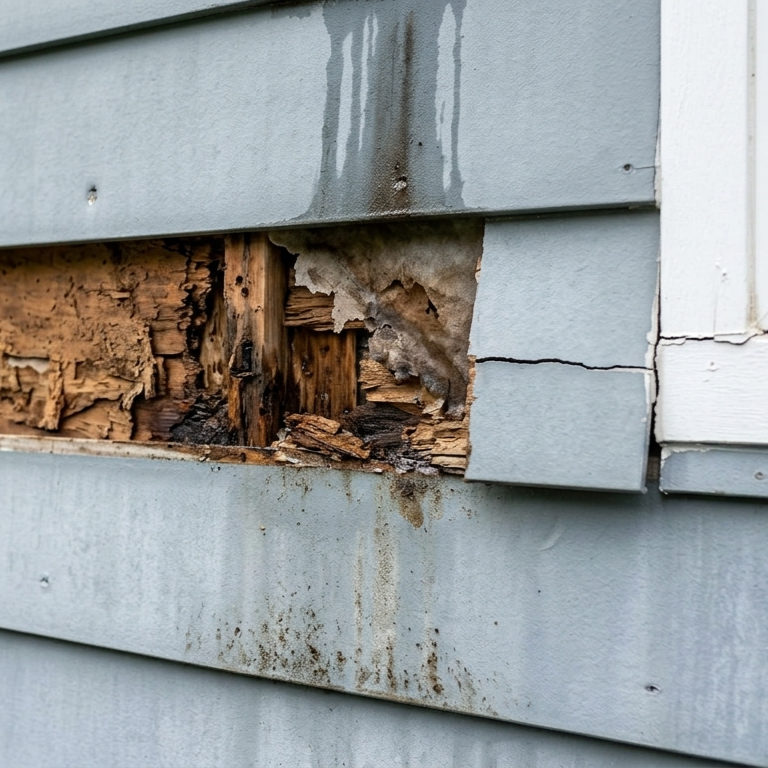
Your siding is the part of the house you can see, and it does a real job: it keeps most of the weather off the wall. But it was never meant to be the last line of defense. Water finds ways past it, and once it does, it lands on the layers you cannot see, the sheathing and the framing that actually hold the house up. That water can sit there for months, quietly turning solid wood into something soft and brown, before anything shows on the outside.
Quick Answer: The clearest signs of water behind siding are bubbling or peeling paint, spots that feel soft rather than firm, dark staining, warped panels, and a musty smell near an exterior wall from inside. Surface scuffs and faded color are cosmetic. Softness and rot mean water has gotten behind the siding, and the entry point needs to be found and fixed before the damage spreads.
How Water Gets Behind Siding in the First Place
Think of your wall the way you would a jacket in a downpour. The outer shell sheds most of the rain, but if a seam splits or the collar leaks, water runs down inside the lining, where you cannot feel it until you are already soaked. Siding works the same way. The panels shed water, but the moment there is a gap, the water goes behind them.
The most common openings are around windows and doors, where caulk cracks with age and flashing gets bent, poorly lapped, or left out during a past project. From there, the list runs long: gaps or hairline cracks in the siding itself, missing or torn house wrap behind the panels, wind-driven rain that pushes moisture uphill under laps, roof or gutter overflow sheeting straight down the wall, splashback where rain hits the ground and kicks dirt and water onto the lower courses, and even water vapor pushing outward from a humid interior.
Climate adds its own pressure, and it works in both directions. In a cold, wet stretch, water that soaks into siding or a seam freezes, expands, and pries the material apart a little more with every freeze-thaw cycle, opening the next gap. The rest of the year, heat and UV do their own damage, baking caulk brittle, cracking paint film, and cupping wood so the joints no longer sit tight. Cold is one stressor. Sun and heat are another, and a wall takes both.
The Signs You Can See From Outside
Most homeowners spot the outside clues first, usually while doing something else in the yard. The tell that gets missed most often is paint. Bubbling, blistering, or peeling paint on siding is not always a paint problem. It often means moisture is pushing out from behind the coating, lifting it off the wood.
Run your eyes and, where you can safely reach, your hand along the wall for these:
- Bubbling, blistering, or peeling paint on the siding
- Soft, spongy, or crumbling spots in siding, trim, or corner boards
- Dark staining or vertical streaks running down from a joint, window, or nail line
- Warped, cupped, or buckled panels that no longer sit flat
- Fasteners that are rusting or leaving rust-colored stains around the nail heads
- Wood-boring insects, or fuzzy fungus and mold growth on shaded lower courses
- Efflorescence, a chalky white crust, on any masonry or foundation near the wall base
Warping and rust matter because they point to steady moisture, not a one-time splash. Rust needs water over time to form, and wood only warps once it has taken on and given up water more than once.
The Signs You Notice From Inside
Water behind siding does not always announce itself on the outside. Sometimes the first real clue shows up in a room. When water gets behind the panels, it soaks into the sheathing and flows along the path of least resistance, often inward through the wall assembly.
Inside, watch for a musty smell that gets stronger near an exterior wall, especially in a closet or corner that does not get much air. That smell is usually mold or mildew feeding on damp material inside the wall cavity. You might also feel a patch of an outside wall that is cooler and slightly damp to the touch, or notice trim along the baseboard that has begun to swell or separate. A jump in the heating or cooling bill with no change in habits can be part of the same story, because a wet wall insulates poorly.
Why Hidden Water Damage Gets Expensive Fast
Here is the part that makes this worth checking. A little water on your siding is a cosmetic issue. Water behind the siding is a structural one, and the two are worlds apart in cost and effort.
Once moisture reaches the sheathing and framing, it does three things at once. It rots the wood, breaking down the fibers until studs and sheathing lose strength. It feeds mold, which spreads across the cavity and can affect indoor air. And it stays hidden, so it keeps working while you have no idea it is happening. When caught early, with only a small area of trim or sheathing affected, the fix is contained. Left for a year or two, the same leak can involve a whole wall section, the framing behind it, and mold remediation.
The gap between a small repair and a large one is almost always time. That is the entire argument for learning these signs.
How to Tell Cosmetic From Structural
The distinction that matters is whether the trouble sits on the face of the siding or comes from inside the wall. A surface issue is one that stays on the surface. Faded color, light scuffing, chalky residue that can be wiped off, and a single hairline crack in one panel are cosmetic. They are worth watching because a crack is a future entry point, but they do not cause damage behind the wall.
Behind-the-wall trouble reads differently. Look at where a stain starts and which way it runs. Dirt and pollen wash down the outside of a panel and rinse off. A stain that bleeds outward from a seam, a nail line, or the underside of a lap is coming from moisture inside the assembly, not from the weather. Warping tells the same story, because a panel only cups and buckles after the material behind it has swelled and shrunk with repeated wetting. Cosmetic problems are uniform and shallow. Structural ones are local, centered on a joint or opening, and they get worse in the same spot over time.
A trained eye can also open a small, inconspicuous window into the wall. A probe at a suspect joint lets a contractor see the sheathing behind the siding without tearing off a whole wall, which turns a guess about one corner into a definite answer.
What to Do When You Find It
The order of operations matters more than any single step, because fixing the wrong thing first wastes the work. The goal is always the same: stop the water, dry the wall, then rebuild.
- Find and fix the entry point- Trace the water back to its source, the failed caulk joint, the bent or missing flashing, the torn house wrap, the overflowing gutter. The source has to be sealed first, or every step after it is temporary.
- Let the wall dry out- Wet framing and sheathing need to release their moisture before anything gets closed back up. Sealing damp wood inside a wall traps it and invites more rot.
- Replace what is rotted- Soft sheathing, punky studs, and crumbling trim get cut out and replaced with sound material. Wood that has lost its strength does not come back.
- Check behind the siding at suspect spots- Before the wall goes back together, look at the sheathing anywhere the outside signs pointed, so nothing wet gets buried.
A Word on Safety
Two things on this job deserve real caution. The first is mold. If you find significant mold inside a wall cavity, disturbing it releases spores, and larger growth is a job for people with the right containment and protective gear, not a weekend scrub-down. The second is height. A lot of these signs are high up near the roofline, gutters, and second-story windows, and inspecting them means climbing a ladder on uneven ground. If a suspect area is out of easy, safe reach, that is exactly the point to bring in a professional.
A trained exterior contractor can read the entire wall, connect the exterior signs to the interior ones, and open only what needs to be opened. That combination is what tells you whether you are looking at a small, contained repair or something that has been quietly spreading behind the panels.
Frequently Asked Questions
Press on the siding and trim with your thumb. Firm material that pushes back is fine, but soft, spongy, or crumbling spots mean water has gotten behind the panel and rotted the material underneath. To be sure, a moisture meter reading taken on the suspect area confirms whether the wall is actually wet inside rather than just weathered on its face.
Water that gets behind the siding soaks into the sheathing and then works its way inward through the wall assembly. A moisture meter pressed against the interior drywall will read high, above the low teens percent that dry framing shows, well before any paint visibly bubbles, so the wall is often wet inside for weeks before the surface shows it. Bubbling or peeling paint and stains on the inside face of an exterior wall usually trace back to a leak behind the siding, not a spill inside the room.
The common entry points are failed caulk and flashing around windows and doors, gaps or cracks in the siding, missing or torn house wrap, and roof or gutter water running down the wall face. One of the most overlooked is the kickout flashing where a roof edge meets a wall: when that small diverter is missing or bent, roof runoff pours straight behind the siding instead of into the gutter. Those are the first places a contractor checks, because closing them off stops the leak at its source.
House wrap is a weather-resistant barrier, the layer installed behind the siding. Its job is to shed any water that gets past the siding and to let the wall dry outward. If it is missing, torn, or lapped in the wrong direction, water reaches the sheathing directly instead of being channeled back out, and rot follows before anyone sees it.
No. Putting new siding over rotted sheathing or wet framing traps the damage inside the wall, where it keeps spreading under a fresh face. The wet and rotted material has to be removed and replaced, and the original entry point sealed, before any new siding goes on. Otherwise, you have hidden an active problem, not solved it.
Wet insulation loses most of its R-value, so a wall carrying hidden moisture insulates far worse than a dry one. On top of that, the same gaps that let water in usually let air leak too. The result is a wall that no longer holds temperature, so heating and cooling costs climb as the damage spreads unnoticed.
Book a moisture inspection before small leaks become structural repairs — a trained crew reads the whole wall, confirms what is wet, and opens only what needs opening. Craftsman Exteriors serves Madison, Verona, Fitchburg, and the surrounding area. Call (608) 843-5007 for a free estimate.
