
Do Replacement Windows Actually Lower Energy Bills?
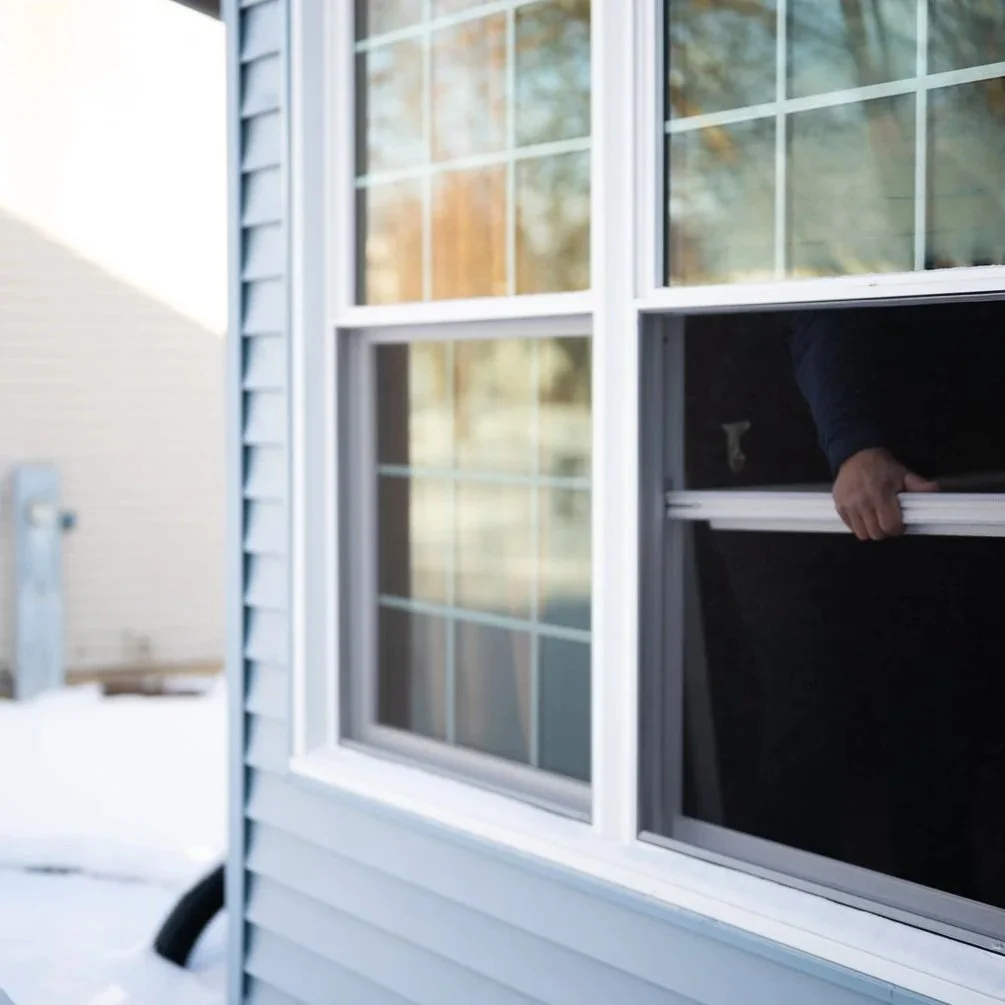
You are standing in the kitchen, and you can feel the cold coming off the glass from three feet away. The single-pane window above the sink has frost on the inside corners. Your furnace kicked on at 5 a.m. and hasn't quit. The question isn't whether those windows are costing you money—it's how much, and whether replacing them is actually worth it.
The short answer: yes, replacement windows lower energy bills. But the full answer involves some honest numbers that most window contractors don't bother sharing.
A Single-Pane Window Has the Insulating Value of Cardboard
Why old windows bleed heat comes down to one number: R-value. R-value measures resistance to heat flow—higher means better insulation. A 2x6 exterior wall with fiberglass batt runs around R-19. A single-pane window has an R-value of about R-1.
That's not a typo. One pane of glass insulates about as well as a sheet of cardboard, because thermal conductivity through glass is that high. Glass doesn't trap air, and trapped air is what insulates. When it's 5°F outside and 68°F inside, that 63-degree difference pushes heat through single-pane glass at a rate your furnace has to fight around the clock.
Double-pane windows with low-E coatings and argon gas fill reach R-3 to R-4. Triple-pane reaches R-5 to R-8. Not as good as a wall—but three to eight times better than what most older homes have.
The argon gas between panes matters more than people expect. Argon is denser than air—about 34% better at slowing heat transfer across that cavity. It doesn't do anything dramatic; it just slows the movement of heat molecules from the warm inner pane to the cold outer one, the way a thick wool blanket holds heat better than a cotton sheet. Same principle. Different materials.
What Low-E Coating Actually Does—and Why It Matters More Than the Glass
Low-E stands for low-emissivity. The coating is a microscopically thin metallic layer—invisible—applied to the inner surface of the glass unit. Think of it as a one-way thermal mirror.
In winter, your furnace heats the air in your home. That warm air radiates heat toward the windows. Without a low-E coating, that radiant heat passes straight through the glass and disappears outside. With it, most of that energy bounces back into the room. Your furnace puts out the same BTUs, but more of them stay where you need them.
Summer runs the opposite direction. The coating reflects solar infrared heat back outside before it can warm your interior, which cuts the load on your air conditioning.
ENERGY STAR-certified double-pane windows with low-E coating cut home heating and cooling costs by 7–15% compared to older single-pane windows. The U.S. Department of Energy puts annual savings at $126–$465 when replacing single-pane windows with ENERGY STAR models, depending on home size, climate zone, and total glass area.
But that range is wide for a reason. Where you land in it depends heavily on your climate.
The Cold-Climate Math: Why a Wisconsin Home Sees Larger Gains Than Average
Not every home saves the same amount. Climate zone drives a big part of the calculation. ENERGY STAR divides the country into zones, and Wisconsin falls in Zone 6—one of the coldest categories in the contiguous U.S. For Zone 6, the program requires a maximum U-factor of 0.27. U-factor is the inverse of R-value: lower numbers mean better insulation. The difference between 0.40 and 0.27 is real money every heating season.
For Wisconsin's climate (Zone 6), ENERGY STAR requires a U-factor of 0.27 or lower. That's the floor worth buying — not a premium spec. Any window above 0.30 will underperform compared to what's available at a similar price point.
Here's the geography piece: heating degree days (HDD) measure how cold a climate is and how hard heating systems work. A Wisconsin home with single-pane windows averages over 7,000 heating degree days per year—roughly three times the HDD of Dallas, and more than most major Midwest cities. More heating degree days mean more hours when your windows are fighting a big temperature gap. The better the window, the less energy bleeds out over those hours.
For a typical Wisconsin home with 15 windows, replacing single-pane units with ENERGY STAR Zone 6 windows can cut annual heating costs by $200–$400, depending on natural gas prices and square footage. That's not huge money on its own. But it adds up alongside lower HVAC wear and a federal tax credit that can put $600 back in your pocket at tax time.
Window Type Comparison: What You're Actually Choosing Between
Not all replacement windows perform equally in a cold climate. Here's how the main options stack up:
| Window Type | U-Factor (typical) | R-Value | Gas Fill | Relative Cost |
|---|---|---|---|---|
| Single-pane (existing) | 0.85–1.0 | ~R-1 | None | baseline |
| Double-pane, standard | 0.35–0.50 | R-2 to R-3 | Air | $$ |
| Double-pane, low-E + argon | 0.25–0.30 | R-3 to R-4 | Argon | $$$ |
| Triple-pane, low-E + krypton | 0.15–0.22 | R-5 to R-8 | Krypton | $$$$ |
For most Wisconsin homes, double-pane low-E with argon is the right call. Triple-pane makes sense in an exposed location with persistently cold rooms, in new construction where the cost premium is smaller per window, or when outside noise matters as much as thermal performance. For a straight replacement project, double-pane low-E gets you most of the thermal gain at a lower cost.
Frame material counts too, but less than salespeople imply. Vinyl frames are the standard—they don't rot, they don't conduct heat well, and they handle freeze-thaw cycles without warping. Fiberglass frames perform slightly better thermally and hold their shape more precisely through temperature swings, but they cost more. Wood frames insulate well and look great, but they need consistent maintenance to stay watertight through wet spring seasons.
What Most Contractors Don't Tell You: Installation Quality
A window rated U-0.25 in a factory test only hits that number when the installation is right. Air leakage around the frame is a separate problem from heat loss through the glass—and it can erase most of the efficiency gain from a high-quality window.
A frame with even a small gap—say, 1/16 inch on one side—lets cold air pour straight in. Air at 5°F doesn't need to conduct through glass; it just flows around the frame. No U-factor rating accounts for that, because the spec assumes an airtight fit.
A $700-per-window unit can underperform when the installer leaves gaps at the sill. Proper flashing, tight frame fitting, backer rod in larger gaps, and quality caulk on both sides of the frame are the difference between a window that performs as rated and one that behaves like an expensive single-pane. The installer matters as much as the window brand.
The Honest Payback Period
Here are the actual numbers.
A mid-quality double-pane low-E window installed runs $400–$800 per window, depending on size and style. A home with 15 windows costs $6,000–$12,000 to fully replace. If that project saves $300 per year in heating and cooling, the payback from energy savings alone is 20–40 years.
That's longer than the warranty on most windows.
So why do people replace them? Because energy savings are one reason, not the only one. Drafty rooms become livable. Condensation stops rotting window sills from the inside. UV fading of floors and furniture slows down. Outside noise drops with double- or triple-pane glass. And resale value improves—remodeling data consistently shows 60–70% of window replacement costs recouped at sale.
The federal Energy Efficient Home Improvement Credit offers 30% back on qualifying window costs, up to $600 per year. On a $2,000 window project, that's $600 at tax time. It meaningfully shrinks the payback period.
Here's how to think about it: if your windows are single-pane, original to a 1970s or 1980s house, showing condensation between panes, visibly rotting at the frame, or letting in drafts you can feel from across the room—the economics work. You are replacing windows that are actively costing you money in energy, maintenance, and comfort. That's not a speculative investment. But if you have modern double-pane windows with intact seals, replacing them purely to save energy is hard to justify. The jump from single-pane to any modern double-pane is massive. Going from one generation of double-pane to a newer one is much smaller.
What to Look for When Shopping
Three numbers worth knowing before you talk to any contractor:
U-factor: For Wisconsin's Zone 6, look for 0.27 or below. ENERGY STAR certification guarantees that threshold. Higher-performance windows hit 0.20–0.22, which gives you more on north-facing exposures and rooms that run cold.
SHGC (Solar Heat Gain Coefficient): This measures how much solar heat the window lets in. For cold climates, a higher SHGC on south-facing windows (0.25–0.40) helps pull in passive solar heat during winter, which reduces furnace run time. For north-facing windows, U-factor matters more than SHGC.
Visible Transmittance (VT): Measures how much natural light gets through. Aggressive low-E coatings can reduce VT noticeably. If a room is already on the dark side and you want it to stay bright, check the VT rating before settling on a glass package.
Frequently Asked Questions
The U.S. Department of Energy puts annual savings at $126–$465 when replacing single-pane windows with ENERGY STAR models. In a cold climate with high heating degree days, you're more likely to see the higher end of that range—especially if the existing windows are leaking air at the frames.
Marginally, if the existing ones are in good shape with unbroken seals. The real savings come from single-to-double-pane upgrades. If your current double-pane windows have fogged glass between the panes—a broken seal—replacing them does restore real performance.
Hold a lit candle near the frame on a windy day. If the flame flickers near the edges, you've got air coming in. Condensation between panes means the seal is broken and the insulating gas is gone. Cold glass on the room side in winter is normal with single-pane windows—that by itself is enough reason to replace.
ENERGY STAR's Zone 6 spec requires 0.27 or below. Better windows hit 0.20–0.22. The difference between 0.27 and 0.22 is real—but it's much smaller than the difference between any older window (typically 0.85+) and any modern double-pane.
As of 2025, yes. The Energy Efficient Home Improvement Credit offers 30% of qualified window costs, up to $600 annually. Windows must meet ENERGY STAR Most Efficient criteria to qualify. Confirm current eligibility requirements with a tax professional, as program terms can change.
For most replacement projects, double-pane low-E with argon is the better value. Triple-pane earns its cost in new construction, rooms with persistent cold spots on north-facing walls, or situations where noise reduction is a priority alongside thermal performance.
Schedule an estimate — Craftsman Exteriors handles window replacement across Madison, Verona, Fitchburg, Middleton, Sun Prairie, and southern Wisconsin. We'll assess your existing windows and tell you honestly whether replacement makes financial sense for your situation. Call (608) 975-5747.
