
What Roof Damage Does an Insurance Adjuster Look For?
The adjuster's truck pulled into your driveway two days after the April hailstorm. You'd already walked the yard, counted a few cracked shingles, and snapped photos on your phone. You felt reasonably ready. Then he was on the roof for 12 minutes, came back down, and handed you an estimate for $1,800 — and you weren't entirely sure what he'd looked at or how he got there.
That 12-minute visit matters more than most people realize. What an adjuster flags — and what they don't — decides your payout. Knowing how they inspect, what pushes a claim toward replacement, and what they're specifically watching for gives you a real shot at a fair outcome.
An Adjuster's Goal Is Not the Same as Your Contractor's
Here's what most homeowners miss: the adjuster works for your insurance company, not for you. That's not an accusation — it's just how the job works. Their task is to assess damage within the terms of your policy. Your contractor's job is to find everything that needs fixing to restore your roof. Those two goals aren't always the same.
Adjusters are trained to separate storm damage from normal aging and deferred maintenance. A policy covers sudden, accidental damage from a covered peril — hail, wind, ice, or a fallen tree. It doesn't cover a roof that simply got old. So when an adjuster gets up there, they're asking one specific question: what did the storm do, and what was already there before it hit?
That distinction drives everything else.
Shingle Damage Is the First Check — and the Most Contested
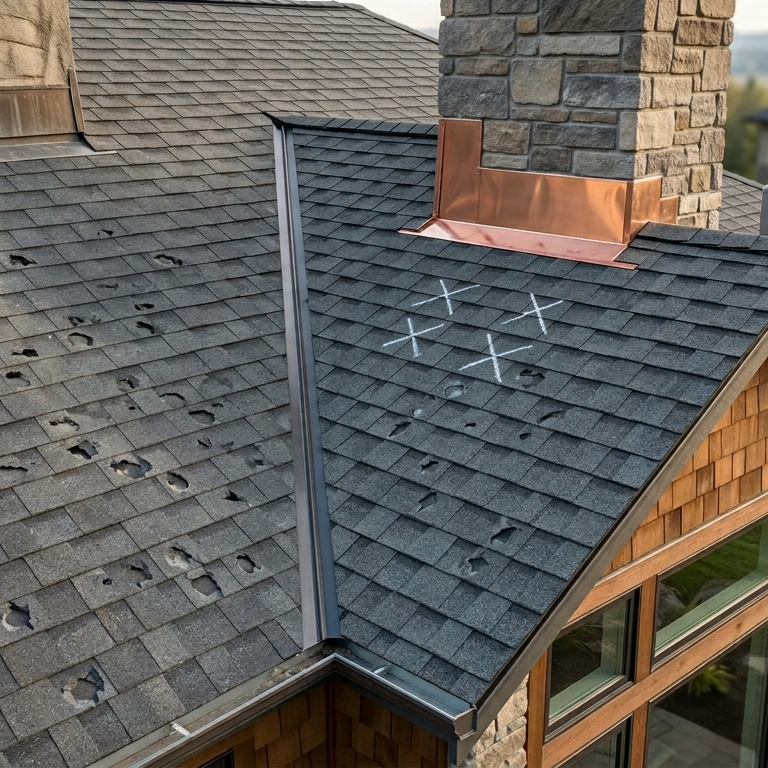
Hail doesn't punch holes through asphalt shingles. It dislodges granules. Those granules coat the shingle's surface and protect the fiberglass mat underneath from UV. When hail hits, it creates an impact point where the granule layer fractures loose. On fresh damage, you can feel a soft spot with your thumb — like pressing on a slightly undercooked brownie. The mat below shows through darker where the coating's gone.
But granule loss also happens naturally as shingles age. Wind scours them. Finding granules in your gutters after a rain isn't proof of hail by itself. A good adjuster tells the difference between the scattered, diffuse wear of an aging shingle and the concentrated circular impact pattern of a hail hit — dense at the center, with a rim of loosened granules around it.
To get a repeatable count, adjusters use a 10x10-foot test square — 100 square feet exactly. They'll mark impact points with chalk on each slope and tally them up. Eight hits per square is the threshold many insurers use to determine whether a slope requires full replacement rather than spot repair, though that number varies by carrier. Consistent hit density across all four slopes tells the story: this was a storm, not a decade of wear.
Wind tells a different story than hail does. Lifted or missing shingles usually show up at the edges first — ridge and hip shingles take the most exposure and go earliest. Adjusters look for tabs where the sealant strip has failed. That factory adhesive holds adjacent shingles tight; once wind breaks it, the shingle's a liability even if it's still sitting in place.
Flashing, Vents, and the Components That Get Overlooked
Most homeowners are looking at shingles. Adjusters don't stop there. Flashing — the metal strips sealing roof-to-wall transitions, chimney bases, skylights, and pipe penetrations — is one of the clearest damage indicators because metal dents, and dents don't lie.
Your gutters are a good example. After a real hailstorm, gutters show clearer evidence than shingles — small, circular impacts from each hailstone. A thorough adjuster uses dented gutters to back up shingle claims. And it's not just gutters. Aluminum AC condensers, painted deck railings, and soft-metal fence posts — anything that takes an impact without prior damage becomes proof of the storm's reach. Your neighbors' damage matters too. Consistent hits across three houses on the same block makes it much harder for an insurer to argue yours is wear and tear.
Pipe boots — the rubber-and-metal collars around exhaust stacks — crack from UV exposure, but hail cracking has its own look. Ridge vents and ridge cap shingles sit at the highest point and take the most direct impact from vertical hail. Both get checked. Chimney flashing and skylight edges are spots where slow water intrusion often gets blamed on pre-existing conditions instead of the storm.
Freeze-thaw cycles are hard on flashing in a way that's easy to misread. Water finds a hairline gap, freezes inside it, expands by about 9%, wedges the gap wider, and repeats that cycle 100 or more times through a single winter. By spring, when an adjuster sees it, the gap looks old — because it's been getting worse since November. An adjuster who doesn't know northern climates can write off genuine freeze-season damage as neglect. If this comes up, your contractor should walk them through exactly how that mechanism works.
Age and Condition: How Adjusters Separate Storm Damage from Normal Wear
This is where claims get denied. Adjusters note your roof's age — sometimes through permit records, sometimes just by reading the shingles. A 25-year architectural shingle in its last 8–10 years shows brittleness, curling tabs, and heavy granule loss. An adjuster can legitimately argue that storm damage to an already-degraded roof only warrants partial coverage.
And your policy's coverage type matters a lot here. A replacement cost value (RCV) policy pays what it costs to replace your roof with comparable materials today. An actual cash value (ACV) policy pays replacement cost minus depreciation — on a 20-year-old roof with a 25-year lifespan, that depreciation could be 80%, leaving you with 20 cents on the dollar. The adjuster's estimate doesn't shift based on your coverage type. But your check does.
Adjusters also read maintenance history from what they see on the roof. Clean gutters, intact caulk around penetrations, no moss in the valleys — these signal a maintained roof. Clogged gutters with weeds growing in them, cracked caulk at every pipe boot, shingles that were curling before the storm — that's ammunition for the pre-existing condition argument. It's worth knowing that all of that evidence works both ways. Getting your roof in decent shape before storm season protects your claim if something does hit.
The 25% Rule: When Partial Damage Can Trigger a Full Replacement
Most homeowners don't know about this before the adjuster shows up. In many jurisdictions, when storm damage covers more than 25% of a roof's total area, building code requires bringing the entire roof up to current standards — not just patching the damaged sections.
A claim covering 30% of your roof can, by code, require a full replacement. Whether your insurer pays for the other 70% depends entirely on whether you have an ordinance-or-law endorsement in your policy. Without it, they cover only the damaged portion. You pay for the remaining required replacement out of pocket.
Call your insurer before the adjuster visits. Ask specifically whether your policy includes ordinance or law coverage. That call takes 10 minutes. The answer can be worth thousands.
What to Have Ready Before the Adjuster Arrives
Your own documentation — gathered before the adjuster walks through — carries real weight. Don't just wait for their findings. Bring your own.
Photos taken within 24 to 48 hours of a storm are harder to dispute than photos from two weeks later. If you can shoot from the ground with a zoom lens, do it right after the storm clears. Better yet, get a contractor on the roof before the adjuster comes out. Their written inspection report gives you a second set of findings to compare with whatever the adjuster writes down.
Pull your prior maintenance records. Receipts from a contractor, an inspection report from when you bought the house, and photos from a repair a couple years back — anything that shows the roof was in reasonable condition before the storm. That paper trail pushes back hard against the pre-existing condition argument.
Know your deductible and what kind of coverage you're carrying. Wind and hail deductibles in storm-prone areas are sometimes structured as a percentage of your home's insured value rather than a flat number. On a $400,000 home, a 2% hail deductible is $8,000 before coverage kicks in. That's important to know before you decide whether filing makes sense.
If the Estimate Comes Back Low
You don't have to accept the first offer. If the adjuster's number and your contractor's estimate are significantly apart, you can request a reinspection, ask your insurer to assign a different adjuster, or hire a public adjuster — a licensed professional who works for you, not the company, and typically takes 10–15% of your final settlement as their fee.
Most policies include an appraisal provision. Each side appoints its own appraiser, and those two agree on a neutral third party. That process settles most disputes without going anywhere near a courtroom. It's almost never mentioned upfront, but it's usually sitting right there in your policy language.
Don't sign anything releasing the insurer from further claims until the estimate actually covers the scope of the repair.
Frequently Asked Questions
A company adjuster works for your insurer and is paid by them. A public adjuster is an independent professional you hire to represent your interests — they work on your side of the claim and typically take 10–15% of your settlement as their fee.
Yes, and it's often worth arranging. Your contractor can flag damage the adjuster might undervalue, and having both assessments happen simultaneously creates a side-by-side comparison that's hard to dismiss.
Eight hits per 100-square-foot test square is a commonly cited industry threshold, but this varies by carrier. Hit density across multiple slopes is more compelling than isolated damage on one side of the roof — adjusters look for a pattern consistent with a single weather event.
It can, depending on your carrier and claims history. A single storm claim often has a smaller impact than homeowners expect. Ask your insurer to walk you through the potential rate effect before you file, especially if your damage is close to your deductible amount.
Request the denial in writing and ask for the specific policy language used as the basis. You can then challenge it with additional evidence, request a reinspection, or use the appraisal process if the dispute centers on damage amount rather than coverage eligibility.
Coverage is based on the cause of damage, not the age of the roof — but age affects the payout significantly under ACV policies. Depreciation is calculated on the roof's remaining useful life. A 20-year-old roof with 5 years left may receive just 20–25% of replacement cost under ACV terms, even with legitimate storm damage.
Schedule an estimate — Craftsman Exteriors handles roof inspection and insurance claim documentation across Madison, Verona, Fitchburg, Middleton, Sun Prairie, and southern Wisconsin. A contractor's written assessment in hand before the adjuster arrives gives you a second set of findings — and often means a better settlement. Call (608) 975-5747.
