
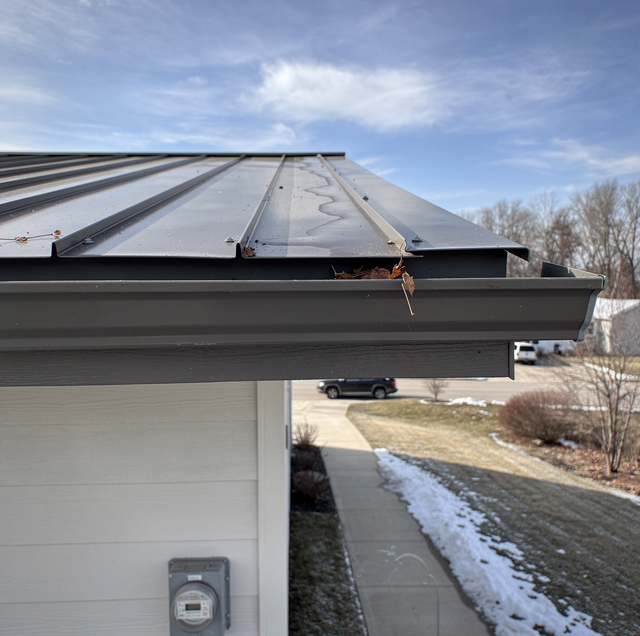
A sheet of snow can let go from a metal roof all at once, sliding off the panel and slamming into the ground below the eave with little warning beyond a brief rumble overhead. A shingle roof sheds that same snow far less often, since it sits up there and melts off in slow trickles instead. On a metal roof, a whole slab can cut loose in seconds, and where it lands is the part most homeowners never think about until it happens over the front steps.
How Metal Lets Snow Go
A shingle roof holds snow because the granular shingle texture and lapped edges give snow something to grip, so it tends to melt and drain off gradually rather than move as a single piece. A metal panel roof, whether standing seam or a ribbed, exposed-fastener panel, has almost none of that texture. The surface is smooth and slick by design, which is exactly why metal sheds rain and meltwater so well in the first place.
That same slickness works on snow. A thin layer of meltwater forms between the snowpack and the panel on a sunny day or once the sun angle climbs, even with the air well below freezing, and that meltwater acts as a lubricant. Once friction drops low enough, gravity takes over, and the accumulated snow releases as a single slab instead of dribbling off in small amounts. The steeper the roof pitch, the faster that slab accelerates once it starts moving, and the less warning there is between the first crack of movement and the snow hitting the ground.
Where That Snow Lands When It Releases
A slab sliding off a metal roof does not fall straight down. It travels forward along the roof's pitch and launches off the eave with real horizontal speed, so it can land several feet out from the wall rather than dropping right at the foundation. A slide off a two-story eave carries more height, speed, and force than the same slab released from a single-story roof, and a slide off a steep pitch clears the eave with more momentum than one off a shallow pitch.
Where that path ends depends entirely on what sits below it: a front walkway, a parked car in the driveway, a deck, an HVAC condenser, a lower roof section, or the gutter run itself. That shedding behavior changes which parts of the yard and the house sit in the discharge path every time snow builds up and lets go.
How a Guard Breaks Up the Slide
A snow guard is a small bracket or bar fastened to the roof surface, positioned to interrupt that slide before it clears the eave. On standing-seam panels, the common style clamps onto the raised seam itself, gripping it mechanically without punching a new hole through the panel. On exposed-fastener panels and metal shingle profiles, guards are typically surface-mounted pads fastened through the metal, closer to how the panel itself is already attached.
What a guard does is hold back a portion of the snowpack so it releases in smaller amounts or melts in place, rather than leaving as one large sheet. What it does not do is stop snow from moving off a metal roof entirely. Guards manage where and how fast the roof sheds, not whether it sheds. And a guard system says nothing about whether the roof structure underneath can carry the snow sitting on it in the first place; that is a framing and truss question, separate from where a released slab travels once it lets go.
Where Guards Get Placed on a Roof
Guards go wherever a released slab would land somewhere that matters. That usually means over the front steps and any door, over parked cars and the path to them, over a deck or patio, above an outdoor HVAC unit or window air conditioner, and along the eave that discharges onto a lower roof section or the gutter run below it.
| What sits under the eave | Typical guard priority |
|---|---|
| Entry door or walkway | High |
| Driveway or parking area | High |
| Deck or patio | High |
| HVAC unit or utility meter | High |
| Lower roof section or gutter run | Moderate to high |
| Open yard with no traffic | Low or none |
A roof plane that discharges into open lawn, away from anything used regularly, carries far less urgency than the same slope over a front walkway. That distinction is what a guard layout is built around, not a blanket rule for every metal roof.
How Much Snow a Roof Carries Decides Guard Density
The amount of snow a roof carries through a winter changes how much retention it needs, not just whether it needs any. Heavy, repeated accumulation builds a larger slab behind every release, so a roof that regularly holds deep snow loads through the season typically calls for more rows of guards, spaced closer together, to break that mass into smaller, more manageable increments. A roof that rarely sees more than a light dusting, and clears again quickly, has far less snow behind each release to begin with, and in many cases the snow that slides off it never carries enough mass to matter.
That same difference decides how much a guard layout leans on the gutter run itself. A winter that regularly stacks deep snow and lets ice build along the roof edge puts real weight on the eave and the gutter beneath it, which is why a run of guards over that gutter earns a spot on the layout. A winter that rarely produces more than a shallow accumulation puts far less of that weight on the edge to begin with, so guards over the gutter run matter less there, and the layout can instead lean on the higher-priority spots.
When a Metal Roof Can Skip Guards Altogether
Not every metal roof needs a full guard system, and adding one everywhere regardless of what is underneath is overkill. A detached shed or garage roof with no walkway, parked vehicle, or equipment beneath its eave often does fine without guards even when the main house gets a full layout. A steep gable end that discharges into an open side yard, away from any path used by people or cars, falls into the same category.
The ground beneath a metal roof's eave can become a sudden slide zone after a hard freeze gives way to a sunny thaw. Keep people, pets, and vehicles clear, and have a roofer set guard placement instead of guessing at it yourself.
Frequently Asked Questions
Yes. Holding capacity is tied to the seam clamp rating tested for a specific panel profile, not a single number that applies across every metal roof: a clamp rated for a standing-seam panel with a given seam height and thickness has a tested load it can hold before it slips on the seam. Clamp-style guards are manufactured to fit that exact seam profile and spacing, so a retrofit starts with identifying the panel's manufacturer and seam dimensions before ordering hardware, not with picking a generic clamp off a shelf; a mismatched clamp can sit loose on the seam or fail to seat fully, which defeats the point of adding guards at all.
Installers typically stagger multiple rows of pad-style guards in a triangular pattern, starting near the eave and working up the roof, rather than relying on a single line at the edge. The number of rows and how tightly they're spaced is tied to how much snow that section of roof carries through a typical winter, not a fixed count based on roof size alone.
Specs for most clamp-style and pad-style systems put the first row within about a foot of the eave, since snow below the first row is not held and a slab that starts low has less room to build speed. Installers work from that spec rather than judgment alone, since a row set too far up the panel lets a slab gain momentum before anything interrupts it.
It depends on the style. Color-matched, low-profile pad guards blend into the panel and are hard to spot from the driveway, while continuous bar or rail systems sit visibly above the roofline and read as a deliberate design feature rather than hardware. Either style works structurally; the choice mostly comes down to whether a homeowner wants the guards to disappear or to show.
It can, depending on how they're attached. Which snow-retention systems and fastening methods are approved varies by panel profile, so a guard installed outside those specs, or one that punctures a panel where a seam clamp is called for instead, can void that portion of the coverage even though the roof itself isn't structurally affected. Checking the panel's warranty terms before installation avoids that gap.
Yes, in practice. Two dissimilar metals held in constant contact with moisture can set up galvanic corrosion, so guard manufacturers offer clamps and pads in aluminum, stainless steel, or coated steel to pair with a given panel's finish rather than one universal metal for every roof, and an installer checks that compatibility before ordering hardware for a specific job.
Get a snow-guard layout mapped for your roof — see which fall zones need coverage before the next heavy snow. Craftsman Exteriors serves Madison, Verona, and Fitchburg. Call (608) 843-5007.