
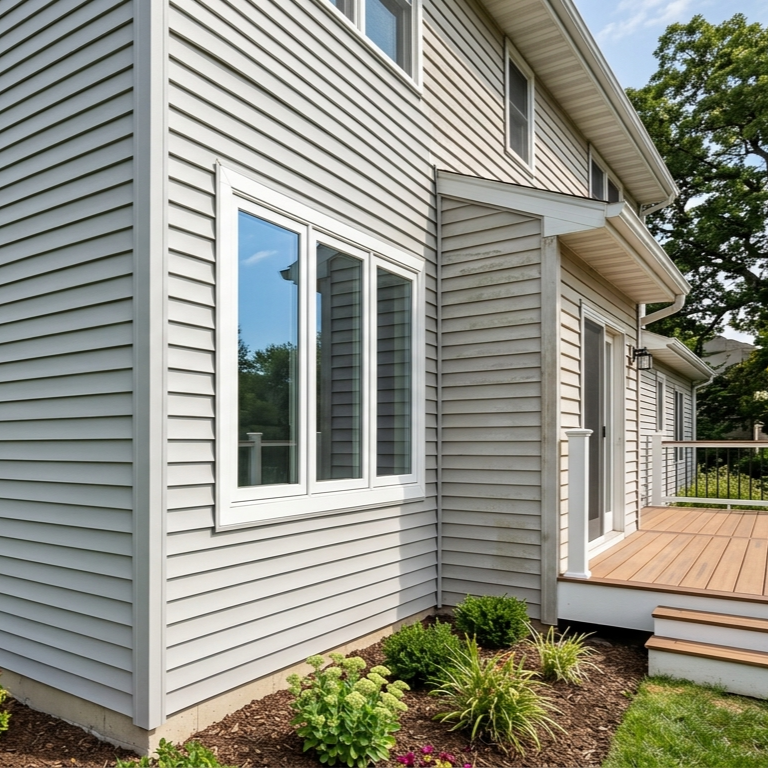
You noticed it walking to your car one morning — a panel on the south wall bowed out like a potato chip, something you don't remember seeing last fall. Or maybe it was a cracked section near the corner, found after the snow finally melted, and you got a real look at the wall. Either way, you're staring at a siding problem that wasn't there a year ago, and you want to know whether it means a $200 repair or something a lot worse.
Vinyl fails in two main ways: warping—buckling, rippling, bowing outward—and cracking. They look similar from the driveway, but happen for completely different reasons. Knowing which one you've got, and what caused it, is the difference between swapping one panel and discovering you've got rotted sheathing behind a wall that's been taking on water for two winters.
Quick Reference: Reading the Damage Pattern
| What You See | Most Likely Cause | Urgency |
|---|---|---|
| Panels bowing outward on a hot afternoon | Heat expansion, nailed too tight | Moderate — re-installation required |
| One warped panel next to a window, the rest of the wall is fine | Reflected heat from Low-E glass | Moderate — won't self-correct |
| Clean break or spiderweb fracture, single panel | Cold-weather impact | Low-to-moderate — check sheathing behind it |
| Multiple hairline cracks, no obvious impact | UV embrittlement, aging siding | High — full replacement likely |
| Panels buckling near all trim and corners | Over-nailing across the whole wall | Moderate — re-installation required |
| Wall bulging inward when you press it, soft sheathing | Moisture trapped, freeze-thaw damage | High — remove panels, replace sheathing |
Vinyl Moves More Than Most Building Materials — and That's by Design
Vinyl is polyvinyl chloride, a plastic that expands and contracts with temperature changes more aggressively than most things on a house. A standard 12-foot siding panel expands roughly a half inch for every 50°F swing in temperature. Across a full Wisconsin season — 85°F in July, 30°F in November — a single panel moves close to an inch just from seasonal change. That doesn't count daily cycling.
This movement isn't a defect. It's built into how the product works. Vinyl panels have a slotted nail hem — an elongated oval hole, not a round one. The nail goes through that slot and stops about 1/16 inch short of snug. That gap is the expansion allowance. When the panel heats up and grows, it slides along the nail. When it cools, it contracts back. A properly installed panel does this thousands of times over its life without any visible movement at all.
When that space is gone — because the crew nailed through the center of the slot instead of leaving the gap, or drove every nail flush against the hem — the panel has nowhere to go. Heat builds, the PVC expands, and since it can't slide laterally, it pushes outward. That's the buckle you're looking at. Think of vinyl like a bridge expansion joint: it's designed to move, but only if you leave it room. Nail it tight and it buckles the same way a concrete road does after a hard freeze.
Heat Causes Warping — But Not Always from the Sun
Direct sun is the obvious culprit. South- and west-facing walls take the worst of it. But one of the worst heat sources for vinyl isn't the sun at all — it's your windows.
Modern double-pane windows with Low-E coatings bounce infrared radiation back into the house. In January, that's exactly what you want. In July, those same coatings act like a focusing mirror, concentrating heat on the siding panel directly below or beside them. Surface temperatures in that reflected zone can hit 160 to 180°F — well above the softening point of standard vinyl, which runs around 140 to 150°F. Once a panel reaches that temperature, it doesn't just expand. It permanently deforms. It won't spring back when the sun moves.
And that's why you sometimes see one badly warped panel in the middle of an otherwise flat wall — right next to a window. Replacing just that panel does nothing. The window hits the new one the same way.
Dark paint colors accelerate this. A panel painted deep charcoal or navy, absorbs a lot more heat than white or light gray, and what would have been a slow expansion becomes a fast one. If your siding warped shortly after a repaint, the color is likely the cause, not the paint formula itself.
Other heat sources that warp vinyl: grills less than four feet from the wall, dryer vents exhausting against siding, and dark mulch beds radiating ground heat against low panels in direct sun.
Cold-Weather Cracking Is a Completely Different Failure
Cracked siding is almost never a heat problem. It's a cold one.
PVC gets brittle as temperatures drop below freezing. Below about 10 to 20°F, standard vinyl behaves more like glass than plastic. An impact that would dent or flex a panel in October—ice falling from the eave, a hailstone, or a shovel blade—can shatter the same panel in January.
Wisconsin winters deliver that combination regularly. Spring hailstorms hit when temperatures are still in the teens and 20s. The hailstone strikes a panel that's been below freezing for weeks and cracks it clean through, or leaves a fracture that doesn't show until the panel thaws and the crack spreads open.
But impact isn't the only way cold cracks vinyl. When the afternoon sun hits a wall that's been sitting at 5°F all morning and brings the surface up to 40°F in two hours, the outer face of the panel expands faster than the interior, which is still rigid and cold. That stress hits hardest at corners and cut edges where the material is thinnest. The result looks like a random hairline crack. It's not random — it's thermal shock, the same reason you don't pour boiling water into a frozen glass.
Installation Mistakes That Set Up Both Problems
Nailing technique is the big one, but not the only error that shows up behind failed panels.
Panels also need a 1/4-inch gap wherever they meet J-channel, corner pieces, or trim boards. Cut them tight, and they bow outward the first time they heat up. Installers sometimes cut panels on a cold morning and set them snug, figuring they'll settle in. They won't — they buckle. Same story with face-nailing: driving a nail through the face of the panel instead of the hem locks it solid with no expansion relief. It's most common on trim pieces and cut panels near corners where the nail slot isn't accessible. Face-nailed panels warp fast.
Panel thickness matters too. Standard-grade vinyl runs 0.040 inches thick. Premium product runs 0.044 inches or better. The thinner the panel, the more it moves and the less it tolerates marginal installation. Budget vinyl on a south wall is a pairing that shows up as buckled panels within five to seven years — long enough that the original crew is gone and the homeowner has no idea what happened.
One more. Saturated or rotted sheathing won't hold nails at the right depth. They pull through soft wood, the panel drifts, and what looks like warping is actually the wall itself shifting. That's not a siding problem — it's structural, and new siding won't fix it.
Freeze-Thaw Cycling Can Push Panels Out From the Inside
Cold climates with 30 or more freeze-thaw cycles per winter have a warping mechanism that doesn't get talked about enough. Water gets behind siding through failed caulk at J-channel seams, gaps at window trim, or unsealed nail holes. Under normal conditions, it drains out the bottom before anything happens. In a hard winter, it refreezes before it gets that chance.
Water expands roughly 9% when it freezes. Trapped behind a panel, that expansion pushes the siding outward. The panel thaws, the water drains partially, and the next hard freeze pushes it a little further. After a full winter of that cycling, you can have a section of wall that bows several inches when it was perfectly flat in September.
The siding isn't the real problem in this scenario. Pull the panel, and you'll usually find OSB sheathing that's soft, gray, and wet — sometimes half an inch deep into the board. The freeze-thaw warping was the first signal. The sheathing damage is the actual repair. Fix the moisture entry point at the same time or the new panels warp on the same schedule.
When Damaged Siding Means Something Worse Is Happening Behind the Wall
A cracked panel is a water entry point. Wind-driven rain gets behind the siding, and if the housewrap is damaged or improperly installed, there's nowhere for it to drain. Water sits against the sheathing and framing and starts the rot process. Rot is slow — it can take two or three winters before the sheathing behind one cracked panel becomes soft enough to notice. But once it gets going in a wall assembly, it doesn't stop on its own.
Warped panels can let water in too, if the bow is severe enough to break the lap seal — the overlap where the bottom of the upper panel covers the top of the lower one. That overlap is your drainage plane. Disrupt it, and you've opened a path just as effective as a crack. Warping concentrated right at a window frame sometimes signals something else entirely: the window flashing or caulk has failed, and water is getting behind the wall at that junction, swelling the substrate and pushing the siding outward. Replace the panel without fixing the flashing, and you'll be doing it again next year.
Before touching anything, press on the sheathing through the opening. Spongy, soft, or darkened wood means the repair scope is bigger than one panel. Fix the moisture source first.
Can You Fix Warped or Cracked Siding, or Does It Need to Come Off?
It depends entirely on what caused it.
One warped panel from over-tight nailing? Pull it off, reinstall with proper clearances, and check the sheathing while you're in there. A couple of hundred dollars in labor. If the wood behind it is dry, it's a quick fix.
Warping from window-reflected heat? Replacing the panel does nothing unless you also address the heat source. Options are changing the window glazing, putting up a shade structure, or switching to a material that doesn't soften at those temperatures — LP SmartSide, for example, is engineered wood with a factory-applied coating and holds up where vinyl won't.
Cracked panels from cold-weather impact? Each one comes off. Inspect the sheathing and housewrap as you go. Clean and dry, the new panel goes right in. Wet or soft wood behind it means you're into a larger repair.
Widespread warping across a full wall on a house that's five to eight years old? That's an installation failure, not a material defect. When every panel on the south elevation is buckling, the problem isn't the vinyl — it's that every single nail was driven too tight across the whole job. That calls for starting over.
Frequently Asked Questions
New siding that warps quickly is almost always an installation error — nails driven through the center of the slot instead of leaving the sliding gap, or panels cut tight against the trim. Pull back one corner and check whether there's a gap for movement. You'll know in 30 seconds.
Yes. Vinyl starts softening around 140 to 150°F, and a gas grill within two or three feet of the wall can easily hit that on the nearest panel. Keep grills at least four feet back. A fire pit built against the house is worse — sustained radiant heat deforms panels permanently within a single season.
The crack itself isn't. The water it lets in can become one over time. Cracked panels should come off within one season to keep moisture from reaching the sheathing and framing behind them.
No. Siding that keeps cracking in cold weather is either below-spec thickness, was cut with exposed edges, or is cycling through extreme temperature swings from a nearby heat source. Standard vinyl handles cold winters fine when the installation is right, and the material grade matches the exposure.
Paint doesn't fix warping. It doesn't touch the expansion problem or the heat causing it. A darker color makes things worse by absorbing more solar heat and pushing panel surface temperatures higher.
Yes. The UV stabilizers and plasticizers in PVC break down over time. Siding that's 20 or more years old cracks more easily in cold weather than it did when it was new. Widespread cracking on aged siding usually means full replacement makes more sense than chasing individual panels.
Schedule an estimate — Craftsman Exteriors handles vinyl siding installation and repair across Madison, Verona, Fitchburg, Middleton, Sun Prairie, and southern Wisconsin. If you are seeing warped or cracked panels, we'll check the wall behind them and give you a straight answer on what needs to happen. Call (608) 975-5747.