
How Long Does a Composite Deck Last in Wisconsin?
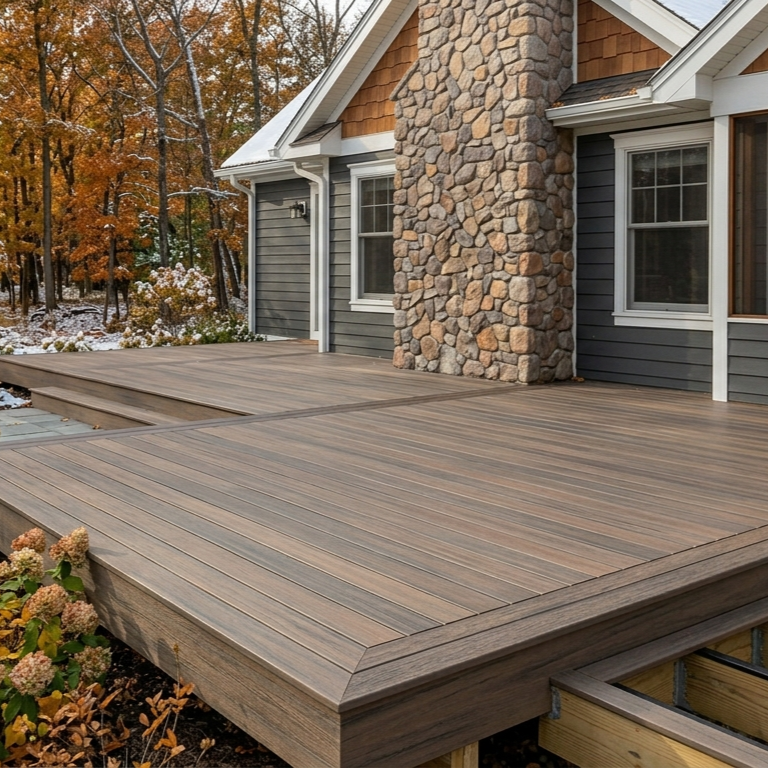
You are standing on your wood deck in April, the one you had built 12 years ago. The snow just melted, and the yard smells like cold mud and last year's leaves. You give the corner board a nudge with your foot, and it flexes. Not a lot — just enough that you notice. Then you glance at your neighbor's composite deck, put in the same year as yours. Same color as the day it was installed. No soft spots. Their kids are already out there.
That moment is usually where the composite deck conversation starts.
Composite decking sold in the US carries manufacturer warranties of 25 to 30 years on most mid-grade products, with some premium lines offering 50-year coverage. But a warranty and a real-world lifespan aren't the same thing. In Wisconsin, with 100-plus freeze-thaw cycles per winter and snow loads hitting 30 to 40 pounds per square foot, a few extra variables determine how long your deck actually lasts — and most of them have nothing to do with the boards themselves.
What "25 to 30 Years" Actually Means for a Composite Deck
When manufacturers advertise a 25- or 30-year warranty, they're covering the decking boards. The boards — the surface you walk on — are typically the longest-lived component on any composite deck. The substructure underneath is a different story, and that's where most real-world composite decks run into trouble first.
Premium capped composite — the type with a polymer shell wrapped around all four sides of each board — generally lasts 25 to 50 years with basic care. The cap is what resists moisture. It prevents liquid from soaking into the wood-fiber core. Without it, the core absorbs water over time, which leads to swelling, softening, and eventually the same rot problems you see with untreated wood.
Entry-level uncapped composite — the kind that was common in the early 2000s and is still sold at the low end of the market — has a realistic lifespan of 10 to 15 years. Sometimes less, if it sits in a shaded area or anywhere water pools slowly. These boards absorb moisture at the cut ends and along the sides, and in a Wisconsin winter, that moisture expands whenever the temperature drops below 32°F.
Water expands about 9% when it freezes. At the microscopic level, that's enough internal pressure to push apart wood fibers that have absorbed water. Repeated 100-plus times per winter, that expansion gradually works apart the fiber matrix inside uncapped boards. You don't notice it at first, but by year 10 or 12, the boards feel slightly spongy underfoot, and the ends near the fascia start to look rough and frayed.
Why Wisconsin Freeze-Thaw Cycles Are the Real Test
Freeze-thaw is simple physics with consequences that compound slowly. Any material that holds moisture — wood, concrete, brick, or low-quality composite — suffers more in climates where that moisture freezes and thaws repeatedly. Wisconsin averages well over 100 freeze-thaw cycles per winter, meaning this process runs nearly continuously from November through March.
Capped composite handles perform well in freeze-thaw cycles because the polymer shell prevents moisture absorption. Think of it like the difference between a sealed concrete floor and bare concrete — the sealed surface doesn't absorb water, so freezing doesn't create internal pressure. The cap does the same job for composite boards.
But the cap only protects what it covers. That's why impact damage matters more on composite than you might expect. A sharp strike — an ice chipper used aggressively, a dropped metal tool — can crack the polymer shell. Once the cap is breached, the board underneath absorbs moisture at that point. In a Wisconsin winter, that spot swells and contracts with every freeze-thaw cycle, and the breach slowly widens over the next several seasons.
Thermal expansion is the other Wisconsin-specific wrinkle. Composite boards expand and contract as temperatures swing. A 12-foot board can shift 1/8 to 3/16 of an inch with a 30°F temperature change. During a Wisconsin January, you can see 40 to 50 degree swings between a sunny afternoon and the following morning. That movement is why proper installation requires specific gap spacing at every board end — without those gaps, boards buckle when they expand against each other in the summer heat that follows a hard freeze season.
The Lifespan Gap Between Capped and Uncapped Composite
There are three broad categories of composite decking, and the real-world lifespan difference between them is substantial.
An entry-level uncapped composite gives you 10 to 15 years in most climates. The wood fiber core is exposed on the sides and at the cut ends. Moisture absorption is gradual and inevitable. In a shaded area or anywhere water drains slowly, expect the shorter end — 8 to 12 years before the boards feel noticeably different underfoot.
Capped-on-three-sides composite runs 15 to 25 years. The polymer shell covers the face and two long edges, but not the cut ends. If installers apply cut-end sealant during the build, you can push toward the higher end of that range. Skip the sealant, and moisture enters from every trimmed board end — stair nosing cuts, fascia board edges, any place a board was shortened on site.
Fully capped four-sided composite is where the 25- to 50-year claims are legitimate. The polymer shell wraps all four sides. Cut ends are still exposed, but the exposed surface area is small relative to the board's total resistance to moisture. Brands like Trex Transcend, TimberTech AZEK, and Fiberon Paramount fall in this category and back their products with warranties in that range.
The price difference between entry-level and premium is real — plan on $8 to $12 per linear foot for mid-grade capped products versus $3 to $5 for basic uncapped. Over a 400-square-foot deck, that's roughly a $4,000 to $6,000 material difference. Over 25 years, that math flips when you factor in replacement costs for uncapped boards that fail at year 12.
What Actually Ends a Composite Deck's Life
Most composite decking boards don't fail first. The frame underneath does.
A pressure-treated wood substructure, properly installed with the right treatment rating, has a realistic lifespan of 15 to 20 years in Wisconsin — often less at the ledger connection and anywhere wood contacts or stays near soil. If composite boards go on a frame that was built with inadequate drainage or undersized treatment, the frame can rot while the boards above it still look fine.
This is the scenario that catches homeowners off guard. They paid extra for a premium capped composite. Year 18, the boards look great. Then they poke the joists from underneath with a screwdriver, and the tool sinks in without resistance. The frame is soft, and the deck needs to come down regardless of what's on top of it. The boards go into the dumpster along with everything else.
Joist spacing and ventilation matter too. Composite manufacturers specify maximum joist spacing — often 16 inches on center for perpendicular board runs, sometimes 12 inches for diagonal or picture-frame patterns. A frame built to those specs allows air circulation under the boards and prevents moisture from pooling on the boards' undersides. Tight framing with no airflow accelerates moisture buildup even under fully capped products.
Ledger flashing is where the most expensive failures originate. Where the deck connects to your house, water has to be directed away from both the framing and the house wall. A missing or failed flashing at the ledger connection can rot the rim joist within five to eight years — not because the composite boards failed, but because that one installation detail was skipped or done wrong.
The Installation Details That Add or Subtract Years
Even a premium capped composite board underperforms if the build is wrong. A few specifics matter most.
Board gap spacing. End gaps of at least 1/8 inch, side gaps of at least 3/16 inch. These let boards expand without pressing against each other and let water drain rather than puddle under the boards.
Fastener method. Hidden fasteners maintain consistent gaps and keep the board face undisturbed. Face screws work if done correctly — but a screw driven without a pre-drilled pilot hole can crack the polymer cap around the fastener head, creating a small but persistent moisture entry point.
Cut-end sealant. Every cut composite board end should be sealed with a manufacturer-approved sealant before it's installed. Takes about 10 seconds per cut. Contractors who skip this step leave moisture entry points at every stair nose, every fascia trim, every shortened board on the project.
Frame treatment rating. The substructure should use pressure-treated lumber rated for its actual exposure — UC4B for ground contact at posts, UC3B for above-ground framing. Using the wrong grade doesn't fail immediately, but it shortens the frame's useful life by years.
How to Tell If Your Composite Deck Is Still Performing Well
If you have an existing composite deck and want to know where it stands, a few checks give you a clear read.
Surface texture. Capped composite holds its embossed texture for years. If boards that once had a wood-grain grip feel smooth and slick, the cap has degraded or worn down. This shows up first on high-traffic paths and stair treads.
End-grain condition. Look at the cut board ends near your fascia and at stair nosings. Rough, fraying ends or swelling around those areas means moisture has been working in. That's a board condition issue.
Frame firmness. Probe the joists from underneath with a screwdriver or a sharp awl. Solid framing pushes back firmly. Soft framing lets the tool sink in with light pressure. If you find soft spots, that's the problem to address first — before any decisions about the boards.
Gap status. If boards have grown together with no visible gaps, they've expanded and lost their room for expansion. The next summer heat cycle has nowhere to put that movement.
Frequently Asked Questions
Premium capped composite lasts 25 to 50 years with minimal maintenance. A pressure-treated wood deck lasts 10 to 15 years without consistent staining and sealing — or up to 20 to 25 years if the owner genuinely keeps up with it every two to three years. The gap widens in climates with hard winters and 100-plus freeze-thaw cycles.
The boards handle snow load fine. The bigger concern in Wisconsin isn't weight — it's water infiltration during the freeze-thaw cycle. The polymer cap on the quality-capped composite prevents moisture absorption that causes freeze-thaw damage in lower-grade materials.
Entry-level composite fades noticeably within five to eight years. Premium capped composite uses UV inhibitors built into the polymer shell that hold color for 15 to 25 years before noticeable change occurs. Most major manufacturers cover fade and stain in their warranties at the premium product tier.
Yes — if the frame is structurally sound. This is one of composite decking's practical advantages. You can swap boards without demolishing the whole structure if the substructure is still solid. Get the frame inspected before deciding, because a compromised frame makes a board-only replacement a short-term fix.
Poor installation. Specifically: no gap spacing between boards, cut ends left unsealed, wrong joist spacing, and ledger flashing that's missing or done wrong. Premium boards installed badly will underperform entry-level boards installed correctly.
Cleaning, yes; sealing no. Wash the deck with mild soap and water once or twice per year. After fall leaf drop, clear debris from between boards — packed organic material traps moisture and can stain even fully capped composite if it sits long enough. Don't use metal ice chippers on the boards; they can crack the polymer cap.
Schedule an estimate — Craftsman Exteriors handles composite deck installation across Madison, Verona, Fitchburg, Middleton, Sun Prairie, and southern Wisconsin. We'll assess your site conditions and substructure to recommend the right product grade for how your yard actually drains and sits. Call (608) 975-5747.
