
Metal Roof vs. Asphalt Shingles: Which Is Better for Wisconsin Homes?
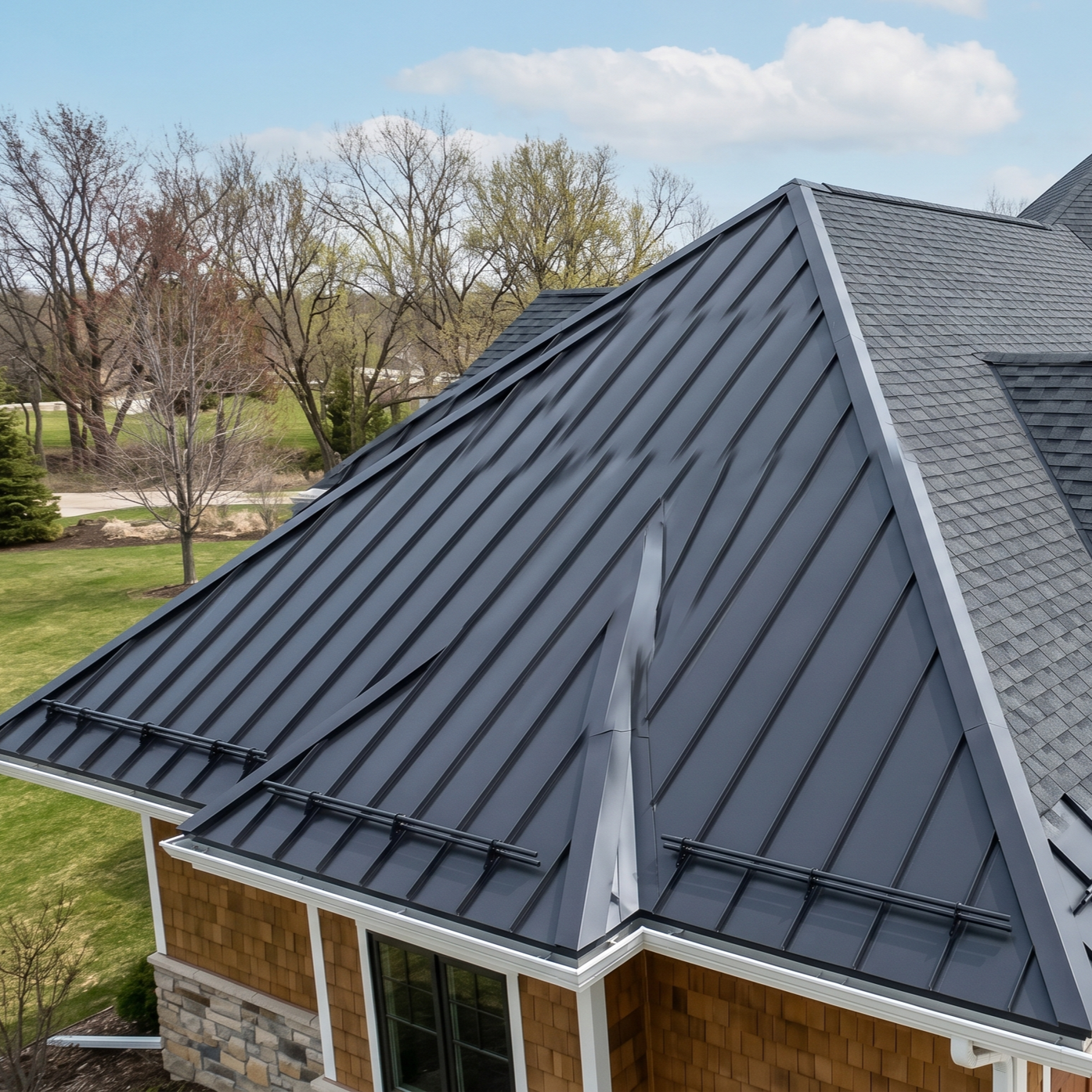
You get up on the ladder in late March to clear the gutters, and something stops you. A patch near the ridge looks wrong — no granules, just a dull gray mat staring back at you. The inspector called this roof sound eight years ago. Now you are standing there doing the math on whether to patch it one more time or replace the whole thing, and if you replace it, whether to go back to asphalt or finally put metal on this house.
That question comes up a lot in Wisconsin. The climate here puts roofing through things manufacturers don't always test for: 40 inches of snow per year, 100 to 130 freeze-thaw cycles every winter, spring hailstorms that can strip granules in 20 minutes, and summer sun that bakes shingles from above while heat bounces back up off the driveway. Both materials can handle Wisconsin — but they handle it differently, and those differences add up fast over a 20-year horizon.
The Price Gap Is Real — Here's What You're Actually Buying
Start with money. That's where most roofing conversations start, and it's the clearest way to see what you're actually getting.
Asphalt shingles run $7,000 to $14,000 for a typical 1,500- to 2,000-square-foot roof in the Midwest, installed. That's for architectural (laminated) shingles — 3-tab has largely disappeared from residential jobs. The high-end covers Class 4 impact-resistant shingles, which cost 20 to 30 percent more than standard architectural shingles but qualify for insurance discounts in many states and hold up noticeably better against hail.
Metal costs more. Standing-seam steel or aluminum on that same roof runs $16,000 to $28,000 installed. Exposed-fastener panels — the corrugated-style with visible screws — come in at a lower price, around $11,000 to $18,000, but they carry a different long-term maintenance story you need to understand before you sign anything.
Those are first-cost numbers. The smarter comparison is cost per year of service, because the lifespans are so different.
| Asphalt Shingles (Architectural) | Metal Roofing (Standing Seam) | |
|---|---|---|
| Installed cost (1,500–2,000 sq ft) | $7,000–$14,000 | $16,000–$28,000 |
| Expected lifespan | 20–30 years | 40–70 years |
| Approximate cost per year | $280–$560 | $270–$560 |
| Impact resistance | Good (Class 4 available) | Excellent |
| Snow shedding | Moderate | Good to excellent |
| Noise in rain/hail | Minimal (with attic insulation) | Moderate (without insulation board) |
| Weight per 100 sq ft | 275–425 lbs | 85–120 lbs (steel standing seam) |
| DIY repairability | Straightforward | Difficult |
| Maintenance | Periodic inspection | Minimal (standing seam) |
When you run those numbers, the annual cost often lands in roughly the same range. The real difference is timing. Asphalt means two or three replacement cycles over the life of one metal roof. If you're planning to sell in seven years, asphalt probably makes more sense. If you're staying put, that math shifts.
Why Freeze-Thaw Cycles Damage Each Material Differently
Wisconsin's freeze-thaw cycle is what actually separates these materials in practice — and you need to understand the mechanism before you spend $20,000 on a roof.
Water expands by about 9% when it freezes. That sounds small. But when that water is sitting under a loose shingle tab, inside a crack in a sealant strip, or along an improperly lapped section of underlayment, that 9% acts like a hydraulic wedge — pushing the gap wider with each cycle. The next freeze finds more water in a bigger gap. By year three or four of 100-cycle winters, what started as a hairline opening becomes an active leak path.
The multi-layer construction of architectural shingles was designed to flex, which helps. That's part of why architectural shingles replaced 3-tab in most residential jobs — thicker laminations handle thermal movement better than a single thin tab. But the adhesive strips that bond shingle tabs — the sealant line — can lose adhesion in sustained cold. Once a tab lifts, it's exposed to wind uplift. A strong gust can pull it completely free.
Metal handles thermal movement differently. A 40-foot standing-seam panel expands roughly 3/8 of an inch between a cold Wisconsin morning and a warm June afternoon. Standing-seam systems use floating clips that let the panel slide without stressing the fasteners, so that movement happens without consequences. Think of it like the expansion joints in a concrete bridge deck: the movement is expected and built into the design from day one.
But exposed-fastener panels work on a different principle. The screws go directly through the panel and compress neoprene washers. Those washers harden, shrink, and eventually allow water entry at every fastener hole. That's the long-term maintenance issue with exposed-fastener systems — periodic inspection and resealing, or you end up with hundreds of small entry points by year 15.
Ice Dams: What's Actually Happening and Which Roof Handles It Better
Ice dams are the freeze-thaw damage Wisconsin homeowners talk about most. Here's what's actually going on.
Heat escapes through the roof deck and melts snow from the inside out. That meltwater runs downhill toward the eave, where there's no heat loss below the overhang, and refreezes. The dam builds layer by layer until the backed-up liquid water has nowhere to go — and then it pushes under shingles, particularly at seams and valleys, until it reaches the deck. By the time a bedroom ceiling stains, water has already found every weak point between the eave and the interior.
Neither roofing material prevents ice dams on its own. Ice dams are an insulation and ventilation problem — not a shingle problem. But the two materials respond differently once a dam forms.
Standing water is where asphalt shingles run into trouble. They shed rain efficiently by overlapping, but when water sits behind a dam and works under the tab seam, those overlapping layers don't create a watertight seal at near-zero slope. That's why ice-and-water shield — a self-adhering membrane installed under shingles at the eave — is standard practice in cold climates. It catches water that gets past the shingles.
Standing-seam metal is more resistant to water backing up from below. The panel seams are raised, which means water would have to climb a ridge to reach the seam. Metal also sheds snow more aggressively. A steel roof on a 4:12 or steeper pitch sheds snow the way it sheds rain — not slowly, but in sheets.
And snow guards come with the territory on cold-climate metal roofs. Individual puck-style guards run up to $15 per piece, and a full rail system can reach $40 per linear foot. On a typical home, snow management hardware adds $2,000 to $8,000 to the install. That's not a reason to skip metal. But it belongs in your real cost estimate, not a footnote.
When Asphalt Still Makes the Most Sense
Asphalt makes sense in more situations than metal's advocates usually acknowledge.
Planning to sell in 10 to 12 years? A new asphalt roof is a recoverable cost. A two-year-old 30-year architectural shingle roof is a selling point; the incremental resale value of metal over asphalt rarely covers the cost difference at resale.
Complicated roof geometry is another case where asphalt wins. Multiple valleys, dormers, penetrations for chimneys and skylights, and plumbing vents — all of that is easier and cheaper to flash properly in asphalt. Metal's performance advantages are most pronounced on simple geometries. Complex rooflines add installation difficulty and narrow the gap.
And if budget is the constraint right now, a properly installed architectural shingle roof using Class 4 impact-resistant shingles is not a short-term compromise. At 25 to 30 years of life expectancy with adequate ventilation underneath it, you're getting real value for the money.
When Metal Earns Its Higher Price Tag
Metal is worth serious consideration when you are staying in the house for 20 years or more. One metal roof covers a period that would otherwise require two full asphalt replacements — and each of those replacements will cost more in labor and materials than today's prices. Inflation alone makes the math work in metal's favor at that horizon.
The hail story is more nuanced than most metal advocates let on. Small hail — 3/4-inch stones, which southern Wisconsin sees regularly — can dent steel and aluminum without fracturing them. Class 4 impact-resistant asphalt shingles are rated to withstand a 1.75-inch steel ball dropped from 20 feet, which is a harder test than typical Wisconsin hail. Metal dents; good asphalt absorbs and bounces. The difference shows up after the storm. Dented asphalt has lost granules and exposed the fiberglass mat to UV, shortening the shingle's remaining life by years. Dented metal stays waterproof — but any dent that chips the paint coating should get inspected, because exposed bare steel can rust.
Energy efficiency is real, but plays a secondary role here. Painted metal with a cool-roof coating reflects 60 to 70 percent of solar energy, compared with 5 to 15 percent for standard asphalt shingles. Heating is the dominant energy cost in Wisconsin, but the summer cooling reduction does add up over time if you don't have shade coverage on the south- and west-facing slopes.
Frequently Asked Questions
In a conditioned living space with standard attic insulation, the difference is minimal. The insulation board that goes under most residential metal installations absorbs sound effectively. In open structures — a garage, a covered porch, a pole barn — metal is definitely noisier. For a finished home with attic insulation, most people stop noticing within a few weeks.
No more than any other material. Lightning seeks the path of least resistance to ground, determined by height and proximity to the strike zone — not by roofing material. Metal roofing is non-combustible, which is an advantage if a nearby strike causes a fire.
Sometimes. Some metal systems can go over existing shingles if the deck is in good condition and local building codes allow it. This skips the tear-off cost, which runs $1,000 to $3,000 on a typical home. The tradeoff is that you can't inspect or repair the deck before covering it. Get a contractor to assess the deck condition before assuming this option works for your house.
Most insurers offer a discount for metal roofing — often 20 to 30 percent on the dwelling coverage portion of the premium — because metal resists hail, fire, and wind better than asphalt. The exact discount varies by insurer and location. Call your agent before committing to a material. The savings sometimes offset more of the price gap than homeowners expect.
Architectural asphalt shingles typically carry 30-year or "lifetime" manufacturer warranties, but those warranties are prorated after 10 years and cover materials only — not labor. Standing-seam metal commonly carries 40-year paint warranties and 20-year workmanship warranties on installation. Metal warranty terms are generally more straightforward to read and claim, though any warranty requires installation by a manufacturer-authorized contractor to stay valid.
Less, in most cases. Asphalt needs periodic inspection for lifted tabs, cracked sealant, and granule loss. Standing-seam metal requires almost no maintenance beyond clearing debris from the valleys and keeping the gutters clean. Exposed-fastener metal requires fastener checks — the washers harden over time and need resealing. Choose the system based on what maintenance you're actually willing to do, not the best-case scenario on a spec sheet.
Matching the Material to the House
Neither is universally better. That's the honest answer. Asphalt with Class 4 impact ratings and ice-and-water shield at the eaves holds up through Wisconsin winters for 25 to 30 years — it's not a consolation prize. Metal costs more upfront, lasts longer, sheds snow more aggressively, and keeps UV from degrading the shingle mat when hail hits.
Your timeline, your roof's geometry, and what you can spend right now — those factors tell you more than any spec comparison ever will.
Schedule an estimate — Craftsman Exteriors handles metal roofing and asphalt shingle installation across Madison, Verona, Fitchburg, Middleton, Sun Prairie, and southern Wisconsin. We'll walk you through both material options with a real cost comparison for your specific roof. Call (608) 975-5747.
