
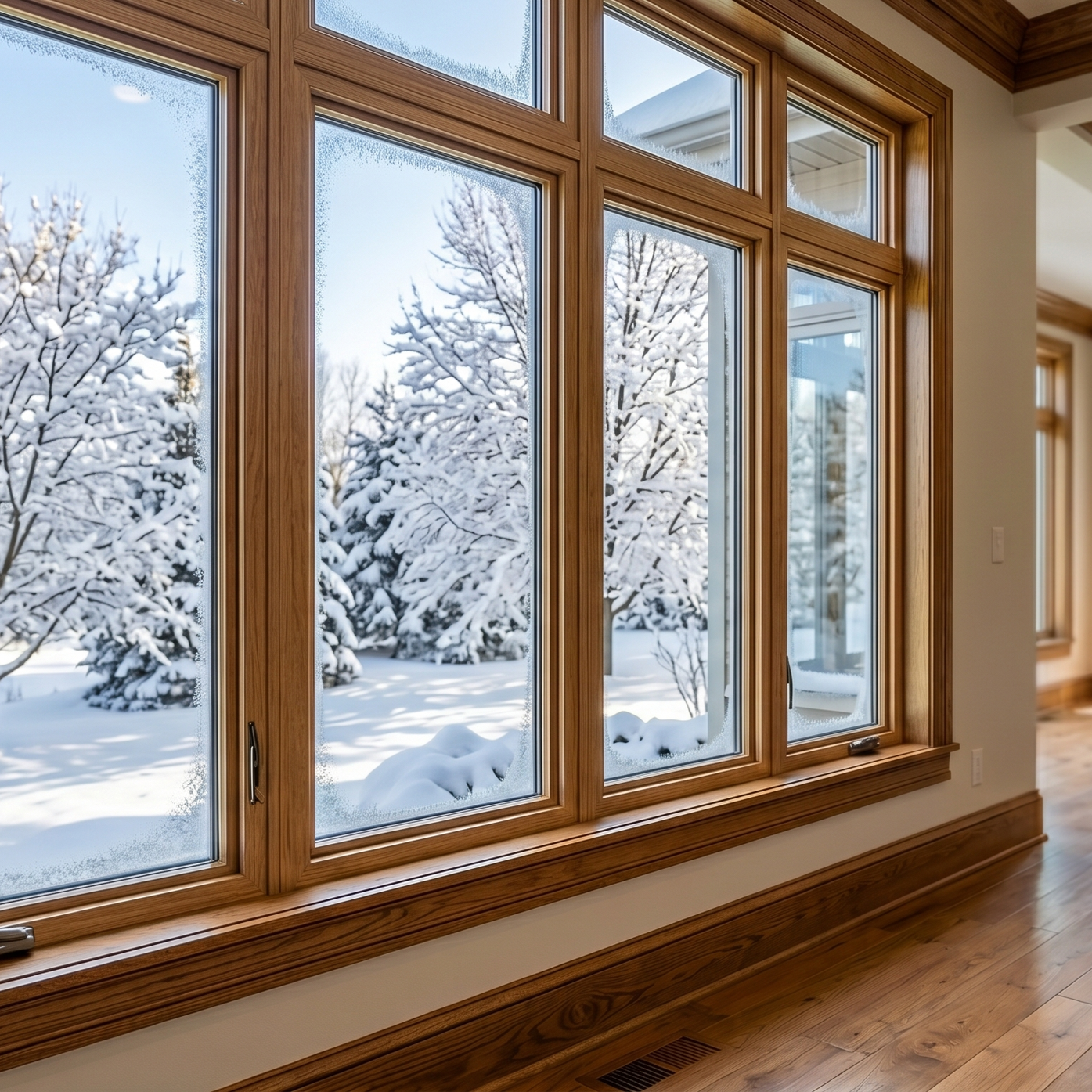
You notice it every cold weather. The wood window in the spare bedroom—the one that's always been a little stiff—won't open at all now. You push, it groans, and eventually you stop trying. By June, it'll slide fine again, and you'll forget about it until next winter. That's not a fluke. That's wood absorbing and releasing moisture across 100-plus freeze-thaw cycles, and the frame swelling and contracting until the gap between frame and sash is gone. Most homeowners live with it for years before they realize what's actually happening.
The vinyl vs wood window debate sounds like a preference question, but in a climate with -15°F lows, 40 inches of annual snowfall, and wild temperature swings between January and July, it's mostly a physics question.
What Wisconsin's Climate Actually Does to a Window Frame
The core problem is thermal movement. Every building material expands when it heats and contracts when it cools—the question is how much, and whether that movement causes damage over time.
Wood's coefficient of thermal expansion runs about three to five millionths of an inch per inch per degree Fahrenheit, depending on species. That sounds tiny. But across a 36-inch window frame cycling between -10°F in January and 90°F in August—a 100-degree swing—you're looking at a frame that moves roughly one-eighth of an inch in each direction. Add moisture absorption on top of that thermal movement, and wood can shift up to three-eighths of an inch across its width in extreme cases. After 15 or 20 years of that, frames warp, sashes bind, and the paint seal cracks—letting more moisture in and accelerating the whole cycle.
Vinyl expands more per degree than wood—roughly three to four times more, at 30 to 60 parts per million per degree Fahrenheit. But it doesn't absorb moisture, so the only movement you're dealing with is thermal. Quality vinyl window manufacturers address this with thermal breaks, expansion channels, and multi-chamber frame designs that allow the frame to flex without cracking. The movement is controlled; it doesn't compound over the years the way wood moisture absorption does.
How Vinyl Windows Hold Up in Cold Climates
Vinyl became the dominant replacement window material partly because of price and partly because of what it doesn't do: it doesn't rot, doesn't require painting, and doesn't absorb water. In Wisconsin, those aren't just maintenance conveniences—they're structural advantages.
Modern vinyl windows use multi-chamber uPVC (unplasticized polyvinyl chloride) construction—hollow chambers inside the frame that act as insulating dead-air pockets and distribute stress across the frame instead of letting it concentrate at joints. Better-grade frames add steel reinforcement in the sash corners and meeting rails, which addresses vinyl's one real structural weakness: it's not as stiff as wood or aluminum under heavy point loads.
Cold temperatures do affect vinyl. Below about 0°F, uPVC becomes more brittle, and a sharp impact—a branch in a storm, a baseball—can crack a vinyl frame that would have just dented at 50°F. But in normal operation—opening, closing, and weathering thermal cycles—vinyl holds up reliably into the -20°F range common in a Wisconsin winter.
Energy performance is where vinyl genuinely wins over older wood windows. A quality vinyl replacement window with low-E glass and argon fill hits U-factors of 0.22 to 0.28, meaning it loses roughly a quarter of a BTU per square foot per hour for every degree of temperature difference. An older single-pane wood window runs around 1.0—roughly four times the heat loss. That's a real number on your gas bill. A 1,500-square-foot home with 15 old single-pane windows replaced with quality vinyl units will typically see a 15 to 25% reduction in heating load, depending on window size and orientation.
Vinyl windows in the $400 to $900 installed range (per window, for typical double-hung replacements) will last 20 to 40 years with essentially no maintenance beyond occasional cleaning.
How Wood Windows Perform—and Where They Fall Short
Wood has genuine advantages. It's dimensionally stable in controlled indoor environments, it accepts paint and stain, and it's stiffer than vinyl at the same thickness—which matters for large openings and high-end custom configurations. Historic homes with oversized windows or complex trim profiles often can't accommodate standard vinyl retrofit units without major modifications to the rough opening.
The structural problem with wood in Wisconsin isn't temperature—it's moisture. Wood is hygroscopic: it absorbs water vapor from the air and releases it as humidity changes. In a Wisconsin winter, the indoor side of a window frame sits in a heated 65°F room while the outdoor side faces -5°F air and wind-driven snow. That moisture gradient is severe. Water vapor moves from warm to cold, pushing through the wood toward the outside. If the paint seal on the exterior side of the frame is intact, that vapor has nowhere to go—it accumulates in the wood. Eventually the paint blisters. Then it cracks. Then rain gets in.
Think of it like a water balloon pinched at one end—pressure has to go somewhere. Wood exterior frames that aren't perfectly maintained will absorb water from the outside and soften, blister, and rot from the outside in. On a south-facing window that gets direct sun, UV also degrades the paint film faster, so you're repainting south-facing wood windows every five to seven years just to keep the seal.
Clad wood windows—wood interior, aluminum or fiberglass exterior cladding—solve the exterior moisture problem and last longer in cold-climate conditions. But they run $900 to $2,000 or more per window installed, and they still require attention to the interior wood surfaces to prevent moisture damage from condensation.
Solid-wood windows typically need painting every five to seven years and may need full frame repairs or replacement within 20 to 30 years if they're not meticulously maintained. Clad wood windows reduce but don't eliminate that maintenance burden.
Vinyl vs Wood: Side-by-Side Comparison
| Factor | Vinyl | Wood (Solid) | Clad Wood |
|---|---|---|---|
| Typical installed cost | $400–$900/window | $600–$1,400/window | $900–$2,000+/window |
| Lifespan | 20–40 years | 15–30 years (with maintenance) | 25–50 years |
| Maintenance | Minimal (clean only) | Paint every 5–7 years | Moderate (interior wood) |
| Cold-weather performance | Good to -20°F | Good, but moisture management critical | Good |
| Energy efficiency (U-factor) | 0.22–0.28 | 0.30–0.50 (older units) | 0.25–0.35 |
| Moisture resistance | Excellent | Poor without maintenance | Good (exterior) |
| Freeze-thaw impact | Low | High (swelling, binding, rot risk) | Low to moderate |
| Structural rigidity | Moderate (reinforced) | High | High |
| Custom/historic profile fit | Limited | Fully custom | Fully custom |
| Resale value perception | Neutral to positive | High (if well-maintained) | High |
Where Wood Windows Still Make Sense
Wood isn't obsolete. It's just specific. If you own a 1920s Craftsman bungalow with four-over-one divided-light windows and you're trying to match the original profile for a preservation project, vinyl won't get you there. Standard vinyl units come in a few dozen profiles; custom wood windows can be milled to match almost anything.
Wood also holds up in large structural window walls where rigidity matters—floor-to-ceiling fixed glass, for example, where a vinyl unit the same size might flex more than you'd like. And for homeowners who do meticulous maintenance—annual inspection, repainting on schedule, immediate attention to any failed caulk or paint—wood can last as long as vinyl under cold-climate conditions.
The failure mode for wood isn't the material itself; it's the maintenance gap. Most homeowners delay the repaint cycle by two to three years, skip the caulk inspection, and don't catch the early blistering on the north-facing unit where snow sits longest. That's when rot sets in.
What to Look for in Either Material
If you're buying vinyl: look for multi-chamber frame construction (not a single hollow tube), reinforced sash corners, low-E glass with argon fill, and a U-factor at or below 0.30. Avoid bargain vinyl units with thin frames and single-point sash locks—they'll rack and twist within 10 years. Fusion-welded frame corners are more durable than mechanically fastened ones.
For south-facing windows in a cold climate, pay attention to Solar Heat Gain Coefficient (SHGC). A rating of 0.35 to 0.50 on south-facing glass lets in useful winter solar heat while limiting summer overheating. Most budget vinyl units default to a low SHGC coating that blocks winter sun—fine for east- and west-facing windows, but a missed opportunity on south walls.
If you're buying wood or clad wood: specify a fiberglass or aluminum exterior clad rather than a bare wood exterior, kiln-dried lumber to minimize initial moisture content, and factory-applied primer on all six sides before installation. An unprimed cut edge—even one that's later painted—will wick moisture faster than you'd expect.
For either material, ask about weatherstripping. EPDM rubber or silicone weatherstripping stays flexible at low temperatures and holds a compression seal through thousands of freeze-thaw cycles. Standard foam weatherstripping stiffens and compresses permanently in the cold, leaving gaps you can't see until your heating bill arrives. Also, ask about the warm-edge spacer on the insulated glass unit—aluminum spacers conduct cold and create condensation at the interior glass edge in January. Foam or stainless-steel spacers perform significantly better in sub-zero temperatures.
Frequently Asked Questions
Modern uPVC vinyl is formulated for cold-weather performance. It does become somewhat more brittle below 0°F, but doesn't crack in normal use—opening, closing, wind, and thermal cycling don't generate the kind of impact stress that causes failure. The risk is sharp impacts like storm debris in extreme cold, not weather cycling itself.
On average, every five to seven years for south- and west-facing windows with direct sun exposure, and every seven to 10 years for north-facing units. Skip one cycle, and you're looking at wood prep and spot repairs, not just a fresh coat of paint.
For most older homes, yes. Modern full-frame vinyl replacement windows seal much better than original units and can be ordered with interior wood-grain finishes that closely match painted wood. The limitation is highly custom profile shapes or very large openings that standard vinyl unit sizes don't accommodate without modifying the rough opening.
Window performance is measured by U-factor, not R-value. A quality vinyl window with low-E glass runs U-0.22 to 0.28. A solid-wood window of similar construction runs 0.28 to 0.35. The glass unit is the dominant factor—the frame material accounts for roughly 15 to 20% of total thermal performance. A cheap vinyl window with inferior glass can perform worse than a quality wood window with good glazing.
Yes, but it comes with caveats. Standard vinyl windows are extruded in a base color and accept exterior paint, but darker colors absorb more solar heat, which can warp the frame—especially cheaper single-chamber profiles. Some manufacturers offer factory-applied dark exterior colors with frames reinforced for that thermal load; that's the right way to do it.
Push a screwdriver or awl into the sill and lower corners of the frame. If it sinks more than about 1/4 inch with light pressure, the wood is soft from moisture damage. Also check for glass that's shifted in the frame, visible daylight at the corners when the window is closed, or consistent condensation between panes (a failed seal). Any of those points toward replacement rather than repair.
Schedule a consultation — Craftsman Exteriors handles window replacement across Madison, Verona, Fitchburg, Middleton, Sun Prairie, and southern Wisconsin. If your wood windows are sticking every winter, showing paint failure on the exterior, or you are just done repainting on a five-year cycle, we'll assess what you have, walk you through vinyl and clad wood options, and give you an honest recommendation based on your home and budget. Call (608) 975-5747.