
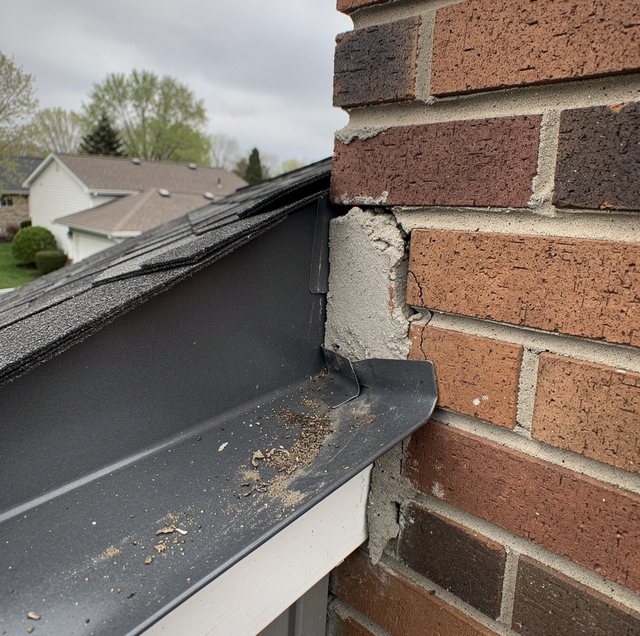
A chimney is a masonry box that the roof deck was cut open to make room for, and that cut is exactly where an ordinary roof stops being simple. Everywhere else, shingles shed water across an unbroken field, one course handing off to the next. At the chimney, the roof has to be rebuilt around brick or block using metal, mortar, and several transitions that must all hold at the same time. Water can get in at the flashing where the roof meets the masonry, through the masonry itself, or from the top of the chimney down. The stain you find on your ceiling tells you a leak is happening, but it does not mark where the water got in: it drips through the drywall wherever it finally found an opening in the framing below, which can sit well away from where it first entered at the chimney. Finding the real source means checking each face of the chimney individually, rather than assuming the nearest visible gap is the cause.
Each entry point around a chimney fails in its own way, and the table pairs each one with what fails there and whether it is roof work or masonry work.
| Entry Point | What Fails There | Roof Work or Masonry Work |
|---|---|---|
| The sides, where the roof runs along the brick | Step flashing works loose, corrodes, or was never lapped correctly under the shingle courses | Roofing |
| Counter flashing at the mortar joint | The metal separates from the joint, or a sealant bead holding it ages and cracks | Roofing |
| The front apron on the downslope face | The single flashing piece bends, lifts, or was undersized for the chimney's width | Roofing |
| The upslope back face and any cricket | Water and debris pool against the chimney instead of splitting around it | Roofing |
| The crown on top | Hairline cracks in the mortar or concrete cap let water soak into the chimney below | Masonry |
| The brick and mortar faces | Porous or unsealed masonry takes on water directly through the wall | Masonry |
| An open flue with no cap | Rain falls straight down the flue and can show up at the firebox or damper | Masonry or chimney service |
Counter Flashing and the Mortar Joint
The counter flashing at a chimney is the piece that laps over the step flashing below it and ties the roof's metal into the masonry itself. It can fail in two ways, and the way it was installed determines how it fails later. Cut into the joint, the installer grinds a shallow groove along the mortar line, and the flashing's top edge is bent into that groove and packed with mortar or sealant, so the metal is locked into the wall and sealed against it. Held against the wall face instead, the flashing sits on the brick surface and relies on a bead of sealant alone to keep water out, with nothing to hold it in place once that bead lets go. Both methods can hold for a long stretch if they were done correctly, and both can fail. The difference shows up in how the failure looks: a sealant bead ages, shrinks, and separates from one side before it looks broken from the ground, while a cut-in joint can fail where the mortar or sealant packed into the groove lets go.
The Upslope Side and What a Cricket Does There
A chimney set across the slope stands square in the path of water running to the eave, so water and whatever the roof sheds (leaves, needles, granules) collects against its back wall before it works sideways around it. A cricket is a small secondary peak built into the roof deck directly behind the chimney, its own ridge running across the main roof slope so it splits the water into two streams and sends each one around a side of the chimney instead of letting it pond against the back wall. Not every chimney gets one. A narrow chimney set high on a steep slope can shed enough water on its own that ponding never becomes a problem, while a wide chimney, or one set on a shallow slope, holds water and debris longer behind it, which is when a cricket earns its place. Where a cricket already exists, its own flashing and the seam tying it back into the roof field are their own leak points, since that small peak has joints of its own to keep sealed.
The Crown, the Cap, and the Masonry
Above the flashing line, three more surfaces face the weather directly. The crown is the sloped cap poured across the top of the chimney around the flue, built from concrete or mortar, and meant to shed water off the masonry below it. A crown that has cracked, even in a hairline pattern invisible from the ground, lets water soak straight down into the brick and mortar it was built to protect. The chimney cap sits above the crown. A single-flue cap covers the flue opening, not the whole top of the chimney, so a cap that is missing, too small, or set off-center can let rain fall past the flue opening and down into the chimney even when the crown around it is sound. The brick and mortar faces below both of those can take on water on their own, apart from the crown or the cap, where the masonry is porous or was never treated to shed water, or where the mortar joints between bricks have worn or cracked open. A roof inspection can identify all three of these as likely entry points from the outside, but fixing the crown, the cap, or the brick and mortar is masonry work, a separate trade from reflashing.
The Sides
The sides that run with the slope carry step flashing lapped under each shingle course and covered by the counter flashing above; at the bottom, each side run tucks over the front apron.
How a Leak at the Chimney Gets Traced
Tracing a chimney leak starts inside the house. In the attic, the framing and deck boards around the chimney may show a wet trail, which narrows the search to a general area, though not yet to a specific face. If the wet area is near a light fixture or wiring, switch off the circuit at the breaker before anyone works near it, since damp insulation near live wiring is not something to check by hand. From there, each face of the chimney gets tested on its own with water, working from the lowest point up: the front apron first, then each side, then the upslope back face and the crown last, since water running on a higher face flows down across the lower ones and would muddy the result. Each face gets wetted and held for several minutes before anyone moves to the next one, because water already following a hidden path behind flashing or through cracked mortar can take a while to reach the attic and show up as a wet spot.
Attic insulation will not hold weight off the framing, and a misstep near the chimney can put a foot through the ceiling below. That inside check and any climb onto the roof or chimney belong to a crew equipped for both.
Reflashing vs a Spot Repair
Once the failing face is identified, the fix is either a spot repair or a full reflash, and the difference lies in how much of the flashing run is replaced. A spot repair reseats or reseals a section that has lifted, cracked, or separated where the surrounding flashing is still sound, and it can hold well when the failure is limited to that one spot. A full reflash pulls the entire counter flashing and step flashing run around the affected side, or around the whole chimney, and replaces it. That is the call when the metal has corroded extensively, when a sealant-only installation has failed at more than one point, or when a spot repair on that face has already been tried, and the leak has come back.
Fresh caulk run over a failing flashing joint sits on a surface that has already let go, and water already under the metal keeps moving toward the deck while the new bead makes the joint look sealed from the ground.
Frequently Asked Questions
Yes. Beyond whether a cap is present or centered, a cap's mesh screen or hood can be crushed, rusted through, or blown off-center by wind, and a cap in that condition can look intact from the ground while still letting rain past it. That is why the cap itself gets checked for its physical condition, not only confirmed as present.
It can. A flue with no cap lets rain fall straight down inside, and if the liner has cracked, that water can soak into the masonry around the flue and show up at the firebox, the damper, or a wall beside the chimney rather than on the ceiling near the chimney, which is one reason a leak that traces to the chimney is worth checking from the fireplace or stove opening as well as from the attic.
A chimney that stands well above the ridge exposes more of its masonry face directly to wind-driven rain than one that only clears the roof by a small margin, simply because more of the chimney sits out in open weather with no roof plane to shield any part of it. That does not make a tall chimney more prone to leaking on its own, since the flashing, the crown, and the masonry's condition still determine the outcome, but it does mean a taller chimney deserves a closer look on all its faces, not only the face toward the wind.
A stain tied to rain from one direction narrows the search to the faces on that side, flashing or masonry; a stain that grows through a run of small, calm rains fits water soaking broadly into the masonry more than one seam giving way under pressure.
An interior chimney, one that rises through the middle of the roof rather than against an exterior wall, sits entirely inside the roof plane, so all four of its faces need their own flashing where the roof meets it: the front apron, both sides, and the upslope back face with its cricket if it has one. A chimney on an exterior wall of the house, where the roof meets just some of its faces, only needs flashing on the faces exposed to the roof, since the wall itself closes off one side, which is why an interior chimney carries more individual flashing runs to keep sealed than an exterior one of the same size.
No. Repointing replaces deteriorated mortar between the bricks, which stops water from soaking into open joints, but it does nothing for a counter flashing that has pulled loose or a sealant bead that has failed, since those are metal and sealant details sitting on top of the masonry, not part of the mortar joints themselves. A chimney that gets repointed without anyone checking the flashing can keep leaking at the same spot, which is why tracing the leak to the face where it starts comes before deciding whether the fix is a mason's work, a roofer's, or both.
Commission roof leak detection and repair at the chimney — tracing at the apron, sides, back face, crown and cap, and reflashing where the flashing is the cause. Craftsman Exteriors serves Madison, Verona, Fitchburg. Call (608) 843-5007.