
What Happens If You Ignore Missing Shingles?
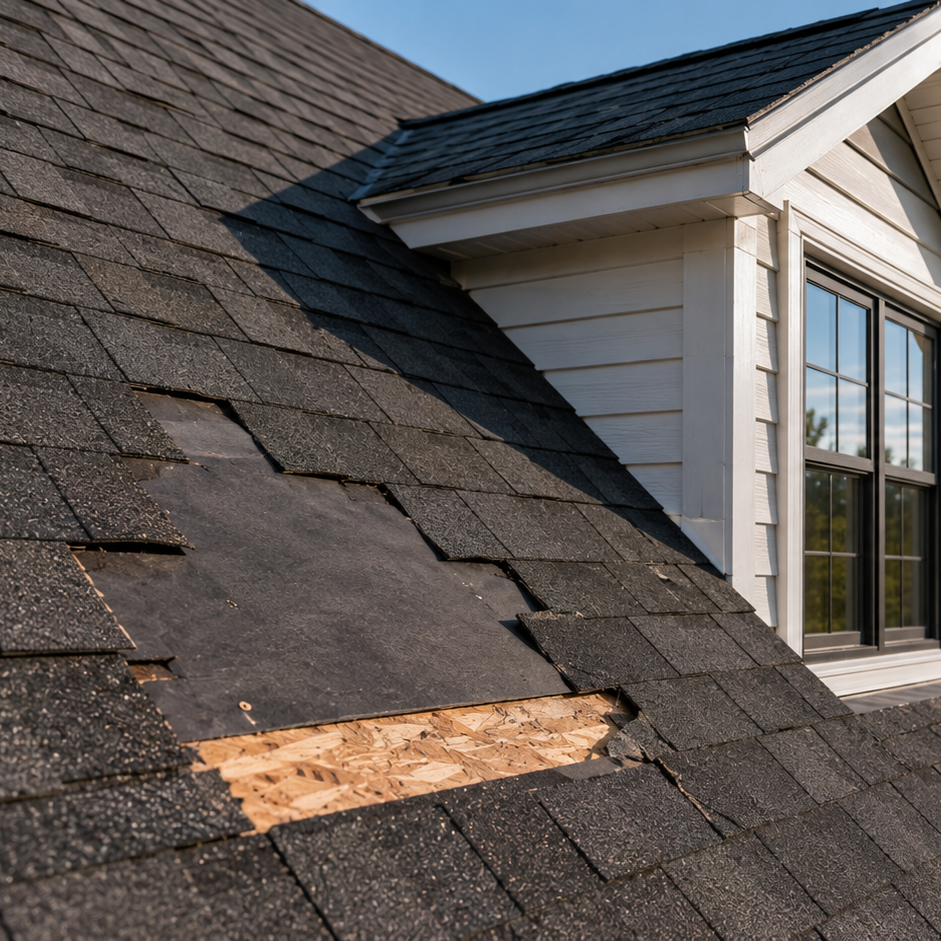
You spot the shingle in your yard after a windy night — textured side up, a corner cracked, granules scattered across the mulch. You make a mental note to call someone. Then life happens, and two months later that bare spot on your roof is still just sitting there. How bad can one missing shingle really be?
Worse than it looks. Here's exactly what's going on inside your roof while you wait.
A Missing Shingle Is an Open Wound, Not a Scratch
Asphalt shingles don't waterproof a roof the way a tarp does. They shed water — each shingle overlaps the one below it, and rain runs downhill from shingle to shingle until it reaches the gutter. That system only works when every piece is in place. Pull one out and you've exposed roughly 1.5 square feet of underlayment — the thin felt or synthetic membrane sitting directly on your roof deck.
That underlayment is a secondary barrier. Not the primary one. It handles splash-back and the occasional water that sneaks under a lifted edge during a storm. It wasn't designed to take direct rain, standing water, and UV exposure day after day. Standard felt underlayment starts breaking down under direct sun within 30–60 days. Synthetic versions last longer, but neither one was built to do the shingle's job indefinitely.
And once that shingle is gone, every storm that follows drives water straight at that spot.
What Water Does Once It Gets Past the Underlayment
Past the underlayment, water hits your roof deck — typically OSB (oriented strand board) or plywood. That's when the real bill starts. OSB is engineered wood: fibers compressed and bonded with adhesives. It's fine when it's covered and ventilated. Sit it wet for a week or two and the adhesive bond starts to fail. The fibers swell. The board goes soft.
Think of the cardboard backing on a notepad. One drop of water — no problem. Leave that cardboard in a wet sink for a week and it's spongy, swollen, and useless. OSB under direct water exposure does exactly the same thing, on a timeline measured in weeks, not months.
In a Wisconsin winter, there's a second problem. Water that soaks into the deck refreezes when temps drop overnight. Water expands roughly 9% when it freezes — and that expansion happens inside the wood fibers themselves, not just on the surface. Each freeze-thaw cycle pries the fibers a little further apart. Over a winter with 100+ freeze-thaw cycles, a saturated section of decking can deteriorate past the point of patch repair long before spring arrives.
Once the deck goes soft, the damage stops being purely structural. Wet, rotting wood is a mold incubator. All mold needs is moisture and something organic to eat — a soggy OSB section gives it both. Visible mold growth can start within 24–48 hours of sustained moisture and spreads fast from there.
The Cascade: From One Shingle to a Full Replacement
This is how a $200 repair turns into a $3,000 problem.
| What You're Seeing | What's Actually Happening | How Urgent |
|---|---|---|
| Shingle in the yard, gap visible on the roof | Underlayment exposed to direct weather | Repair within 1–2 weeks |
| Water stain on the ceiling below the gap | Underlayment breached, deck absorbing water | Repair within days |
| Soft spot or bubbling paint on the ceiling | Deck damaged, possible structural compromise | Same-day call |
| Visible mold in the attic near the gap | Extended moisture exposure, mold established | Emergency — remediation needed |
| Sagging or soft spots across a section | Deck failed, adjacent framing at risk | Full section replacement likely |
Catch that missing shingle within two weeks: one shingle, some roofing cement, and 30 minutes of labor. Maybe $150–$400 depending on whether the underlayment needs patching too.
Leave it through a wet fall and a freeze-thaw winter? Now you're cutting out a 4×8 section of decking, replacing underlayment, and re-shingling the surrounding area — $1,500 to $3,500 or more if the damage spread. Leave it a full year? You may be looking at a partial roof replacement.
The math isn't complicated. Every week of delay narrows your options and pushes the cost higher.
Why Missing Shingles Are More Common After Wind and Hail
Wind uplift is the most common culprit. Asphalt shingles are sealed at installation with a heat-activated adhesive strip along the bottom edge. That seal cures within the first season. On older roofs, the adhesive dries out, and the bond weakens. On roofs installed in cold weather, the seal may never have cured at all.
Once wind gets under a shingle edge, it gets under the whole tab. Spring storms regularly hit 40–60 mph sustained — more than enough to lift an unsealed shingle completely. After one goes, the shingle above it is now exposed at its base. It's next.
Hail is a slower problem. A hail strike doesn't always knock a shingle loose right away. What it does is knock the granule coating off the surface. Those granules are the UV shield for the asphalt below them. Strip enough granules, and UV degrades the asphalt over 18–24 months until the shingle goes brittle — and the next windstorm finishes the job. That's why hail damage that looks cosmetic in May can result in missing shingles the following January.
Ice Dams Make Everything Worse Near the Eave
A missing shingle near the eave isn't just a water problem. In a Wisconsin winter, it's also an ice dam problem.
Ice dams form when heat escaping through the roof deck melts snow from the inside out. That meltwater runs downhill toward the eave, where there's no heat below — so it refreezes. The dam builds higher. Liquid water backs up behind it, pools against the eave, and finds every gap, every nail hole, every place where the underlayment wasn't lapped tightly. A missing shingle there is an open door.
Ice-and-water shield — a rubberized self-sealing membrane over the first 3–6 feet of eave — is what's supposed to stop this. But roofs more than 20 years old may predate it, or may have been installed without it. A missing shingle at the eave on an unprotected roof is nearly a guaranteed path to a ceiling stain before February.
How Many Missing Shingles Changes the Equation
One missing shingle on a 5-year-old roof in otherwise good shape is a roof repair call. Same shingle missing on a 22-year-old roof with granule loss, curled edges, and a handful of prior patches? That's a different conversation. The shingle that blew off just told you what the rest of the roof is about to say.
The real question isn't how many are missing. It's why they came off — and what that means for everything still up there. Age, original installation quality, and hail history matter as much as the count. A roof inspection after you lose a shingle costs $0–$300 and tells you if you're dealing with a $300 problem or a $12,000 one — before you've committed to either path.
Frequently Asked Questions
Yes — and sometimes faster than you'd expect. The underlayment provides short-term protection, but it degrades under direct exposure. If it's already older or was damaged, a missing shingle can lead to a leak within a single heavy rainstorm. You often won't see the ceiling stain until the deck beneath has already absorbed water for a while.
In dry summer conditions, one to two weeks to schedule a repair is reasonable. In fall heading into a wet season — or anytime freeze-thaw cycles are a factor — get it repaired within days. Each rain event and each overnight freeze drives more moisture into the exposed deck.
It depends on the cause. Wind or hail damage is typically covered under standard policies; normal wear and aging generally isn't. Document the storm event and get an inspection done promptly — adjusters want to see evidence while the damage is fresh, and roofs weather quickly between the storm and the claim.
Usually nothing, at first. Most missing shingles don't produce visible ceiling stains right away — the underlayment holds for a while. By the time you see a stain inside, the damage above it is already more extensive than the stain suggests. The stain tells you where the problem landed, not how far it spread.
A single tab on an accessible, low-pitch roof is within reach for an experienced DIYer. The repair itself — matching shingle, roofing nails, and sealant — isn't complicated. Getting the overlap right, sealing the nail heads, and not damaging adjacent shingles in the process takes more care than it looks. A sloppy repair can redirect water rather than stop it. For anything near the ridge, chimney, or valley flashing, hire a roofer.
From inside the attic, press on the decking from below — soft spots mean water already got in. Also look for dark staining or discoloration on the underside of the boards, or visible mold. From outside, a roofer walks the area and feels for give in the deck. If your attic has insulation tight against the roof deck, the damage may not show at all until it's well along.
Don't Let a Small Gap Turn Into a Full Re-Roof
One missing shingle is fixable. Cheap and fast, if you catch it early. But leave it through a wet fall and a hard Wisconsin winter and you could be cutting out deck sections in the spring. The damage works quietly — no warning, no announcement — until what started as a $300 repair is well into four figures. If you spotted a shingle in your yard, call now. Not after the next storm.
Schedule an estimate — Craftsman Exteriors handles roof repair and replacement across Madison, Verona, Fitchburg, Middleton, Sun Prairie, and southern Wisconsin. If you've lost a shingle or noticed a ceiling stain after a recent storm, we'll come out and tell you exactly what's up there. Call (608) 975-5747.
