
With Shingles Off, Should the Skylight Be Replaced?
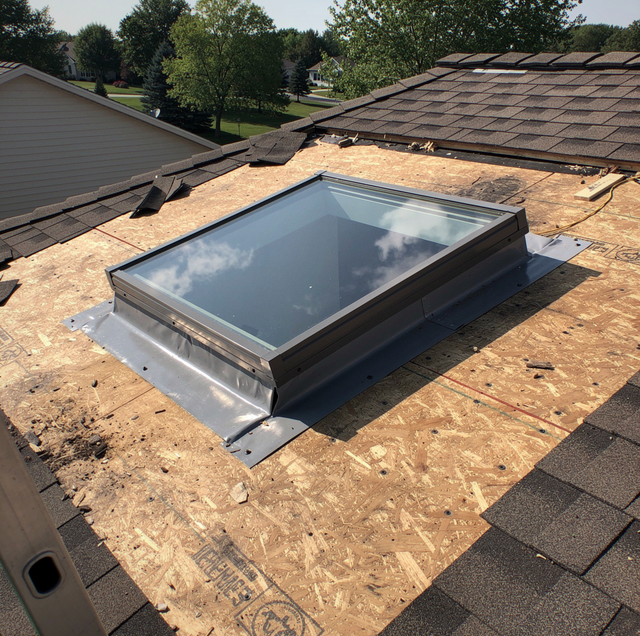
The glass overhead is clear, and that is not what the crew on your roof is looking at. By the time the shingles around a skylight are down in a pile on the driveway, the unit is sitting on an open deck with nothing lapped over its edges, and it will not sit that way again until the covering going down today comes back off.
For a unit that went up with the covering now coming off, the answer is yes, and it has little to do with how the glass looks from the room below. It is two dates and a subtraction. The covering going down starts a fresh service life; the sealed unit above your head does not, because nobody is touching it.
The Morning the Field Comes Off Around a Skylight
A skylight is a hole cut through the roof deck with a unit set in it, and the covering manages water around that hole with metal that goes in as the courses go up, one piece to a course. Strip the courses, and that metal leaves with them. Nobody removes it as a separate step, because it was never fastened to the skylight in the first place. It belongs to the covering's own sequence, and it comes off in that sequence.
What that state exposes is what a decision needs. The cut edge of the deck around the opening is in plain sight from above, and so is the condition of the wood the unit's frame bears on, for the hours between the tear-off and the dry-in. Then the new underlayment goes down, the courses go back up, and every part of that assembly below the top edge of the unit is under new material again.
None of that access is created by choosing to work on the skylight. It arrives with the tear-off, on a roof that was going to be stripped anyway, and it arrives at the same moment for a unit you plan to keep and a unit you plan to change. So the question is about timing, not condition. You are not choosing whether the roof gets opened around your skylight. It is being opened.
The window also closes on the covering's schedule instead of yours. A crew dries in what it strips on the same day it strips it, because an open deck cannot sit through a night of weather, and the section around a skylight gets dried in with the rest. So the answer must exist before the crew arrives, while the field is still intact.
Sealed Glass and Asphalt Age on Different Schedules
The covering's number is the easier of the two to find. The 2007 study of home-component life expectancy published by the National Association of Home Builders with Bank of America Home Equity puts an asphalt shingle roof at about twenty years, and that figure is an expectancy for asphalt roofing as a class in a national study. The shingle line going onto your house has its own number, and it lives in that manufacturer's literature, which supplies the figure a roofer quotes for your covering.
The unit's number has to be read more carefully, because it is not a service life at all. VELUX's limited warranty provides 20 years' coverage against an insulated glass unit developing a material obstruction of vision due to a failure of the glass seal. That period applies to VELUX's insulated glass units; acrylic and polycarbonate units are covered by separate, shorter clauses in the same document. A figure attached to one unit construction does not transfer to another, and a warranty period promises against defects; it does not predict how long your skylight will hold.
So the subtraction is short. A skylight set with the covering coming off today has roughly twenty years behind it. The covering going down has roughly twenty ahead of it. Leave the unit and its seal is being asked to reach about forty, against a clause written for twenty, with the whole of that second span outside it. Nobody has to look at your glass to arrive at that number.
When Is the Unit Younger Than the Roof Around It?
Not every skylight went up with the covering underneath it. One added during a remodel, or put in after a storm, has its own start date, and your arithmetic moves with it. Say the unit went in at year twelve of a covering that is coming off at twenty. On the morning of the tear-off, it is eight years old, with twelve of its twenty warranted years still to run and twenty more ahead. The shortfall drops from twenty years to eight.
Eight is a span a household can plan around, and twenty is not, so for that unit the answer is that it stays, and the covering after this one is the roof that takes it out. Which turns the job before your roof date into finding a date rather than a symptom: the year the skylight itself went in.
Opening a Bonded Field a Second Time
Asphalt shingles are not simply nailed down and left as separate pieces. Shingle courses are engineered to bond to each other: once each course is attached to the deck, every subsequent course bonds to the one already installed, with the asphalt-based sealant fusing the shingles together, and heat and ultraviolet light from the sun activate and soften that sealant so the bond forms at all. Two summers after a covering goes down, the field around your skylight has stopped being a stack of loose components and become a single bonded plane. Reaching the unit at that point means separating courses that have fused together, working outward and upward far enough past the opening to get in above its head, and re-bedding every tab that came up. The bond those tabs re-form is made on whatever day the work happens, into shingles that have already been weathering.
The water-management layers come apart in the same direction. The underlayment running up to the head of the opening sits under a field that is now bonded, so the new membrane at that head has to be lapped into the old material instead of being laid as part of one continuous run. And the staging a crew struck two winters ago goes back up around your roof, which is otherwise sound.
None of this is difficult work. It is ordinary roofing, done a second time, on a section that is no longer new and around an opening that was already open once.
A Later Date Reaches the Ceiling Below
Get the timing wrong and the second visit does not stay on the roof. A skylight set into a covering that is already down is reached from above and finished from below, so the drywall returns lining the shaft and the trim around the ceiling opening come off before the inside of the frame can be closed up again. A room in your house that sat outside the roof job the first time is inside it the second, on a day the roof itself chose.
The clause covering the installation runs on its own terms. The same VELUX warranty gives ten years against water leaking through an installed covered product, or between that product and your roof deck. Ten years is the span associated with the installation, and it is shorter than the one associated with the glass above it.
Frequently Asked Questions
Leak history is not the input. A unit that has never let water in has held at its flashing; the glazing seal is a separate part with its own date. What you want is the year your skylight went in, and the paperwork from the job that put it in your house carries that date. Where none survives, your unit is taken as the age of the covering when it comes off.
Tear-off is percussive work. Shovels and bars are driven against the deck to lift the courses, and a skylight is fastened to that same deck, so the loading reaches the unit through its own frame. A crew told to keep a unit works differently from one removing it, and needs to know which before your tear-off starts.
Before the covering is ordered. Waiting until the deck is open is too late. A replacement unit is ordered to the rough opening already framed in your roof, and it arrives on the supplier's lead time. Your deck cannot sit open waiting for a delivery, so a unit not on order when your crew arrives stays for another covering.
A venting unit has an operator and a sash gasket; a fixed one does not, plus controls on a motorized one. The same VELUX document that gives 20 years against glass-seal failure gives 5 years for blinds and motorized controls. Those periods sit on one skylight; the shortest is the one your roof date plans against. You will not find it on the glass.
For a while, yes. The courses laid back around the opening come from a different production run than the field around them, and that field has weathered since your roof went on. The patch stays legible across the plane from the ground long after its water side is sound. A strong color blend softens the boundary; on a plain covering, you will see it from your driveway.
The shorter one, and you start it earlier than you would think. VELUX lists its glass-seal period as 20 years from the date of purchase, so a unit that sat in a warehouse or on your jobsite has spent part of that time before daylight. Start that number at the date on your own invoice; your planning horizon begins there.
An assessment of the skylight while the roof date is still being set — a unit and the covering around it go in on one day only if that day is still open. Craftsman Exteriors serves Madison, Verona, and Fitchburg. Call (608) 843-5007.
