
How Storms Damage Siding and Trim: A 20-Minute Check
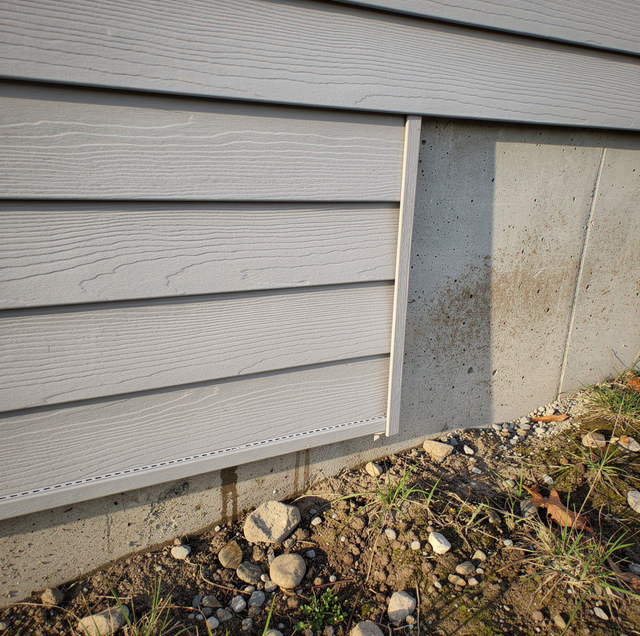
The wind quit around two in the morning, and by breakfast the yard had mostly sorted itself out. A trash can in the neighbor's driveway. One panel of siding on the side wall sitting visibly crooked, four feet off the ground. That crooked panel is what you will stand and stare at, and it is rarely the most important thing the storm did.
The rest is quieter. Wind, impact, and wind-driven rain each work on the vertical face of a building differently, and each leaves marks that look like nothing until you know what you are seeing. The order you walk in decides how much you find: ground level first, hardest-hit wall first, eaves last.
Wind, Impact and Driven Rain Leave Three Different Marks
Wind does not push a wall evenly. Air piles up against the face the storm is driving at, pressing the cladding inward, then accelerates around the corners and over the eaves, creating suction that pulls outward at every edge. Pressure rises with the square of wind speed: a 60 mph gust is not twice as hard on the wall as a 30 mph gust; it is four times as hard. Corners and edges carry higher pressure than the middle of the wall, and that is where cladding lets go first.
Impact is different: a hailstone, gravel off a roof, a branch, a piece of fence. It is local and sudden, and the material either deforms, cracks, or shrugs it off, depending on how it responds to a point load applied in a few thousandths of a second.
Wind-driven rain is the third force and the least visible. Rain in a storm is not falling straight down; it moves sideways with the air and hits the wall with energy behind it. Siding is not a seal. It sheds water down its face and relies on a drainage plane behind it, so every lap, butt joint, and penetration is a place sideways water gets past. Wind opens those joints; rain uses them.
Start on the Face the Storm Was Driving Against
Pick the windward wall first, even if the obvious damage is somewhere else. That is the wall whose windows were streaming while the others stayed dry; if you slept through the worst of it, the wall that dried last is a fair stand-in.
It took the positive pressure, the heaviest rain load, and, if there was hail, most of the impacts. A partial failure hides best there too, because pressure holds a loosened panel flat against the house while the storm blows. Walk it at arm's length, corner to corner in one direction, rather than zigzagging toward whatever catches your eye.
The Bottom Course Is Where Wind Gets Its First Grip
Start at the ground and work up the first three or four feet. The lowest course is the only one with an unprotected leading edge; every course above it is locked under the one above. It hangs on a starter strip, and wind that gets under that bottom edge lifts the panel and peels it free upward, course by course.
Look along the bottom edge for panels dropped out of the starter strip, panels standing slightly proud of the wall, and a widened shadow line where two courses lap. Fastener spacing gives wind its opening too: lap siding is typically fastened at roughly 16 inches to match the framing behind it, so one missed stud leaves a 32-inch span with nothing holding the middle.
Step Back and Read the Whole Wall Before the Details
Now back up about twenty feet and look at the wall as one surface. Close inspection finds punctures and cracks; distance finds the damage with no edges, meaning waviness, panels out of plane, courses no longer parallel, and shallow dents spread wide.
Light matters more at this step than sharp eyes. A wall lit flat at midday hides shallow deformation; the same wall lit at a low angle throws a long shadow off every dent, and every panel pulled away from the sheathing.
Read each wall within the first hour after sunrise or the last hour before sunset. Low-angle light rakes across the surface and shadows shallow dents and out-of-plane panels that flat midday light erases entirely.
Waviness is worth reading. Vinyl siding is hung rather than clamped, and it is meant to slide: a 12-foot panel changes length by close to half an inch between a cold morning and a hot afternoon. Fasteners leave roughly 1/32 inch of clearance under the head so the panel shifts sideways by hand. A panel driven tight cannot move, so it buckles.
Each Siding Material Shows Storm Damage Differently
The same gust leaves different evidence depending on what is on the wall.
| Material | Impact leaves | Wind leaves | Driven rain finds |
|---|---|---|---|
| Vinyl | A star crack from the strike point, or a chalky bruise | Panels pulled out of the course below, fasteners torn through the hem | Widened laps, and the gap behind a lifted J-channel |
| Fiber cement | A crater or chipped edge where the surface spalls | Boards cracked at the fastener line rather than released | Open butt joints, unsealed cut ends |
| Wood | A bruise, a dent, or a split with the grain | Split boards, pulled nails, boards that rattle | Raised grain, swollen edges, paint lifting at butt ends |
| Aluminum | A permanent dent that will not rebound | Creased panels, trim wrap peeled back from a corner | Little at the face; entry is at the trim laps |
The difference is stiffness and recovery. Vinyl is elastic at ordinary temperatures: it deflects under a strike and springs back, so an impact leaves nothing, a chalky whitened bruise where the PVC has been stressed past recovery, or a clean crack. Aluminum is ductile, absorbing energy by deforming permanently, so it keeps every dent it receives. Fiber cement is stiff and brittle at roughly 5/16 inch thick, resisting deflection and then spalling or cracking through when it gives.
Corners, Trim and Penetrations Take the Pressure First
After the field of the wall, go to the edges: outside corner posts, the J-channel around every window and door, mounting blocks, vent hoods, hose bibs, and the frieze board at the eave.
These are the highest-pressure locations on the wall and the places where the water-shedding face has been cut open. An outside corner post catches wind from two directions at once; check that it still sits tight to both walls. Around windows, the J-channel receiving the cut ends of the siding can be lifted at its outer leg by suction, leaving a hairline gap along the head of the opening that you see only by crouching and sighting up.
Penetrations deserve the slowest looking of the walk. Anything passing through the wall is closed at the face with a mounting block, a flange, a bead of sealant, or all three, and horizontal rain at pressure tests a seal vertical rain never reaches. Look for sealant joints that have opened, mounting blocks shifted on their fasteners, and damper flaps hanging open.
Look Up Last, at the Soffit and Fascia
The eave is the final stop and the most commonly damaged part of the vertical envelope: the one horizontal surface with wind pressure acting on its underside. Air moving up the wall separates there, and the suction is strongest near the corners. Soffit panels sit in a receiving channel at each end, with nothing fastening the middle of the run, so uplift pops them out rather than tearing them.
From the ground, sight along the underside of each eave rather than looking straight up. A soffit run should read flat and continuous; panels bowed downward, gapped at a seam, or missing outright are the clearest storm signature on the house. On the fascia, aluminum wrap released along its bottom hem shows a wavy line, and once a corner lets go, it peels back fast.
Losing soffit matters more than it looks from the driveway. A vented soffit is an intentional opening into the eave, so once a panel is out of its channel, driven rain reaches the attic edge with nothing in front of it. Damage to the roof covering is a separate inspection, not one to attempt from a ladder.
Stay on the Ground and Know What Not to Touch
Every step above happens from the ground and from inside your own windows. Nobody should be on a ladder or a roof after a storm to look at siding: the ground is soft, gusts are often still running, and nothing on a wall is worth a fall.
Two things are hands-off entirely. The first is any panel that has partly released. The second is electrical: any downed line, any line lying across the roof or touching the house, and any bent or separated service mast where the wires enter the building is utility and licensed electrician work, at any distance.
A partly released siding panel is still fastened along part of its run and can be under spring tension. Do not pull or reseat it. Wind gusting behind a loose panel can drive it hard when the last fastener lets go.
When the walk is finished, photograph each elevation before anything is covered or moved, and write down what you found and where. A record made the same day beats a memory reconstructed a month later.
Frequently Asked Questions
Within a day or two, while the ground still holds evidence you cannot recreate. Leaf litter and twigs plastered flat against one wall face mark the windward elevation better than memory does, and drop off within about a day of drying. The debris shadow, the clean strip of ground on the sheltered side of a fence, lasts a little longer.
Yes, and it is the failure most often missed. A panel can slip partway out of its interlock along a few feet of its run, leaving a slightly widened shadow line and nothing else to see. The fastener holes in the nailing hem also elongate into ovals under repeated loads, so the panel hangs but has some play. The tell is often audible: a loose course ticks in a breeze.
Shelter, mostly. A row of mature trees or a taller building reduces wind speed downwind by roughly 10 to 20 times the height of the obstruction, enough to leave two houses on one street with very different exposure. Wind-blown hail adds its own bias, arriving at an angle and landing hardest on the highest elevation and the corners flanking it.
Both, though vinyl's response depends heavily on temperature. Rigid PVC is more brittle in cold and more forgiving in warm conditions, which is why the standard impact test for the material drops a weighted dart under controlled temperature conditions. The same stone that scuffs a warm wall can punch through the identical panel on a cold morning.
Look at which way the joint failed. Exterior sealants are rated by movement capability, commonly plus or minus 25 or 50 percent of joint width, and a joint pushed past its rating usually lets go cleanly along one edge instead of tearing down its middle. That thin adhesive split against the trim is easy to walk past and is a direct path for horizontal water.
Shoot a wide photo of each elevation, then close-ups with an object of known size in the frame for scale. Keep the original image files rather than screenshots or texted copies, because re-compressed copies usually strip the embedded capture date and time that makes the set worth having.
Book a ground-level storm inspection of your siding, trim and eaves — find out what the wind actually did before the next rain finds it for you. Craftsman Exteriors serves Madison, Verona, and Fitchburg. Call (608) 843-5007.
