
What Happens If You Never Clean Your Gutters?
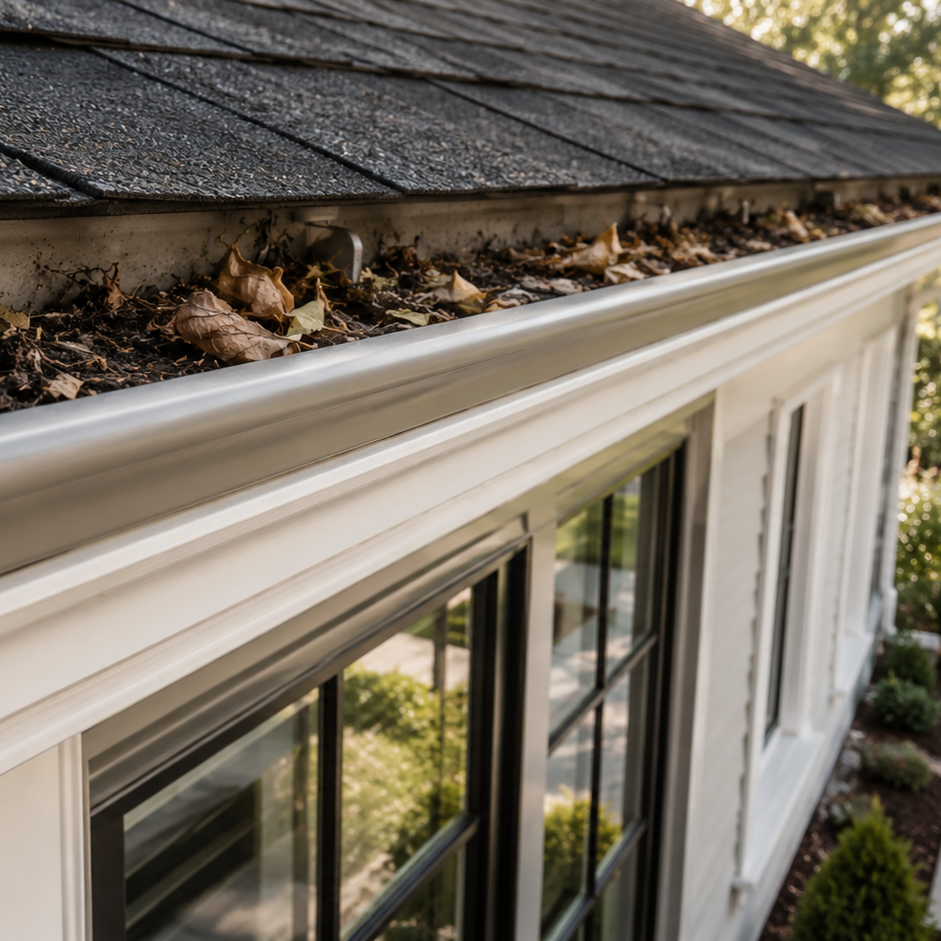
You noticed the sapling growing out of your gutter last fall and told yourself that's a problem for spring. By the time you got around to it, the whole trough was packed solid — a compressed mat of wet leaves, shingle granules, and dirt sitting through four months of freezing and thawing. The downspout was completely blocked. And the fascia board behind it felt soft when you pressed your thumb against it.
That's not a one-season problem. That's a few years of damage compressed into one ugly discovery.
Gutters aren't complicated. They're open channels designed to move rainwater off your roof and away from your foundation. When they're clean, they do exactly that. When they're clogged, water has nowhere to go — and it finds a way out anyway, usually somewhere you really don't want it.
Here's what actually happens when gutters go uncleaned for a season, two seasons, and beyond.
A Clogged Gutter Backs Water Up Under Your Roof Edge
The first place water goes when it can't drain forward is backward — up and over the back edge of the gutter, which sits directly against your fascia and the very bottom course of your roof.
An asphalt shingle roof drains by slope. Shingles overlap like scales so water runs downhill and off the edge. But the bottom edge of your roof isn't sealed against standing water — it's just shingled over a drip edge that hangs into the gutter trough. When that trough fills and water can't escape, it pools at the back wall. The drip edge sits in that pool. Water wicks under the bottom shingles and soaks the first foot or two of roof decking.
That decking — usually 7/16-inch OSB or plywood — isn't meant to stay wet. Once it absorbs water, it delaminates. The top layer swells and separates. A few rainstorms of this and you've got soft, spongy decking at the eave that gets cut out and replaced during reroofing.
The repair cost for a few square feet of rotted eave decking: $200–$600 on top of whatever the roof job already costs. Gutter cleaning twice a year: $100–$200.
Fascia and Soffit Rot Starts Silently and Spreads Fast
Your fascia board — the flat, vertical board running along the roofline that your gutters are actually nailed to — takes a beating when gutters stay full. Every rainstorm pushes water against the back of that board. Give it a year or two, and the paint fails. Once the paint fails, water gets into the wood grain directly.
Fascia on older homes is almost always solid wood — pine or cedar. Wood that stays wet rots. Not all at once. Progressively. The rot starts at the bottom, where the gutter bracket sits, and works upward. You often won't see it until you try to re-hang a sagging gutter and find the bracket has nothing solid to bite into.
The soffit — the horizontal panel underneath the eave — is next. Water that saturates rotted fascia wicks into the soffit panel and, from there, into the rafter tails and roof sheathing above. A $150 gutter cleaning stops this cycle before it starts. Replacing rotted fascia and soffit along a full roofline runs $1,500–$4,000, depending on the home's size and the material.
Pests are part of this, too. Standing water in a clogged gutter is a mosquito breeding ground — a female mosquito can run through a full reproductive cycle in about a week of stagnant water. Carpenter ants and earwigs are drawn to wet wood, and rotted fascia is basically an open invitation. Wasps chew through soft soffit panels. Squirrels gnaw through them. Once any of those get into the soffit and from there into the attic, you're not just dealing with water damage anymore — you're looking at a pest mitigation job on top of the repair work.
Foundation Damage Is Slow, Expensive, and Invisible Until It Isn't
Here's the damage that almost nobody connects back to their gutters: foundation cracks and basement water intrusion.
A properly functioning 5-inch aluminum gutter can handle about 1 inch of rainfall per hour on most residential roof pitches. When that same gutter is clogged and overflowing, all of that water cascades straight down the exterior wall and pools against the foundation. Every rainstorm.
Clay soil — common in southern Wisconsin — expands when wet and contracts when it dries. That cycle against your foundation wall creates lateral pressure that works on mortar joints, block seams, and poured-concrete walls over the years. A French drain helps. Basement waterproofing helps. But neither one fixes a gutter system that's actively dumping water at the base of the wall with every storm.
A minor foundation crack repair: $500–$2,500. A full basement waterproofing job: $15,000–$30,000. Gutter cleaning is maintenance. Foundation work is a crisis. The math isn't close.
Downspout placement matters here, too. If your downspouts discharge within 6 feet of the foundation, you're dumping the overflow in exactly the worst spot. Downspout extensions that carry water 6–10 feet from the house cost $10–$30 each and make a real difference — but they're useless if the gutters themselves are blocked.
Ice Dams Form Faster When Gutters Are Clogged
This one is specific to cold climates, and it's worse than most people realize.
An ice dam forms when heat escaping through the roof deck melts snow from the bottom up. That meltwater runs toward the eave, where there's no heat below — and refreezes. The dam builds layer by layer until liquid water backed up behind it has nowhere to go but under the shingles, through nail holes and seams, and into the ceiling below.
Clogged gutters make this worse in two specific ways. The debris in the gutter acts as insulation, keeping ice locked in place far longer than it would drain naturally. And a frozen-solid gutter full of leaves and debris adds serious weight — sometimes 50–80 lbs per linear foot once ice is factored in — that gutter hangers were never designed to carry. Brackets are rated for water and light debris. Not a 30-foot trough of solid ice.
The gutter pulls away from the fascia. Sometimes it tears the board with it. By spring, you're looking at a gutter replacement and a fascia repair that a November cleaning would have prevented entirely.
Think of a clogged gutter going into a Wisconsin winter like a backed-up sink drain going into a hard freeze: everything that should have drained out is now frozen solid inside, and the pipe can't hold what's in it.
Siding Damage and Staining Build Up Season After Season
When gutters overflow consistently, water doesn't fall straight down. It sheets across the siding on the way down, carrying tannins from decomposed leaves, algae spores from the standing water, and shingle granules.
On vinyl siding, this shows up as dark vertical streaking — sometimes called tiger striping — running from just below the gutter line to the bottom of the wall. The staining often cleans off with a soft brush and diluted oxygen bleach. But after a few years, the granule-laden overflow starts to pit the surface of lower-grade vinyl panels, and the constant moisture contact oxidizes the color coat from the outside in.
On LP SmartSide or fiber cement, the risk is higher. Both products are factory-primed and painted specifically to keep moisture out of the substrate. Constant runoff works on the paint film at cut edges and butt joints. Once the film fails, moisture gets into the substrate, and the material swells or delaminates.
What most people don't expect is the interior side of this. Repeated runoff against an exterior wall — especially an older wall with a compressed or missing vapor barrier — pushes moisture into the wall cavity. That moisture doesn't evaporate. It sits in insulation and framing, and mold follows. It rarely announces itself until you smell something musty or find a stain on the drywall that keeps coming back through the paint. Mold remediation inside a wall cavity runs $500–$3,000, depending on how far it has spread. A $200 gutter cleaning can add years of life to a siding job that costs $8,000–$20,000 to install.
How Often Should You Actually Clean Your Gutters?
Twice a year is the right answer. Timing matters more than most people think.
Once in late spring, after the tree pollen and seed pods finish dropping. Once in late fall — after the last leaves come down but before the first hard freeze. That fall cleaning is the critical one. Going into a Wisconsin winter with packed gutters is exactly how you end up with the ice-dam-and-pulled-fascia situation described above.
If you have pine trees or cottonwoods nearby, three cleanings per year is smarter. Pine needles pack down in gutters like felt — they don't flush out the way deciduous leaves do.
Signs your gutters need cleaning right now: water pouring over the front edge during rain, plants growing out of the trough, staining on siding below the gutter line, gutters sagging or pulling away from the fascia, or birds spending an unusual amount of time up there. Any one of those is worth getting on a ladder for.
Frequently Asked Questions
It depends on your tree coverage. In a low-tree yard, gutters might go two or three years without major problems. In a yard with overhanging maples or oaks, one season of heavy leaf fall can pack a gutter tight enough to cause overflow and fascia damage. Two seasons without cleaning is risky regardless of the tree situation.
Foundation damage is the most expensive and the hardest to reverse. Fascia and soffit rot is the most common result. Ice-dam-related roof damage is most likely in northern climates, especially after heavy snow seasons.
Yes, if you're comfortable on a ladder. Use a stable extension ladder, never lean it against the gutter trough itself, and scoop debris into a bucket instead of letting it drop on the siding below. A garden hose with a spray nozzle flushes the residue and tells you whether the downspout is flowing freely at the same time.
They reduce how often you need to clean — they don't eliminate the need. Fine mesh guards do well against leaves but can clog with shingle granules and pine needle residue. Worth the investment on homes with heavy tree coverage if you buy a quality product matched to your debris type. Not worth it if you're expecting to never clean gutters again.
Most manufacturer warranties require the homeowner to perform routine maintenance, which typically includes keeping gutters and drainage systems functional. Water damage traced back to blocked gutters is usually excluded from coverage on both roofing and siding warranties.
Professional gutter cleaning runs $100–$250 for a single-story home and $150–$350 for a two-story. That's the full cost of avoiding hundreds or thousands of dollars in fascia rot, roof decking damage, siding staining, and foundation problems.
Schedule an estimate — Craftsman Exteriors handles gutter installation, replacement, and guard installation across Madison, Verona, Fitchburg, Middleton, Sun Prairie, and southern Wisconsin. If your gutters are pulling away, overflowing, or you're seeing siding stains below the roofline, call before it becomes a larger repair. Call (608) 975-5747.
