
What Happens to a Foundation When Gutters Overflow?
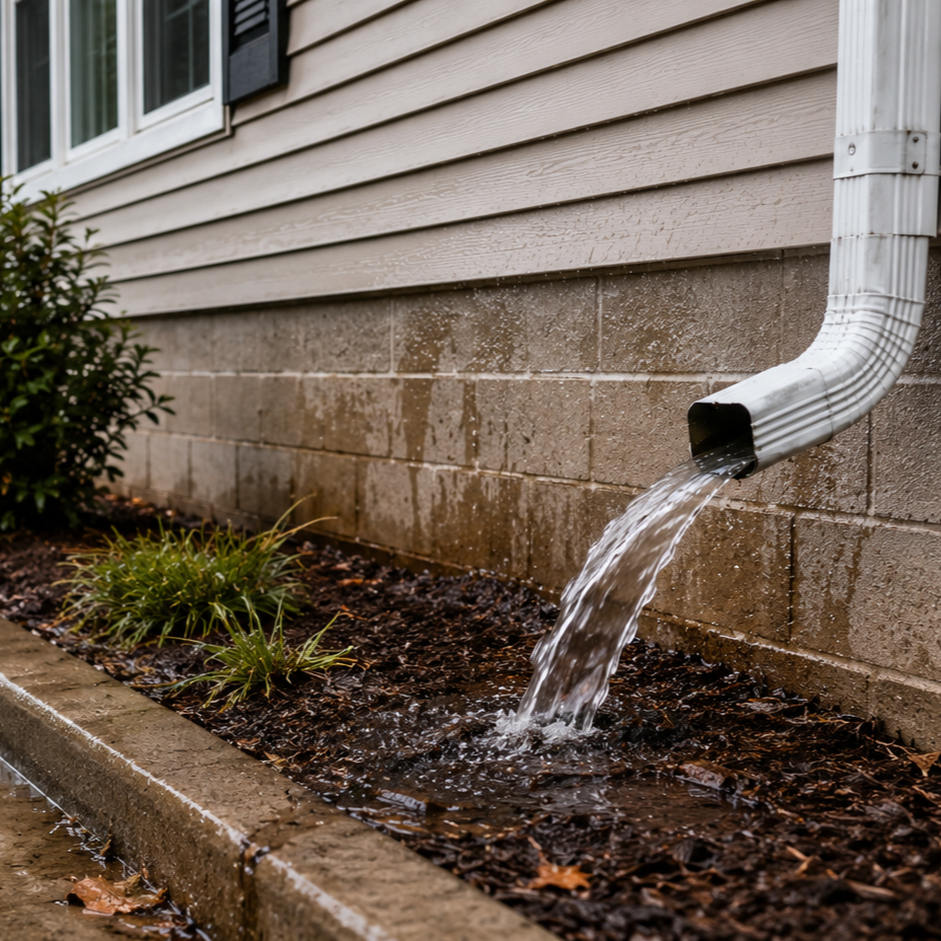
You noticed it last spring—water sheeting off the roofline instead of flowing through the downspout, hitting the ground right against the house, soaking into the mulch bed six inches from the foundation wall. The gutters were clogged. You meant to deal with it. Then summer came and went, and by the time fall rolled around, those same gutters were full of maple leaves again.
That water didn't disappear. It went somewhere. And where it went is the part most homeowners don't find out about until they're standing in a damp basement or getting a quote from a foundation contractor.
Overflowing gutters are one of the most reliable ways to create serious foundation problems over time. Not dramatic, immediate failures—the slow kind, where the damage compounds across seasons until one day the repair bill reflects years of accumulated stress on soil, concrete, and drainage systems that were never designed to handle concentrated roof runoff.
How Gutters Are Supposed to Move Water Away From Your House
A properly working gutter system collects water from the entire roof surface—which, on a typical two-story, 2,000-square-foot home, can generate several thousand gallons of water during a one-inch rainstorm—and channels it to downspouts that discharge several feet from the foundation. That distance matters. The ground immediately around your foundation is your first line of defense against hydrostatic pressure on the basement walls.
When gutters work correctly, roof water exits at the far end of a downspout extension, soaks into the yard, and disperses. The soil around the foundation stays at a stable moisture level. The concrete or block walls below grade experience consistent, manageable pressure from the surrounding soil.
When gutters overflow, all that water drops straight down at the roofline—usually right at the foundation perimeter, often in concentrated spots at every low point in a sagging or clogged gutter section. You've essentially redirected your entire roof's drainage to the worst possible location.
What Overflowing Water Does to the Soil Around Your Foundation
Soil that absorbs water expands. Clay-heavy soils—common in southern Wisconsin—can expand by 10 to 15 percent when saturated. That expansion creates lateral pressure against whatever is next to it, and in this case, that's your foundation wall.
But saturation is only part of the problem. The repeated cycle of saturation and drying is what does the most structural damage over time. Think of it like a sponge being wrung out over and over: the soil particles shift slightly with each cycle. After enough cycles—and Wisconsin gives you plenty—the soil immediately against the foundation can develop voids as it contracts during dry periods. Saturate it again, and it shifts to fill those voids unevenly. That uneven soil movement is what creates differential settlement, the condition where one section of the foundation sinks or tilts relative to another.
Concentrated roof runoff landing in the same spot every rainstorm also erodes the soil away from the foundation. Over a few seasons, you can end up with a channel where water flows straight to the footings—the concrete pads below the foundation wall that the whole structure rests on. Footings are designed to sit in stable, compacted soil. When that soil washes away or becomes permanently saturated, the footing loses bearing capacity.
The Freeze-Thaw Problem: Why Wisconsin Winters Make It Worse
Saturated soil that freezes is not the same as dry soil that freezes. When water trapped in soil freezes, it expands by about nine percent in volume. In soil pressed against a foundation wall, that expansion generates enormous outward pressure—in some conditions, up to 50,000 pounds per square foot. Foundation walls are designed for vertical load and consistent lateral soil pressure. They are not designed for the kind of repeated, extreme lateral force that frost-heave creates.
Wisconsin averages more than 100 freeze-thaw cycles per winter. Each cycle—a day above 32°F followed by a night below it—is a separate event where saturated soil expands against your foundation, then contracts, then expands again. A wall that handles 20 cycles mostly fine may develop hairline cracks by cycle 60. A wall that already had a hairline crack may see that crack widen noticeably by the end of a hard winter.
Water finds those cracks. It enters the wall during the thaw, freezes inside the crack when temperatures drop, and expands. That's the mechanism behind spalling—where chunks of concrete or mortar break away from the interior surface of a block or poured wall. Spalling is usually the first visible sign that freeze-thaw cycles have been working against the wall for years.
The analogy is a pothole. Pavement cracks are just like a foundation wall; water gets in, freezes, and the crack becomes a hole. The road doesn't fail in one winter; it fails over several seasons of the same process. Your foundation is the same material, doing the same thing, under the same conditions.
Signs Your Foundation Is Already Taking Water Damage From Overflow
Some of these signs show up on the exterior. Some you'll find in the basement. Either way, they're worth knowing.
Efflorescence on basement walls. White or gray chalky deposits on concrete or block walls are left behind when water moves through the wall and evaporates on the interior surface. The mineral salts come from the concrete itself and from the surrounding soil. Efflorescence doesn't mean your wall is failing—but it's direct evidence that water is passing through it regularly.
Horizontal cracks in block walls. Vertical cracks in a poured concrete wall are often the result of concrete shrinkage during curing and may not indicate structural movement. Horizontal cracks are different. They typically indicate lateral pressure—soil or frost-heave pushing inward on the wall. A horizontal crack running the length of a block wall at mid-height is a warning sign that should not be ignored. The wall may be in the early stages of bowing inward.
Bowing or bulging walls. If you hold a long level against a basement wall and see a consistent curve inward, the wall is bowing. This happens when soil pressure—often amplified by sustained saturation and freeze-thaw cycling—exceeds the wall's lateral capacity. Bowing walls require structural repair, typically carbon fiber straps or steel I-beams installed against the interior.
Basement flooding after rain. Water in a basement can come from a lot of places: window wells, floor drains, plumbing, or wall seepage. If the flooding correlates closely with heavy rain events, and the gutters above that part of the house are chronically clogged or overflowing, the connection is usually obvious once you're looking for it.
Sticking doors and windows. When a foundation shifts—even slightly—the door and window frames move with it. Doors that used to swing freely start catching on the frame. Double-hung windows become hard to raise or lower. This symptom shows up because soil movement around the foundation creates differential settlement: one part of the foundation sinks or tilts more than another, and the frame of the house follows. It's subtle at first and easy to attribute to humidity, but if you're seeing it in combination with any of the other signs above, the foundation is worth inspecting.
Concrete slabs sinking around the perimeter. Driveways, sidewalks, and patio slabs adjacent to the foundation are supported by the same soil. When that soil erodes or compacts unevenly from repeated water saturation, voids form below the concrete. The slab bridges those voids until it can't—then it cracks and settles. A driveway section that's dropped an inch below grade near the garage, or a sidewalk panel that rocks when you step on it, is usually a sign that the soil has been washing away beneath it for a while.
Soil pulling away from the foundation. If the soil immediately against your foundation wall has settled noticeably lower than the surrounding yard—a condition called negative grade—water naturally drains toward the house instead of away from it. Overflowing gutters accelerate this because they dump water repeatedly in the same low spots, washing soil away and creating or deepening that downward slope.
Downspout discharge at the wall. If your downspouts terminate right at the foundation instead of extending at least four to six feet away—or if an underground drain pipe connection has broken or clogged—you may have the same problem as overflowing gutters, just happening at ground level instead of at the roofline.
What These Repairs Actually Cost
Getting gutters cleaned and extended costs $150 to $500 in most markets. That's the number to compare everything against.
Waterproofing a basement wall from the interior—which involves installing a drainage channel, a sump pump, and a vapor barrier—runs $5,000 to $15,000 or more depending on the basement perimeter length and the severity of the problem. That repair doesn't fix the foundation; it manages water that's already getting in.
Structural repairs for a bowing basement wall run $3,000 to $10,000 per wall, depending on severity and method. In extreme cases where a wall has failed significantly inward, it may need to be replaced—a project that costs $15,000 to $30,000 and involves excavating the exterior, which means your landscaping and anything near that wall comes out too.
Foundation settlement repairs that require underpinning—driving piers down to stable soil to lift and stabilize a section that has sunk—run $1,000 to $3,000 per pier, and a typical repair might require six to ten piers. The math adds up fast.
None of those repairs is uncommon. Foundation contractors work on them regularly because gutters are neglected regularly. The failure mode is predictable, the cause is usually traceable, and the prevention—keeping gutters clear and functioning—costs almost nothing compared to what happens when they don't.
When the Gutters Themselves Need to Be Replaced
Gutters don't always overflow because they're clogged. Older aluminum gutters sag over time as the spikes holding them to the fascia pull out of aging wood. Sagging gutters hold standing water, develop leaks at the seams, and overflow at low points even when they're technically clean. Gutters that are pitched incorrectly—either sloping the wrong direction or not sloping steeply enough—have the same problem.
A gutter that consistently holds water at the middle of a section, with no discharge after the rain stops, needs to be re-pitched or replaced. A gutter that has separated from the fascia, is visibly pulling away from the roofline, or has seams that leak during every rain event is not doing its job regardless of whether it's clean.
The downspout side of the system matters just as much. A downspout that empties six inches from the wall, or discharges onto concrete that slopes toward the foundation, or connects to an underground pipe that has filled with soil or roots, is directing water to the foundation even if the gutter above it works perfectly.
Replacement costs for standard aluminum gutters run $5 to $15 per linear foot installed. For a typical home with 150 to 200 linear feet of gutter, that's $750 to $3,000 total—a fraction of what any meaningful foundation repair costs.
What to Do If You Are Seeing These Warning Signs
If you've got efflorescence, hairline cracks, or occasional basement damp, the first step is fixing what's driving the water there—not patching the inside of the wall. Start with the gutters and grading. Get the gutters cleaned, check the pitch of every section, make sure downspouts terminate at least four to six feet from the foundation. Add downspout extensions where needed. If the grade around the foundation slopes toward the house, adding topsoil to restore a positive slope (dropping about one inch per foot for six feet from the wall) can dramatically reduce infiltration.
If you're already seeing horizontal cracks, bowing, or active water intrusion during rain events, the structural work needs a foundation contractor or structural engineer. A gutter replacement alone won't undo damage that's already occurred—but it will stop the damage from progressing.
Frequently Asked Questions
Yes—not usually from a single event, but from repeated saturation and freeze-thaw cycles across multiple seasons. The mechanism is soil expansion, hydrostatic pressure, and frost-heave working on the foundation wall over time. It's one of the most common preventable causes of foundation damage in cold climates.
It depends on soil type, drainage conditions, and climate. In a clay-heavy yard with poor drainage and regular freeze-thaw cycling, you can see early signs—efflorescence, hairline cracks—within two to three years of sustained gutter neglect. In sandy, well-drained soil, the timeline is longer. Either way, the damage is cumulative.
A dry basement doesn't necessarily mean there's no soil saturation or pressure building against the foundation. Efflorescence and hairline cracks often precede visible water intrusion by years. Check the exterior walls and the basement walls carefully before concluding there's no problem.
Most gutter guards prevent overflow caused by leaf and debris buildup, but they don't fix sagging gutters, incorrect pitch, or undersized gutters that can't handle heavy rainfall. Gutter guards are maintenance reduction tools, not a complete solution for overflow. A gutter that sags or is pitched wrong will still overflow even with guards installed.
Vertical cracks are often the result of concrete curing shrinkage and may be stable for years. Horizontal cracks typically indicate lateral soil pressure and are more serious—they can progress to bowing if the pressure continues. Any horizontal crack wider than 1/4 inch or that is actively growing warrants a structural evaluation.
At minimum, four feet. Six feet is better. In areas with poor yard drainage or significant slope toward the house, underground drain pipes that carry water to daylight at the far edge of the property are more reliable than surface extensions.
Schedule an estimate — Craftsman Exteriors handles gutter replacement and installation across Madison, Verona, Fitchburg, Middleton, Sun Prairie, and southern Wisconsin. If your gutters are overflowing, sagging, or discharging against the foundation, we'll assess the whole system and recommend what actually needs to be replaced. Call (608) 975-5747.
