
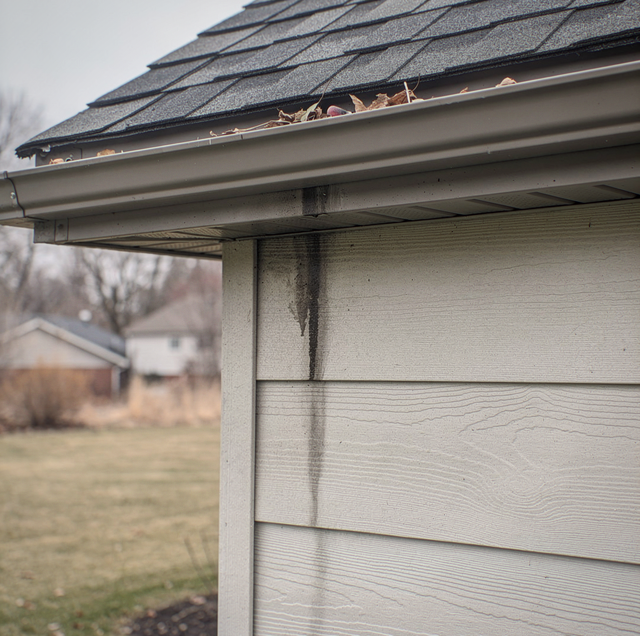
Where a roof edge runs alongside a wall instead of straight out to a gutter, as where a lower roof dies into a second story or an attached garage meets the house, water traveling down that slope gets caught between two surfaces: the shingles on one side, the siding on the other. It has to go somewhere. On a well-built wall, a small bent piece of metal sends that water clear of the wall and into the gutter below. Leave that piece out, and the same water travels down behind the siding instead, out of sight, until enough of the wall has softened for a sign to show.
Where the Roof Meets the Wall: What a Kick-Out Flashing Does
Along any roof-to-wall intersection, individual pieces of step flashing are woven in, course by course, one under each row of shingles, each lapped over the piece below it and tucked behind the siding on the wall side. Together they carry water down the slope and keep it moving toward the low end of that intersection. The question is what happens when the flashing run reaches the bottom, at the gutter.
A kick-out flashing is the last piece in that run, and it does one job differently from the rest: instead of continuing straight down the wall, it bends outward, away from the siding, and directs the water it carries into the gutter or off the roof edge entirely. Without that outward kick, the final piece of step flashing simply dumps its water against the wall face, right where the siding meets the roofline, and the water that does not run off the siding face gets behind the cladding.
Without One, Water Travels Behind the Siding Toward the Framing
Light rain can run off the siding face without forcing its way behind it, especially in small amounts moving down a short run of flashing. A sustained flow concentrated at one point behaves differently. Instead of spreading across a wide shingle field the way open roof runoff does, all the water from that section of roof funnels down to a single narrow gap at the base of the step flashing, and it keeps arriving there for as long as the roof sheds water.
That concentrated stream finds the seam behind the siding at that corner and follows it inward, reaching the house wrap, then the sheathing, then the framing behind it. Once there, it sits where neither sun nor wind reaches it, so the wood at that corner can stay damp between storms while the siding face dries. The missing diverter itself never goes away, and the gap keeps doing the same thing at that one spot for as long as it stays open.
Framing softened by hidden water can give way underfoot near this joint. Leave probing and any roofline work at this joint to a crew equipped for the height and trained to test for rot before stepping or leaning on it.
The Signs You Can Spot From Outside and Inside
A missing kick-out appears in a specific place rather than spreading across the whole wall. Because the water source is one point at the bottom of a roof-to-wall run, the damage concentrates in a vertical strip below that exact spot, rather than spreading evenly across the siding. Look for it right where a lower roofline meets a sidewall: below the gutter end, at the corner where the roofline stops, and the wall continues down.
The wall itself shows the same signs any hidden water problem behind siding produces, but a kick-out problem stays local: the trouble sits at that one roof-to-wall corner, while a wider siding failure can turn up along several stretches of wall at once.
| What you notice | Where it shows up | What it points to |
|---|---|---|
| Staining or discoloration in a narrow vertical band | Directly below where a lower roofline runs into a sidewall | Water is running down the wall at that corner instead of into the gutter |
| Interior stain low on an exterior wall, near a corner | Inside, roughly below the same exterior spot | Moisture has worked all the way through the wall assembly |
Retrofitting a Kick-Out Flashing Into an Existing Wall
Because the diverter has to sit under the siding and behind the last piece of step flashing, tucking a new one on top of finished siding does not solve the problem. Sealant applied over the joint might slow a leak for a while, but it sits on the outside face of the very material that is already wet and does nothing to stop water already traveling behind the wall.
A proper retrofit starts with removing the siding around that corner, a section rather than the whole wall, to expose the bottom of the step flashing run and the sheathing underneath. The work sits at a roof edge above a lower roof, so it means ladder work and footing on shingles next to a wall that may be soft; it belongs to a crew with fall protection. From there, the diverter slides in as the bottom piece of the run, tucked under the lowest step flashing and against the sheathing, with its toe angled out past the wall line, and the house wrap is lapped over its vertical leg before the surrounding flashing ties back in. Only after that gets checked does the siding go back on. When it does, its bottom edge stops at least an inch above the roof surface, so the siding does not sit in the water running down the flashing. If the sheathing behind that spot turned out to be soft or discolored during the removal, that gets addressed before the new siding closes the wall up again, since covering wet or weakened wood only hides the problem a second time.
Why This Detail Gets Missed
A missing kick-out does not show at the time the roof or siding goes in. The wall looks finished, the roof sheds water everywhere else without issue, and the piece itself is small enough to disappear under a roofer's shingle work or a siding crew's trim. Because the roofing and the siding meet at that exact spot, each trade can reasonably assume the other one handled the transition, and a piece that belongs to neither job by default sometimes belongs to no one in practice.
The delay before it shows also works against catching it early. Years can pass with water quietly running behind the siding before a stain or a soft spot appears on the surface, so a wall that looks fine at closing or at a routine repaint can already be hiding the problem. A repaint over the corner can mask early staining long enough for the damage underneath to grow before it reappears.
Frequently Asked Questions
Only the ones where a sloped roof edge terminates against a sidewall rather than running to open air, such as where a porch roof, a lower addition, or a garage roofline meets the house. A ridge, a hip, or a roof edge that simply ends at open eaves has no wall behind it to divert water away from, so those spots do not need one.
It works best as one formed or seam-sealed piece with no open seam at the bend. A piece folded from flat stock and left unsealed at that bend can leak right at the fold, which defeats the purpose of adding it in the first place.
From the ground, look at the exact spot where the lower roofline meets a sidewall, and follow it down to where the gutter starts. A visible gap, a piece of metal that stops short of the gutter, or a run of caulk standing in for flashing at that joint are all signs worth a closer look from someone equipped for the height, rather than a full climb of your own.
That depends entirely on the policy and the insurer's review of the cause and timeline, since gradual, undetected water damage is often treated differently from a sudden event. Any coverage question belongs to your own insurance provider, who can review your specific policy and the extent of the damage.
Yes. A kick-out can be bent flat during a later roofing or gutter job, packed with debris so water no longer drains off its edge, or installed with too shallow an angle to clear the wall, and any of those leaves it doing little more than a flat piece of metal sitting against the siding.
Not on its own. A re-roof replaces the shingles, and often the step flashing along the field of the roof, but the kick-out sits at the bottom of that run against the wall, and a crew has to specifically address that transition and confirm the diverter is present and angled correctly, rather than assume new shingles overhead solved a wall-level detail.
Request a roof-to-wall inspection — a crew opens the siding at that corner, confirms whether the diverter is present and angled correctly, and checks the sheathing behind it for hidden water. Craftsman Exteriors serves Madison, Verona, and Fitchburg. Call (608) 843-5007.