
Why Are My Gutters Pulling Away from the House?
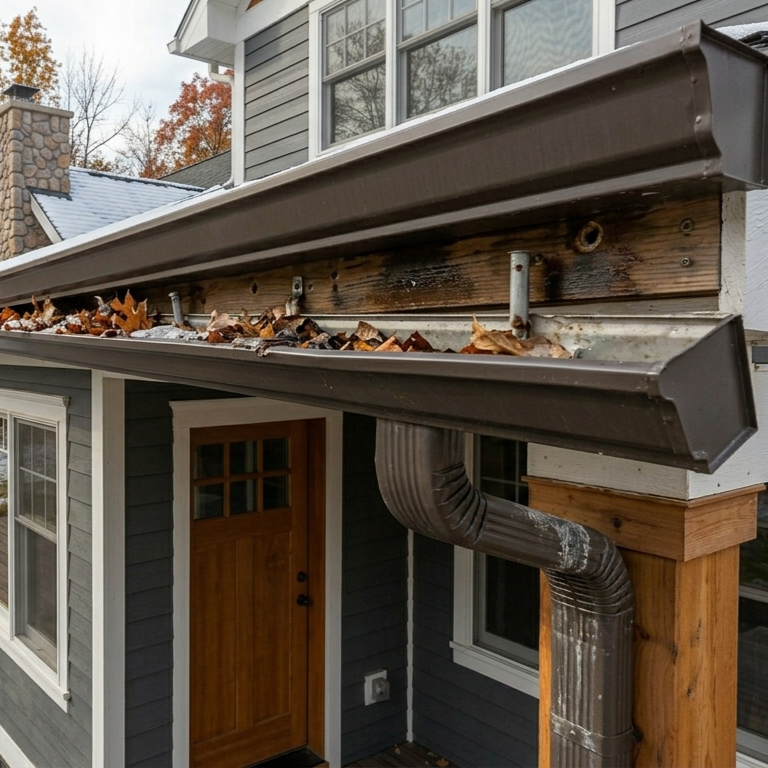
You spotted it from the driveway — a gap where the gutter should be flush against the fascia, maybe half an inch, maybe more. Front corner sagging. After last winter's ice, a whole section droops like it's given up. Easy to tell yourself it's cosmetic. It isn't.
Gutters pulling away from the house mean something specific has failed. Almost never just one loose nail. The question isn't whether to fix it — it's figuring out which of the four actual causes you're dealing with, because each one has a different repair path and a different urgency level.
What's Actually Making Them Pull Away
The Fasteners Backed Out
Most common cause. In older homes, almost always the same culprit: gutter spikes.
For decades, standard installation meant driving a long aluminum or steel spike through the gutter face, through a short cylindrical spacer called a ferrule, and into the fascia board. Worked fine for a few years. But a spike is just a nail. Every time the gutter expands and contracts with temperature swings — and a Wisconsin winter delivers 100 or more freeze-thaw cycles between October and April — the spike works back and forth in the wood. The hole gets bigger. The spike backs out. Eventually, the gutter drops.
Diagnosing this one is easy. Look at the gutter face from the ground. If you see nail heads — cylindrical, about pencil-diameter — those are spikes, and they've probably been backing out for years. Sometimes you can push one back in by hand. That's how loose they get.
Modern gutters use hidden screw-type hangers that fasten into the rafter tails — the actual structural framing behind the fascia — not just the fascia board itself. Screws don't back out under thermal cycling the way nails do. If your gutters went in within the last 10 years, they probably have hangers. Older than that, they probably have spikes.
The repair: If the fascia wood is solid and the holes aren't badly enlarged, swap the spikes for screws. A 3-inch zip screw through the existing hole and into the rafter tail will hold. If the holes are too worn out, shift the fastener location slightly, or deal with the fascia before re-hanging anything.
The Fascia Has Gone Soft
This one's more serious. The fascia board — the vertical board running along your roofline that the gutters mount to — can rot from behind without looking too bad on the surface. Water works in at the top edge where the drip edge flashing meets the fascia, or it wicks in through a failed gutter joint, and the wood rots from the inside out.
Once the wood goes punky, no fastener holds. Drive a new screw in, and it'll strip out inside a season. The gutter'll keep pulling away no matter how many times you renail it.
Here's the test: press your thumb firmly into the fascia at several spots along the gap. Solid wood resists. Rotted wood gives — it'll compress noticeably, and sometimes you'll see the paint dimple before the wood pushes back. If you've got a pocket knife, poke the tip into the grain. Sound fascia gives maybe 1/8 inch. Rotted fascia takes the blade to the handle without any resistance.
Think of it like driving a screw into damp drywall. It goes in easily. But holds nothing.
The repair: Rotted fascia has to come off before anything else happens. You can't slap new gutters on rotten wood and expect them to stay. Depending on how far the rot spreads, you might need to replace 4-foot sections, a full fascia run on one face, or — if water got into the rafter tails — structural work before anything gets re-hung. This is the version with the bigger price tag and the longer repair window.
The Weight Got to Be Too Much
Gutters have a weight rating. Most residential aluminum gutters — the standard K-style profile — handle roughly 10 to 12 pounds per linear foot. That sounds like a lot. Do the math, though.
A 4-inch K-style gutter holds about 1.2 gallons of water per linear foot when full. A 30-foot run with debris-clogged downspouts holds roughly 36 gallons — about 300 pounds sitting on hangers built for a mostly empty channel. Now add compacted leaves and ice. One cubic foot of ice weighs 57 pounds. A single clogged run in a Wisconsin winter can hit 400 to 500 pounds. That's three to four times what older hanger systems were designed to take.
Ice dams make this worse in a specific way. Heat escaping through the roof deck melts snow from the inside out. That meltwater runs to the cold eave and refreezes. The dam that builds up isn't just pushing water under your shingles — it's also loading the gutter with ice that can weigh hundreds of pounds. Over several winters, repeated ice-dam cycles bend gutter troughs, fatigue the hangers, and gradually pull sections free. If your gutters are separating at the corners or across a north-facing run, ice load is the first thing to look at.
And it happens slowly. Unlike a storm ripping a gutter off clean in one event, overloading damage creeps along until the gap is already too big to ignore.
The repair: Start by clearing the gutters completely. If they're otherwise intact and the fascia is solid, you may be able to re-fasten and add hangers — space them every 18 to 24 inches instead of the 36-inch spacing common in older installs. In snow country, tighter spacing distributes the load more evenly. If the gutters are bent, pulled out of pitch, or have joints that blew apart from the stress, re-hanging them usually costs more than starting fresh.
The Pitch Was Wrong From the Start
This one catches homeowners off guard because the gutters may have held fine for years before starting to let go. Gutters need a slight slope toward the downspout — about 1/4 inch per 10 feet. If the original installation was flat or pitched backward, water pools instead of draining. That standing water adds constant weight, speeds up debris buildup, and grinds away at the hangers closest to the low end.
You can spot this from the ground. Stand at one end and sight down the gutter run. A properly pitched gutter has a barely perceptible drop toward the downspout. A flat or backward-pitched run holds water visibly — you'll often see mineral staining right where the water sits and never moves.
The repair: Re-hanging with correct pitch runs $300 to $1,500, depending on how much of the run needs to shift. If the gutter itself has taken permanent deformation from years of pooling, section replacement usually comes along with the job.
What Happens When You Leave It
A gutter that's pulling away from the house isn't just cosmetic. It's sending water somewhere it shouldn't go.
A properly pitched gutter moves water away from your foundation and siding. One that's pulling free — at a corner or near the downspout — can reverse pitch or lose contact with the roofline entirely. Water then runs behind the gutter instead of through it, soaking the fascia, running down the siding, and pooling against the foundation.
Foundation drainage problems aren't cheap. Neither is rotted siding. And a fascia board that's gone from marginally soft to structurally failed tends to take other things with it. The gap you're looking at today is usually three to five seasons into a deterioration sequence that started with small water intrusion events. Waiting two or three more seasons tends to turn a $400 re-fastening job into a $2,000 fascia replacement or a $6,000 section of water-damaged framing.
How to Read the Problem From the Ground
You don't need to get on a ladder to do a useful first assessment. Walk the perimeter and check four things.
Look at the gap pattern first. Consistent gaps throughout the run usually indicate fastener failure. Gaps that worsen at corners or low points suggest weight concentration or rot in a specific area. Then check the paint on the fascia behind the gap — bubbling or peeling paint means moisture has been getting in for a while, and that's a sign of rot. Next, sight down the gutter from one end to check the pitch. It should slope clearly toward the downspout. A level-looking run or one that sags in the middle means the pitch shifted, which goes hand in hand with overloading or multi-point fastener failure. Finally, if the gutters are sectional rather than one-piece continuous runs, look for rust or gaps at the seams. Failed joints drip water directly onto the fascia behind them, which is one of the most common rot entry points.
Binoculars help if you want a closer look. You're checking fastener heads, gap distribution, paint condition, and debris staining lines that show where water's been running off-track.
Repair or Replace: How to Decide
Repair makes sense when the fascia is solid and doesn't give when you press it, the gutter profile isn't bent or kinked, the problem is limited to 8 to 12 feet or less, you've got a one-piece continuous aluminum system that's under 15 to 20 years old, and you haven't re-fastened the same section before.
But if the fascia is soft in multiple places, replacing it means pulling the gutters anyway — you're doing the work regardless. Older sectional systems with multiple failed joints will keep leaking and rotting the fascia even after you fix the hangers. If the pitch is off across the full run, every fastener point has already shifted, and re-fastening buys maybe one season. And if you've re-done the same section twice and it's pulling again, the wood behind it probably isn't holding anymore.
Full gutter replacement on an average home — typically 150 to 200 linear feet — runs $1,200 to $2,500 for one-piece aluminum, depending on downspout count, gutter size (5-inch vs. 6-inch), and whether the fascia needs work. If fascia replacement is part of it, add $8 to $15 per linear foot for that work.
Frequently Asked Questions
Short-term, maybe. If the fascia is solid and the hole isn't enlarged, re-driving spikes or swapping in screws can buy time. But if the hole is already wallowed out or the wood is soft, you're putting a fastener into something that can't hold it — it'll pull free again inside a season or two.
Heavy ice loads are the leading cause of sudden gutter failure in cold climates. One cubic foot of ice weighs 57 pounds, and ice dams can stack up a serious load across a 20- or 30-foot run. If an ice event caused the separation, have the fascia checked before re-hanging — the weight often damages the wood even when it looks intact from the outside.
Standard spacing is 24 to 36 inches. In climates with heavy snow or ice — and Wisconsin qualifies — 18 to 24 inches is better. Tighter spacing distributes the load more evenly and reduces the chance one failed hanger takes a whole section down with it. Most older installs were spaced at 36 inches or wider, which is part of why they fail under a full ice load.
It depends on the cause. Storm-related failure — ice event, windstorm, hail — reported promptly gives you a reasonable shot at coverage. Gradual deterioration from rot, age, or slowly backing-out spikes is typically treated as maintenance and excluded. Get photos as soon as you notice the problem, and call your insurer before making any repairs.
If the fascia is solid, the gutter is intact, and you're steady on a ladder, swapping spikes for screws is a reasonable DIY job. The risk is misdiagnosis — specifically, missing fascia rot or a pitch problem that makes the re-fastening temporary. If the gutter is pulling away in multiple spots or you see paint bubbling behind the fascia, bring someone in to assess before you climb up.
One-piece aluminum gutters with screw-type hangers on solid fascia should hold for 20 to 30 years or more. Sectional systems or spike-installed gutters often start failing at the fasteners within 10 to 15 years, especially in climates with significant freeze-thaw cycling. Installation quality matters more than the material itself.
Schedule an estimate — Craftsman Exteriors handles gutter repair and replacement across Madison, Verona, Fitchburg, Middleton, Sun Prairie, and southern Wisconsin. We assess the fascia condition before recommending any repair, so you're not re-fastening gutters into wood that won't hold them. Call (608) 975-5747.
