
Does New Siding Add Value When Selling a Home?
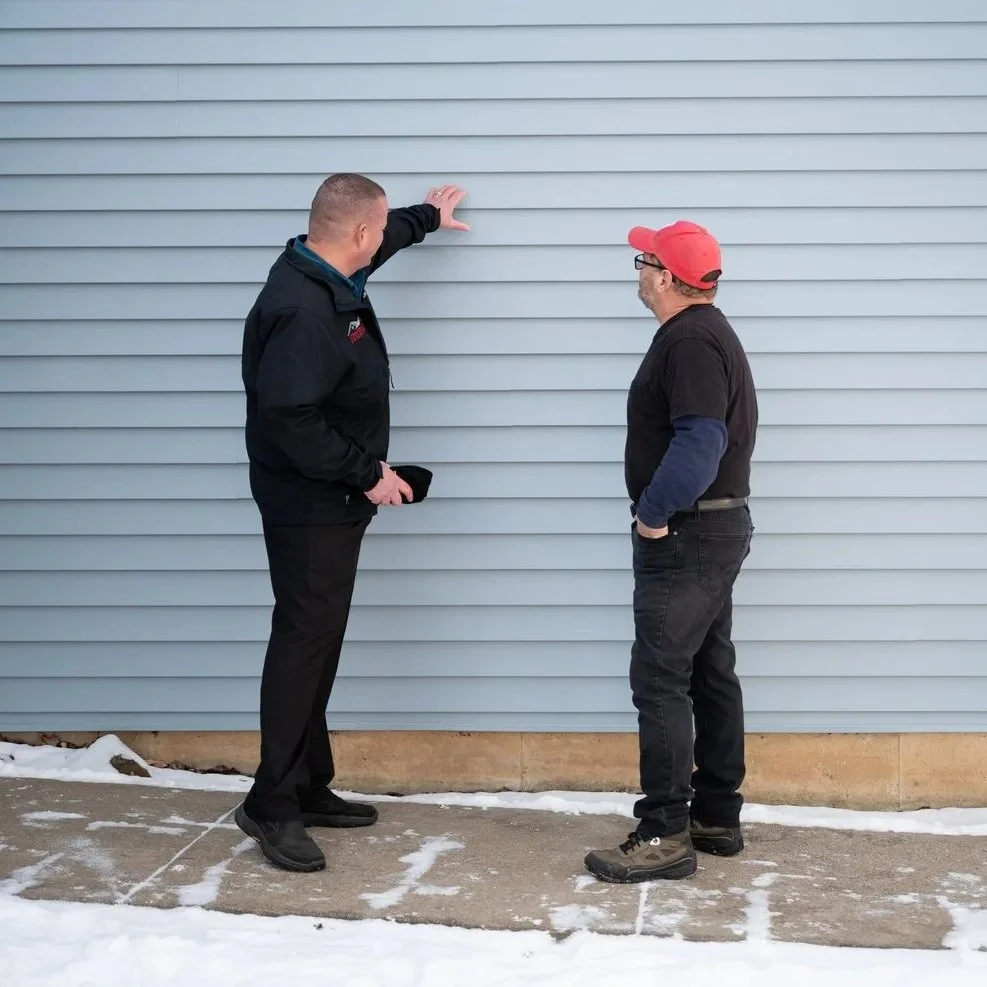
You have decided to sell. The kitchen's freshly painted, the yard is trimmed, and your agent is coming Thursday to walk through before listing. She goes around the outside and stops at the back corner — a section of vinyl gone chalky gray, another panel with a six-inch stress crack running up from the seam near the downspout. She doesn't say anything out loud. She doesn't need to. That look is a price reduction waiting to happen.
Siding is the first thing every buyer sees and one of the first things a home inspector flags. Whether it's worth replacing depends on what's there now, which material you'd put in, and what comparable homes in your neighborhood look like. Here's what the numbers actually say — and when replacing makes sense before you list.
The ROI Numbers: What Siding Replacement Actually Returns
The annual Remodeling magazine Cost vs. Value report has tracked siding replacement returns for over a decade. The 2023 numbers for the Midwest:
Fiber cement siding: $17,129 average installed cost → $12,966 average resale value added — 75.6% ROI
Vinyl siding: $14,359 average installed cost → $10,731 average resale value added — 74.7% ROI
Spend $14,000–$17,000 and get back roughly $10,000–$13,000 at the sale. Not a profit play. It's a loss-avoidance play.
The real question isn't "will I make money on new siding?" It's "how much will buyers discount my house because of the old siding?" When buyers see deteriorated siding, they don't think "$14,000 in new cladding." They think "$25,000 in deferred maintenance" and offer accordingly. Sellers who've replaced failing siding before listing typically don't recover the full cost, but they stop buyers from using condition as a negotiating lever on the final price.
Why Siding Condition Affects Value More Than Siding Age
The real mechanism isn't "new siding = higher price." It's "damaged siding = buyer's negotiating chip."
Cracked, chalky, or separating siding tells buyers and their agents that moisture has made its way in. They are right to be concerned. When vinyl panels crack and lose their tight fit at the seams, water gets behind the cladding layer. In a Wisconsin winter — 100+ freeze-thaw cycles between November and March — that trapped moisture undergoes the expansion-and-contraction cycle within the wall cavity. Water expands about 9% when it freezes, and it does that dozens of times over a single winter, gradually pushing through housewrap, into the sheathing, and eventually toward the framing.
By the time a buyer walks through in March, they can't see that damage. But their inspector can probe for soft sheathing, and their agent has seen enough Wisconsin houses to know what aging siding looks like when it's been leaking for three winters.
That's why siding condition matters at resale beyond curb appeal. Buyers' agents know moisture intrusion behind siding costs $3,000–$10,000 to fix for isolated sections, much more for whole-wall damage. They build that uncertainty into the offer. New siding doesn't just look better — it removes a question mark that buyers are otherwise required to price in.
Siding Materials and Their Resale Returns
Not every siding type returns the same at resale. Material cost, durability, and how buyers perceive it in your price range all affect the math.
| Material | Typical installed cost (1,500 sq ft) | Midwest resale ROI | Cold-weather durability |
|---|---|---|---|
| Vinyl | $8,000–$14,000 | ~75% | Brittle below 10°F; impact-prone in cold |
| LP SmartSide (engineered wood) | $12,000–$18,000 | ~74–78% | High impact resistance; must be sealed at cuts |
| Fiber cement (James Hardie) | $14,000–$22,000 | ~76% | Dimensionally stable in cold; heavier install |
| Everlast composite | $16,000–$24,000 | ~73–76% | Excellent cold-weather performance; no repainting |
| Wood (cedar) | $18,000–$28,000 | ~65–70% | Requires ongoing maintenance; premium niche appeal |
Vinyl has the lowest upfront cost and a solid return, but its cold-weather performance is a real factor in Wisconsin. Below about 10°F, vinyl goes brittle — wind-driven ice or debris can crack a panel that would've flexed without damage in September. LP SmartSide holds up better under cold weather impact (rated 24 on the ASTM D2444 scale versus 12 for standard vinyl) but absorbs moisture at cut edges if installation sealing is sloppy, leading to edge delamination within a few winters.
Fiber cement and Everlast composite cost more up front but are dimensionally stable and hold up in cold without repainting. The appraisal world doesn't always draw fine distinctions between materials when pulling comps. A buyer who specifically wants LP SmartSide may pay a premium for it; an appraiser pulling comps from nearby vinyl-sided homes will often treat it as a condition upgrade rather than a different category.
When Siding Replacement Moves the Needle at Sale
Visibly deteriorated siding makes the clearest case for replacement. Chalky panels, stress cracks, loose J-channel at corners, buckling sections — these aren't just cosmetic. Every one of them flags on a home-inspection report as a moisture-intrusion risk. Buyers get that report before finalizing their offer, and their agent uses it to renegotiate. Replacing failing siding before listing removes that tool from their hands.
Price range matters, too. In the $250,000–$450,000 market — where most Madison-area single-family homes trade — buyers are often comparing three or four similar houses. New siding helps yours photograph better, show better at walk-throughs, and hold its asking price under inspection scrutiny. In a $600,000+ market with low inventory, buyers may be less condition-sensitive and more focused on location.
And neighborhood norms matter as much as price. Appraisers use comparable sales as their baseline. If every comp on your street sold with updated siding in the last two years, your original 1990s vinyl becomes a downward adjustment on yours. Being the outlier costs you.
When condition is fine, the math shifts. If your current siding is old but intact — no cracks, no buckling, no visible moisture damage — it won't flag on an inspection the way deteriorated siding does. In a seller's market with limited inventory, functional-but-dated siding may not cost you nearly what it would in a buyer's market. If you're already pricing aggressively to move fast, $14,000 in siding for a 75-cent return may not be the best use of that money. A professional cleaning, fresh caulking at seams and corners, and trim paint touch-ups can cover a lot of ground for $800–$1,500.
What a Pre-Sale Siding Walk-Through Actually Catches
Before committing to full replacement, have a contractor walk the perimeter and look for specific problems. Panel cracks and stress fractures let moisture in and show up on inspection reports as deferred maintenance — buyers see that line item and think liability. Chalky or severely faded sections signal age; vinyl chalks as UV breaks down its pigment, and heavy chalking also photographs badly, which matters because 90% of buyers form their first impression from online photos before they ever walk the house.
Buckling or warped panels usually come from improper nailing that didn't leave expansion gaps, or from reflected heat off low-E windows running surface temperatures high enough to distort vinyl. Either way, it flags on inspection. Loose J-channel at corners and around windows is where water finds its way in — loose trim at downspout runoff areas, window sills, and wall-roof intersections is where damage typically starts.
The most serious thing a contractor is checking is whether the sheathing is soft. Press against corners and window surrounds — sponginess means moisture has been behind the siding long enough to degrade the OSB or plywood underneath. That's a more serious repair than siding alone, and it changes what you're actually dealing with.
The walk-through takes 30–45 minutes and costs nothing with a reputable contractor. It tells you whether the damage is isolated ($500–$2,000 to swap out a few sections) or the kind of situation where partial repair still leaves buyers skeptical about the rest of the house.
That distinction matters. Replacing three cracked panels on a 1990s house is like patching the tread on one tire of a car with 120,000 miles — the patch is real, but the buyer sees the other three tires and does the math themselves.
What to Ask Your Listing Agent Before You Decide
Real-estate agents are incentivized to list. Some will tell you the current siding is fine when what they mean is "we can list it and see." That may be true. But it's not data.
The question worth asking: "Of the last five comparable sales in this price range, how many had updated siding, and how did the ones with original siding compare on price-per-square-foot?" If updated homes sold for $12/sq ft more than those with aging siding, you have a real number to weigh against the siding estimate you're holding.
Wisconsin buyers — especially repeat buyers in the Madison market — know what aging siding signals in a climate with 40+ inches of annual snowfall and winters that cycle through freezing a hundred times. They've seen the rotted sheathing. They factor it in. Getting ahead of that conversation with a solid exterior is the only way to control what it costs you.
The Halo Effect and Energy Savings: Value That Doesn't Show in the ROI Table
Buyers don't make decisions with spreadsheets. They form impressions. When a house's exterior looks current and maintained, buyers assume the same about the roof, the furnace, the plumbing — even if they've never looked at any of it. When it looks neglected, they go hunting for other problems the moment they step inside. Good siding removes the trigger that puts buyers into skeptical mode before they've even opened the front door.
There's a second benefit that doesn't show up in sale comps: energy costs. Older siding — especially vinyl that's lost its tight seal at seams, or wood siding with failed caulk — lets outside air get into the wall cavity. In a Wisconsin winter, your furnace is running to compensate for heat escaping through gaps you can't see. Modern siding installed over properly detailed housewrap closes those gaps. The U.S. Department of Energy estimates that air seeping through wall assemblies can account for 20–40% of heating and cooling load in older homes. That's real money leaving every month.
For sellers who have a year or more before listing, new siding can pay twice: first through lower monthly utility costs, then again through a stronger market response when you do list.
Frequently Asked Questions
Yes, but rarely dollar-for-dollar. Appraisers pull comparable sales in your area. If updated siding is common on those comps, replacing deteriorated siding brings you up to market standard — removing a downward adjustment rather than creating an upward one. If a few comps have new siding, the appraiser may add modest value for condition improvement. The 2023 Midwest average runs about 75–76 cents returned per dollar spent on fiber cement or vinyl.
It depends almost entirely on current condition. Visibly cracked, chalky, or failing siding gives buyers a negotiating point that typically costs more than the replacement would have. Older but intact siding may not warrant full replacement — cleaning, caulking, and trim paint can close much of the gap in perception for a fraction of the cost.
Fiber cement and vinyl consistently top the Midwest rankings in the Cost vs. Value report, returning 74–77% of installed cost. LP SmartSide returns comparably but has less data history. Premium materials like Everlast composite and cedar have higher upfront costs that don't fully close the resale gap in most Wisconsin price ranges.
Buyers notice condition more than brand. A well-maintained 20-year-old vinyl house photographs and shows better than a 5-year-old LP SmartSide house with buckling panels. Material choice matters more in higher-priced markets where buyers are directly comparing finishes — and where they are thinking about long-term maintenance costs over the next 20 years.
Homes with visibly deteriorated exteriors sit longer because they create hesitation — buyers want to know what else hasn't been addressed. Replacing the siding removes a known concern from the inspection process and the negotiation table, which typically shortens days on market.
Schedule an estimate — Craftsman Exteriors handles siding installation and replacement across Madison, Verona, Fitchburg, Middleton, Sun Prairie, and southern Wisconsin. We help homeowners choose the right siding for their budget and home. Call (608) 975-5747.
