
Can New Windows Reduce Outside Noise?
You are lying in bed at 6 a.m., and the garbage truck is working its way down the block. You can hear it from two streets away — the hydraulic groan, the crash of the bins, the diesel rumble that seems to move through the wall rather than around it. You glance at your windows and wonder whether new ones would actually make a difference, or whether that's just wishful thinking.
The answer is yes — new windows can reduce outside noise, sometimes by half or more. But the results depend almost entirely on which windows you buy and how they're installed. A standard double-pane replacement won't cut it for serious noise. Laminated glass or a well-specified triple-pane unit can bring that garbage truck down from a jarring intrusion to a distant rumble. Here's what you need to know before spending money on the assumption that any new window will help.
How Sound Actually Gets Through a Window
Sound is pressure waves moving through the air. When those waves hit a window, three things happen: some energy reflects back, some gets absorbed by the glass, and some passes through as vibration on the other side. The glass acts like a drumhead — sound hits it, the glass vibrates, and that vibration re-radiates as sound into your room.
The critical measure is the STC rating — Sound Transmission Class. It's a single number that indicates how much a material reduces airborne sound over a standard frequency range. A single-pane window rates around STC 26 to 28. A standard double-pane window with two sheets of glass and an argon-filled gap rates around STC 26-32. Barely better. Both panes tend to vibrate at the same resonant frequency, so the improvement is modest. Laminated glass bumps that range from STC 35 to 45, depending on the interlayer thickness. A quality triple-pane window with laminated glass can reach STC 45 to 50.
Every 10-point jump in STC rating represents roughly a perceived halving of loudness. So going from STC 28 (standard double-pane) to STC 38 (laminated double-pane) doesn't sound like a 10-point improvement — it sounds like the outside world dropped by half. Going from STC 28 to STC 48 makes it sound like you've moved a city block farther from the road.
The Part Most Window Salespeople Skip: Frequency
Windows don't block all sounds equally. High-frequency sounds — voices, birds, a dog barking — are much easier to block than low-frequency ones. Garbage trucks, semi-trailers, bass from a sound system, and HVAC equipment produce sound waves in the 100 to 250 Hz range that have long wavelengths and high energy. Glass doesn't absorb them well at any thickness.
This is why some homeowners replace windows and still hear every motorcycle that passes. The high-pitched tire noise dropped. The low-frequency engine rumble? That's another story.
And if low-frequency traffic noise is your main complaint, laminated glass is the most effective solution available short of a full soundproofing project. The PVB (polyvinyl butyral) interlayer — a flexible plastic film 0.030 to 0.060 inches thick sandwiched between the glass layers — converts sound energy to heat through internal damping rather than letting it vibrate freely through the glass. It's the same technology used in car windshields, which is why your car is much quieter inside than your living room, even with glass walls thinner than most windows.
Think of it as the difference between striking a tuning fork on a hard surface and holding it in your hand. The desk lets the vibration ring on. Your hand damps it out. That's what laminated glass does to incoming sound.
Energy Efficiency and Acoustic Performance Are Not the Same Thing
This trips up a lot of homeowners. A window can be excellent at holding heat in during a Wisconsin February and still let in every truck on your street. Thermal and acoustic insulation are distinct engineering problems addressed by different glass configurations.
Argon-filled double-pane glass improves your U-factor — how well the window resists heat transfer. It does almost nothing to reduce noise because thermal performance depends on gas conductivity, not on how the glass manages vibration. You can have an Energy Star-certified window rated U-0.22 that still lets road noise walk right through. Don't assume the energy efficiency rating tells you anything about sound.
What Window Options Actually Work for Noise
Laminated glass is the single biggest upgrade for noise reduction. A double-pane window with one laminated lite — one pane of laminated glass paired with one pane of standard glass — can achieve an STC rating of 35 to 40. A window with both lites laminated can reach STC 40 to 45. This works in double-pane frames, so you're not necessarily paying for triple-pane hardware to get there.
Triple-pane windows add a third glass layer and two air gaps instead of one. That matters acoustically because two air gaps interrupt the resonance path twice. A standard triple-pane without laminated glass typically rates around STC 34-40. A triple-pane with at least one laminated lite can push STC 45 to 52. For serious noise situations — a busy road, a rail line, a flight path — that combination is what actually delivers quiet.
Air gap width matters more than most people realize. Standard insulated glass units use a 1/2-inch gap. Widening that to 3/4 inch or more improves acoustic performance because the wider gap breaks up sound wave resonance between the panes. Some acoustic-rated windows are designed with asymmetric glass thickness — 3mm on one side, 5mm on the other — to prevent the two panes from vibrating at the same frequency. Matched-thickness panes reinforce each other's resonance. That's the problem you're trying to avoid.
Frame material is a secondary factor. Vinyl and fiberglass frames don't transmit sound the way metal does, so they help slightly. But the gap between frame materials is much smaller than the gap between glass types. Don't let anyone sell you a noise-reduction story based on frame material alone.
| Window Type | Typical STC Range | Best For |
|---|---|---|
| Standard single-pane | 26–28 | Nothing (replace it) |
| Standard double-pane | 26–32 | Basic weatherproofing, not noise |
| Double-pane, one laminated lite | 35–40 | Moderate traffic, neighbor noise |
| Double-pane, both lites laminated | 40–45 | Heavy traffic, road noise |
| Triple-pane, standard glass | 34–40 | Energy savings + moderate noise |
| Triple-pane with laminated glass | 45–52 | Serious noise situations |
What These Windows Cost
Acoustic-grade windows cost more than standard replacements, but the jump isn't as steep as many homeowners expect. In Wisconsin, rough installed pricing by STC tier typically runs:
Standard double-pane vinyl (STC 28–30): $600–$850 per window installed
Upgraded double-pane with laminated or asymmetric glass (STC 32–35): $950–$1,400 per window installed
High-performance acoustic windows (STC 38+): $1,500–$2,200 per window installed
These ranges vary based on window size, frame material (fiberglass costs more than vinyl), and how straightforward the rough opening is. A standard bedroom double-hung window is on the low end of each range. A large picture window or bay window is on the high end.
Most homeowners targeting moderate noise reduction don't need STC 38+ windows throughout the house. A realistic approach: spend for STC 32–35 laminated glass in the rooms that matter most — bedrooms and street-facing living spaces — and use standard double-pane in lower-priority rooms like closets or interior-facing spaces where traffic noise isn't the issue.
Which Rooms to Tackle First
You don't have to replace every window at once to notice a difference. The rooms where noise disrupts you most are the logical starting point.
Bedrooms are usually the priority. Sleep disruption from early-morning traffic, garbage trucks, or a neighbor's commute is the complaint that finally pushes most homeowners to act. A laminated double-pane in the bedroom can solve the problem without touching the rest of the house.
Street-facing rooms — a living room or home office on the front of the house — are the second priority. These windows face the highest-decibel noise source directly.
Basement windows sit close to street level and collect road noise, lawn equipment, and foot traffic sound efficiently. If a finished basement is where your family spends time, don't overlook these.
Installation Quality Determines Whether Any of This Works
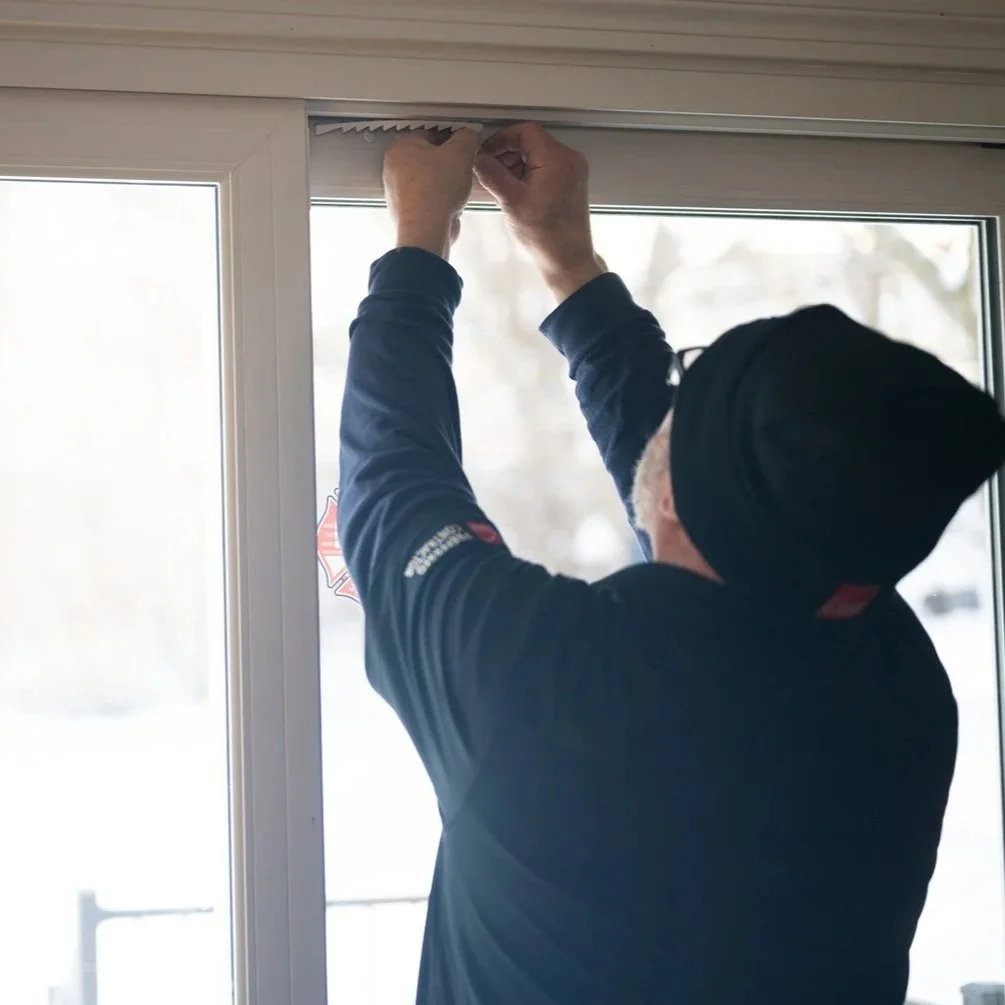
You can buy the best acoustic window on the market and hear everything outside if it's installed poorly. Sound follows the path of least resistance. A small air gap between the window frame and the rough opening — even an eighth-inch gap — bypasses all that engineered glass performance and lets noise stream straight through.
A proper installation for noise reduction includes:
Low-expansion foam packed fully around the perimeter of the rough opening before trim is applied
Acoustic caulk (non-hardening, stays flexible) at the interior trim line
Proper flashing so there are no gaps at the exterior
This matters more in older homes. Houses built before 1990 often have rough openings that weren't sized precisely, and subsequent remodels may have left gaps in the framing cavity. A new window installed in that opening without addressing the cavity is only as good as the weakest gap.
The acoustic test is simple: after installation, on a noisy day, hold your hand around the interior perimeter of the window trim. If you feel any air movement, there's a gap — and that gap is carrying sound in just as readily as it's carrying air.
Realistic Expectations: What Will and Won't Change
A well-specified window replacement — laminated glass, properly installed — will make a meaningful difference for most residential noise situations. You'll stop waking up when the neighbor's car starts. Conversations through closed windows will drop from audible to muffled. Road noise will shift from a constant presence to something you notice only when you're listening for it.
What won't change is the fundamental acoustic character of your home. Windows are typically 15 to 20 percent of a wall's surface area, and even the best-performing window has a lower STC rating than a well-insulated wall. If you're in a situation where traffic noise is genuinely disruptive — a house 30 feet from a state highway — new windows will help, but won't solve the problem completely. They're one part of what would need to be a broader noise management effort.
For most homeowners dealing with ordinary suburban noise — a busy street, early-morning trash pickup, a dog that barks at 5 a.m. — laminated double- or triple-pane windows will noticeably improve your quality of life.
How Wisconsin Weather Interacts With Acoustic Windows
Noise problems often get worse over time in Wisconsin homes, and the reason is usually the seals. Extreme temperature swings — sub-zero January mornings, 90-degree July afternoons — work the caulk and weatherstripping on older windows hard. Seals that kept a window tight at installation crack and shrink over 15 to 20 years of 100-plus thermal cycles. Once the seal fails, the noise barrier fails with it, even if the glass itself is intact.
New windows reset that clock. A well-installed replacement with flexible acoustic sealants starts fresh. With proper maintenance of the exterior perimeter caulk, you can expect 20-plus years before the seals degrade enough to matter acoustically.
One thing homeowners on the fence about timing should know: a window that's already 20 years old has likely lost a meaningful chunk of its acoustic performance due to seal degradation, regardless of how it sounded when new. Age matters. Not just for energy bills.
Frequently Asked Questions
Standard double-pane windows offer only a small improvement over single-pane — typically STC 28 to 32 versus STC 26 to 28. The difference is noticeable for high-frequency sounds like voices, but minimal for low-frequency road or truck noise. For meaningful noise reduction, you need laminated glass, not just extra panes.
Triple-pane windows with at least one laminated glass lite offer the best combination of noise reduction and energy performance. A double-pane unit with two laminated lites is nearly as effective acoustically and costs less than triple-pane hardware.
In some cases, yes — if the window frames are in good condition and the frame dimensions accommodate an acoustic glass unit, a glazing replacement is possible without changing the whole window. Get a glazier to assess whether the frame will hold the thicker unit before assuming this is an option.
Going from standard double-pane to laminated double-pane typically reduces perceived loudness by 40 to 50 percent — about what you'd experience moving from a busy sidewalk table to the inside of a coffee shop. Triple-pane with laminated glass can reduce it by 60 to 70 percent.
Yes. Larger windows have more glass surface area, which means greater potential for vibration and sound transmission, even at the same STC rating. Picture windows and sliding glass doors are more acoustically vulnerable than smaller casement windows for this reason.
Laminated glass helps more than standard glass with low-frequency noise because of the PVB damping layer, but low-frequency sound is physically harder to block than high-frequency. You'll notice an improvement, but if you're dealing with a rail line or major highway, expect "noticeably better" rather than "silent."
Schedule an estimate — Craftsman Exteriors handles window replacement across Madison, Verona, Fitchburg, Middleton, Sun Prairie, and southern Wisconsin. We'll walk you through glass specifications and help you find an option that addresses your specific noise situation. Call (608) 975-5747.
