
Composite vs Wood Decking: Which Is Better?
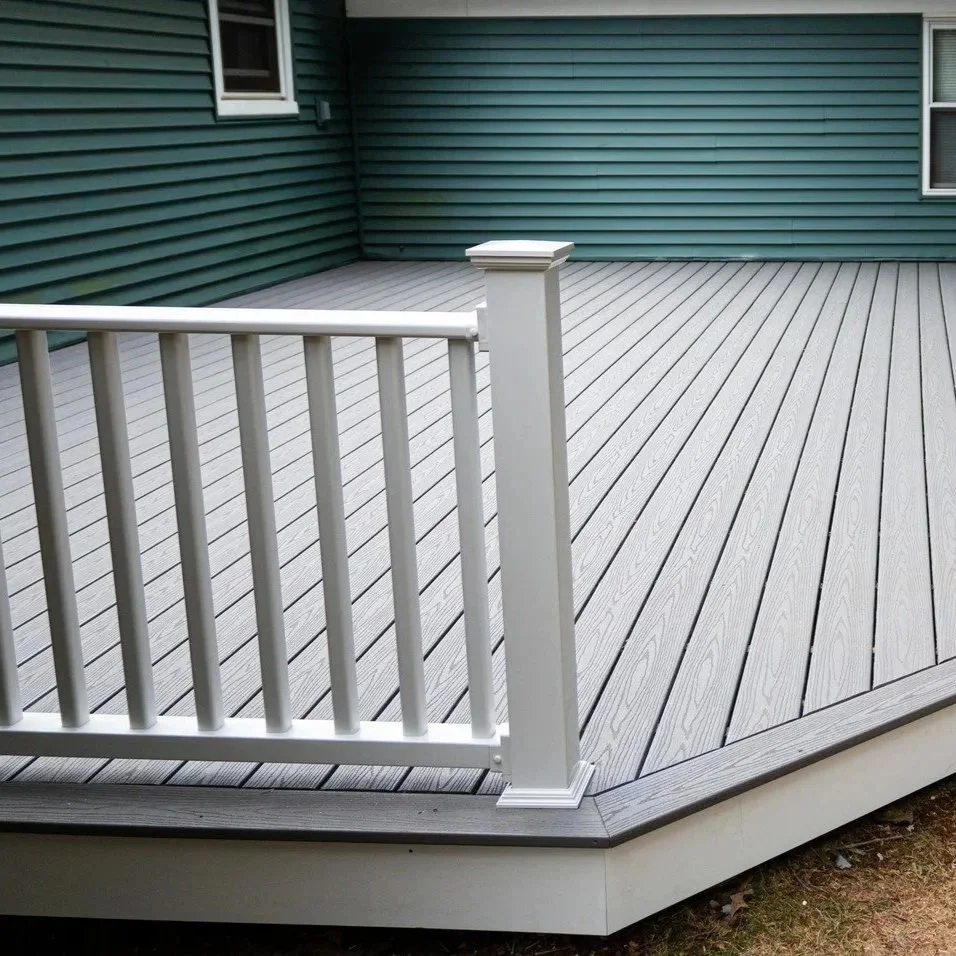
You step onto the deck that first warm Saturday in April. A few boards feel soft under your heels — not rotten yet, but that gives you a sense that another Wisconsin winter might finish the job. You have been sanding and staining every other summer for 12 years. This time, you are wondering if the next deck should be built from something different.
Most homeowners don't start seriously comparing composite and pressure-treated wood until they're standing on something that's failing. Not during the planning phase — but in April, screwdriver in hand, poking at a soft corner and thinking about whether to patch it again or finally replace the whole thing.
The comparison matters because composite and wood have almost nothing in common below the surface. They look similar at the home center. They behave completely differently once Wisconsin starts running through its 100-plus freeze-thaw cycles and dropping 40 inches of snow.
What Composite and Wood Decking Are Actually Made Of
Pressure-treated pine is still lumber. Dimensional 5/4x6 boards cut from Southern Yellow Pine, then injected with preservatives under pressure to resist rot and insects. The chemistry changed in 2003 — copper-chromium-arsenate (CCA) was banned for residential use, and modern boards use alkaline copper quaternary (ACQ) compounds instead. That chemical treatment is what keeps the wood alive. Without it, untreated pine would rot in a wet Wisconsin summer within a few seasons. With it, the wood still moves, breathes, absorbs water, dries out — thousands of times over its life. The treatment slows decay. It doesn't stop movement.
Composite decking is an engineered product. Most boards are roughly 50-60% wood fiber — sawdust, wood flour, and wood pulp — and 50-40% polyethylene or PVC plastic, formed under heat and pressure into planks. The wood fiber gives the board rigidity and the texture of wood grain. The plastic binder makes it waterproof and dimensionally stable. Capped composite goes further: a solid PVC shell wraps all four sides of the board, preventing the wood-fiber core from contacting moisture directly. That cap layer is what the 25-year warranties are actually protecting.
And the price gap is real for a reason. A $12/sq ft composite board with a 15-year warranty and a $22/sq ft capped composite with a 25-year warranty aren't just cosmetically different. The construction is fundamentally different.
How Each Material Handles Freeze-Thaw Cycles
Wood absorbs water. That's physics, not a flaw. When wood takes on moisture, and temperatures drop below freezing, the water inside expands by roughly 9% as it turns to ice. That expansion creates mechanical stress inside the wood fibers. One freeze-thaw cycle doesn't cause visible damage. A hundred of them — Wisconsin's typical winter — gradually work the fibers apart. You see it as checking (surface cracks along the grain), cupping (boards curling upward at the edges), and eventually rot wherever the surface coating has broken down, and moisture has moved in.
Pressure treatment slows this. It doesn't stop it. ACQ preservatives prevent fungal decay — not mechanical damage from freeze-thaw cycling. Stain and sealer slow water absorption, which is why regular recoating extends deck life. But once the coating breaks down and water starts moving freely into the wood, the freeze-thaw clock runs hard.
Composite behaves differently. The PVC or polyethylene binder doesn't absorb water the way wood does, so there's far less moisture to freeze inside the board. Capped composite barely takes on moisture at all — PVC shells have absorption rates below 0.5%. The trade-off is thermal expansion instead of moisture expansion. A 16-foot composite board can shift up to 3/8 inch from a sub-zero Wisconsin night to a 90°F July afternoon. Installers leave gaps between boards specifically for this. Skip those gaps, and you get buckling — boards lifting clear off the frame, which looks dramatic and requires pulling the whole section.
Both materials move. Wood moves from moisture. Composite moves with temperature. Wisconsin tests both.
The Real Maintenance Difference Over Time
A pressure-treated wood deck needs staining and sealing roughly every two years in Wisconsin's climate. Skipping a cycle doesn't collapse the deck, but every summer without recoating, the surface coating degrades further, and moisture penetrates deeper. By the time the wood has gone gray and dried out visibly, you've already lost a season or two that you won't get back.
Professional staining runs $300-$500 for a 300-sq ft deck. Do it yourself, and it's a weekend, $80-$120 in materials, and a pressure wash the day before. Either way, you're doing this 8-10 times over 20 years. That's $2,400-$5,000 in professional staining costs alone — or a significant chunk of personal time if you handle it yourself.
Composite needs cleaning, not refinishing. Soap and water or a composite-approved cleaner, a scrub brush, a low-pressure rinse. Once or twice a year. Stubborn mildew responds to oxygen bleach. No staining, no sealing, no sanding.
Think of it like cloth versus leather car seats. The leather costs more upfront, but you're not conditioning it twice a year for 20 years — you just wipe it down. The cloth is fine, but the care schedule never ends.
Cost Comparison: Upfront, Annual, and Over 20 Years
| Pressure-Treated Wood | Capped Composite | |
|---|---|---|
| Material cost per sq ft | $3–$6 | $8–$18 |
| Installed cost per sq ft | $8–$14 | $15–$25 |
| Annual maintenance cost | $150–$250/yr avg. | $30–$50/yr |
| Typical lifespan | 10–20 years | 25–30 years |
| 20-year total cost (300 sq ft) | ~$8,000–$14,000 | ~$6,500–$9,000 |
| Warranty | Limited, 5–10 years typical | 25 years (most brands) |
Estimates based on Midwest contractor pricing. Actual quotes vary with deck complexity, site conditions, and brand.
The 20-year numbers surprise most homeowners. Composite costs more to build. But add staining costs over the years, periodic board replacement, and potentially a full deck rebuild — pressure-treated pine starts showing serious structural fatigue around years 12-15 in Wisconsin — and wood often ends up costing more across the full ownership period.
The break-even point, where composite's lower maintenance costs offset its higher installation price, typically lands around year 8-10.
Lifespan: What the Warranty Fine Print Doesn't Cover
A 25-year composite warranty sounds solid. Read it carefully. Most warranties cover the decking boards themselves — that they won't rot, splinter, or structurally fail. They don't cover:
Color fade — virtually all composite decks fade over time. Some manufacturers cover "excessive" fade, with definitions that vary by brand and are worth asking about before you sign.
Staining from mold, mildew, or tannins — a real problem on any composite deck that doesn't get regular cleaning. Wet leaves sitting on composite boards all fall will stain them. The warranty won't help you there.
The substructure — the joists, beams, and posts are almost always pressure-treated wood regardless of what's on top. Whatever warranty covers the composite boards doesn't extend to the framing below.
Improper installation damage — buckled boards from missing expansion gaps, or surface damage from power washing above 3,100 PSI, both typically fall outside coverage.
Wood warranties, where they exist, cover chemical treatment failure. Not weather damage, not age, not neglect.
Neither material's warranty replaces a substructure inspection every 5-7 years. The boards on top are only as good as the framing below.
Which Decking Type Makes More Sense for Your Home
Composite is the better fit if you're planning to stay in the house 15-plus years, you want minimal seasonal upkeep, or you are done with the stain-and-seal cycle. It also suits homes with pets, young children, or anyone who likes walking on the deck barefoot — composite boards don't splinter, and they don't develop the rough gray edges that pressure-treated pine gets after a few Wisconsin winters.
Pressure-treated wood makes more sense when budget is the primary constraint, you're planning to sell within 5-10 years, or you're comfortable with a regular maintenance schedule. Wood is also easier to modify on site — ripping a board to fit an odd angle takes a circular saw and 30 seconds; composite requires specific blades and more care at cut edges to avoid breaching the cap.
Cedar and redwood sit between the two. Naturally rot-resistant without chemical treatment, better looking than pressure-treated, but they still need periodic sealing. Typical lifespan is 15-20 years with diligent care. They're harder to source in the Midwest and cost more than pressure-treated at the lumberyard.
There's no single right answer. Match the decking to how long you'll own the house, how much maintenance you'll actually do, and what you're spending over a 20-year horizon — not just the number on the first invoice.
Frequently Asked Questions
Yes. Most capped composite boards are rated for loads well above what Wisconsin winters produce. The bigger concern is thermal expansion after a deep freeze follows a warm stretch — those gaps installers leave between boards aren't decorative. They give the boards room to expand without buckling.
It can. Darker composite boards in full sun can reach 120-140°F on a hot afternoon. This matters less in Wisconsin's shorter summers than in sunnier climates, but it's worth choosing lighter-colored boards for south-facing decks where you'll be standing barefoot. Wood gets warm too, but generally not as hot as dark composite.
Yes, with care. Keep pressure below 3,100 PSI and use a fan-tip nozzle, not a pinpoint tip. High-pressure pinpoint streams can breach the cap layer and create entry points for moisture — the opposite of what you want.
Deck additions recover roughly 65-70% of their cost at resale regardless of material, according to the remodeling industry cost-vs.-value data. Buyers notice a well-kept composite deck, but the resale value difference between composite and wood isn't dramatic. The bigger payoff from composite comes in the years before you sell — in maintenance time and cost, not in the final sale price.
Have a contractor check joist spacing and condition before resurfacing. Composite boards typically require joists no more than 16 inches on center — some brands specify 12 inches for diagonal board layouts. If your existing framing is 24 inches on center, common in older decks, you'll need intermediate joists added before putting composite on top. Otherwise, the boards flex underfoot and may eventually fail.
Yes — a hybrid build. The structural framing (posts, beams, joists) stays in pressure-treated wood, which is what most builders use regardless of surface material, while the visible decking boards, fascia, and railings use composite. It costs less upfront than an all-composite build while cutting out maintenance on the surfaces you actually see and touch. Worth asking for when you're getting estimates.
Schedule an estimate — Craftsman Exteriors handles deck installation and replacement across Madison, Verona, Fitchburg, Middleton, Sun Prairie, and southern Wisconsin. Whether you're ready to replace aging pressure-treated boards or make the switch to composite, we'll assess your existing substructure, walk you through material options, and give you a clear picture of what the project actually costs over time. Call (608) 975-5747.
