
How Do You Know If Your Roof Has Hail Damage?
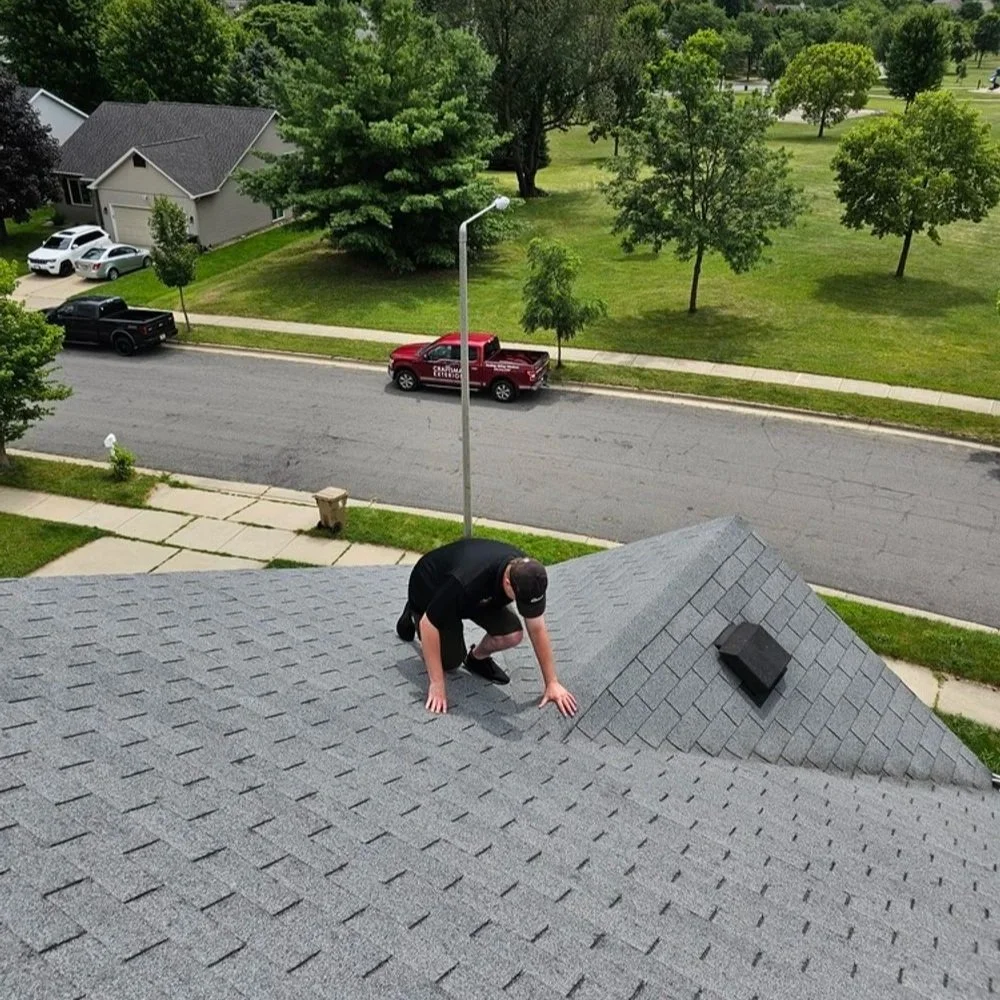
The hailstorm rolled through on a Tuesday afternoon, loud enough to pull you away from the window for a few seconds before it passed. Now it's Thursday, and you're standing in the driveway squinting up at your roof, trying to decide whether anything actually happened. Everything looks fine from here.
That's the problem with hail damage. It doesn't announce itself with a hole in the ceiling the way a fallen branch does. It works quietly—stripping granules, bruising shingles, knocking loose flashing—and your roof looks normal right up until the day it doesn't. Here's how to figure out whether you actually have a problem.
How Hail Strips the Layer That Protects Your Shingles
Before you can read the signs, you need to understand what hail actually does to an asphalt shingle.
The protective layer on top isn't decorative. It's a coating of ceramic-coated granules embedded into the asphalt surface, and those granules do three things: they block UV rays from degrading the asphalt underneath, they shed water away from the mat, and they add impact resistance. Lose the granules, and you are left with exposed asphalt.
When a hailstone hits a shingle, it knocks granules loose at the point of impact. A 1-inch hailstone strikes with roughly 5–7 foot-pounds of force. That's enough to dislodge granules across a quarter-sized area—and a storm that lasts 20 minutes can hit every square foot of your roof dozens of times. The result is hundreds of small bare spots scattered across the surface.
Here's the part that fools homeowners: the granule loss doesn't create a leak right away. The asphalt underneath is still intact. But UV exposure over the next one to two summers oxidizes that exposed asphalt, making it brittle. It cracks. It curls at the edges. Eventually it fails, and water gets underneath—right around the time it's become nearly impossible to tie the failure back to a specific storm.
Think of it like sandpaper dragging across a car's clear coat. The paint underneath looks fine immediately afterward, but the protective layer is gone, and oxidation starts working on it from that first sunny day forward. Your shingles work the same way. The damage is real long before it shows up on your ceiling.
What Hail Impact Marks Look Like on a Shingle
The textbook sign is a circular or oval depression with a dark center. The dark area is exposed asphalt mat, surrounded by a ring of missing granules where the impact happened. These are sometimes called "bruises," and the term is apt—they feel soft when you press them, like a bruised piece of fruit. That softness means the granule layer is gone, and the fiberglass mat has been compressed or fractured at that point.
Hail impact marks tend to appear in a consistent pattern:
Shape and size are uniform across the roof face. If 1-inch hail fell, the impact marks cluster around 1 inch in diameter. They don't vary wildly.
They are random but directional. Impacts scatter across the shingle surface without following wood-grain or seam lines, and they concentrate on the roof face that caught the prevailing wind.
They feel soft, not raised. Press gently with a thumb. A hail bruise compresses; a blister (which is a manufacturing defect) is raised and ruptures from the inside out.
Normal granule loss from age looks different. It produces a patchy, overall thinning of granule coverage spread evenly across the whole roof, not concentrated circular marks. Foot-traffic scuffs are linear. Hail impacts are round and clustered on the downwind face.
The Fastest Diagnostic: Check Your Soft Metals at Ground Level
You don't need to get on the roof to gather useful evidence. The most reliable indicator is what happened to your soft-metal surfaces at eye level.
Gutters, downspouts, AC condenser fins, chimney caps, and exposed metal flashing all dent visibly from hailstones at the same size threshold that damages shingles. Aluminum gutters dent from anything 3/4 inch or larger. Walk around the house—starting with the side that faced into the storm—and look at your gutters and downspouts.
If you see consistent circular dents on the top edge and outer face of your gutters, you have been hit hard enough to damage shingles. This is the shortcut adjusters use on every hail inspection. No dents on soft metals usually mean hail was too small or too light to strip granules. Clear denting on soft metals means the impact energy crossed the damage threshold.
While you're doing this walkthrough:
Gutters and downspouts: Run your hand along the surface. Pockmarking is easy to feel, even when it's subtle visually.
AC condenser unit: Look at the aluminum fins on the exterior. Bent or crushed fins are a reliable hail indicator.
Painted wood trim: Look for spots where paint has been knocked clean off, exposing raw wood. This happens at the same impact threshold as granule loss on shingles.
Window sills and metal cap flashing: Any denting here confirms a damaging event.
If you have LP SmartSide siding, it's rated to impact resistance standards significantly higher than standard vinyl. But hailstones 1.5 inches and above can still mark LP SmartSide panels—look for small circular dents or paint cracking at impact points.
Granules in the Gutters: How Much Is Too Much?
After any hailstorm, check your gutters for granule accumulation. A small amount of loose granules is normal—every asphalt shingle loses some granule material over its lifespan, and rain washes them into gutters. What you're looking for is a sudden, heavy accumulation after a specific storm.
If you're scooping out multiple handfuls of gritty, dark material (the granules are ceramic-coated crushed rock, usually black or dark gray) in the days following a storm, you've lost a significant amount of protective coverage. Granules pile up at downspout elbows and corners where water slows—check those spots specifically.
A 2,000-square-foot roof has roughly 20 squares of shingles. If a widespread hail event stripped even 5% of granule coverage from each square, that's meaningful degradation across the whole surface. A single severe storm can subtract years from a roof's remaining useful life—what might have been 15 more years becomes 8 or 9.
Hail Size and the Damage Threshold
Not every hailstorm damages roofs. The size of the hailstone matters more than the duration of the storm.
Less than 3/4 inch (smaller than a dime): Unlikely to cause meaningful shingle damage on a roof under 10 years old
3/4 inch to 1 inch (dime to quarter size): Can cause granule loss on older shingles (10+ years) or shingles already thin from prior wear
1 inch to 1.5 inches (quarter to golf ball size): Likely to damage most asphalt shingles; will dent aluminum gutters and soft metals
1.5 inches and above: High probability of significant damage across all shingle ages; can crack ridge caps, dent step flashing, and affect even Class 4 impact-resistant shingles
Shingles carry an impact resistance rating from Class 1 (least resistant) to Class 4 (most resistant). If your roof was installed with Class 3 or Class 4 shingles—typically required or discounted by insurers in hail-prone areas—it takes a harder hit before meaningful granule loss occurs. If you don't know your shingle class, your roofing invoice or permit paperwork should list it.
The challenge is that homeowners rarely know the exact hail size at their specific address. Weather alerts give regional data, not block-by-block readings. One useful step: check NOAA's Storm Prediction Center storm reports for the storm date. They log hail size by approximate location, and this documentation is publicly available. If a damaging event was recorded near your zip code, that's useful evidence for an insurance claim.
Why Hail Damage Almost Never Causes an Immediate Leak
This is the detail that catches people off guard. They have a hailstorm in May, check their attic and ceiling in June, find nothing, and decide the roof came through fine. A year and a half later, a shingle in a high-impact zone cracks, and water gets underneath. By the time the ceiling stain appears, the damage is 18 months old, and the insurance claim window has often closed.
The reason: granule loss doesn't punch a hole in your roof. It exposes the asphalt to UV. That exposure degrades the asphalt gradually—it goes from flexible to brittle over one or two summers of direct sun. When it finally cracks or starts curling at the edges, it looks like general age-related wear, and it's nearly impossible to connect it to a specific storm.
This is why most homeowner policies maintain a one-year window to file a hail damage claim. The damage occurred at a defined moment—the day of the storm—even though the failure isn't visible yet. Waiting until the roof actively leaks usually means waiting too long.
If you suspect hail damage, don't wait for a ceiling stain to confirm it. Get an inspection while the evidence is still traceable to the event.
When You're in the Damage Zone, Get on Record
If your soft-metal check shows denting and you've got granule accumulation in the gutters, the next step is to call a roofer for a professional roof inspection. A proper inspection produces close-up photographs of each roof face, measurements of impact diameters, documentation of soft-metal denting, and a written summary that your insurance carrier can use in an adjuster review.
That documentation matters especially if your insurer's adjuster initially denies the claim. Adjusters often spend only 10–15 minutes on a roof during an initial visit. A contractor's thorough inspection report—with photos of individual impact marks and measurements—gives you the evidence you need to challenge a denial or request re-inspection.
You also want the inspection done soon. Impact marks on asphalt shingles are most visible before UV and rain weathering begin to blur the edges of the bruised spots. The longer you wait, the harder it becomes to distinguish fresh hail damage from normal aging. One more thing: if you make any temporary repairs before the inspection—tarping a section, for example—photograph the damage thoroughly first. Adjusters need to see the original state, not patched areas.
Frequently Asked Questions
Most homeowner policies allow one year from the storm date to file a hail damage claim. Some carriers allow up to two years, but one year is the standard. Check your policy under "loss reporting requirements." Don't wait until you see a leak—that usually means the claim window has already closed.
Yes, you can gather strong evidence from the ground. Denting on gutters and downspouts, pockmarking on AC condenser fins, granule accumulation in gutters, and circular impact marks on siding are all ground-level indicators. Any two of those together are enough reason to call a roofer for a proper inspection.
Hailstones 3/4 inch (roughly the size of a dime) and larger can strip granules from asphalt shingles, especially roofs over 10 years old. Hail 1 inch and above will dent aluminum gutters and cause meaningful damage to most shingles regardless of age.
Manufacturer warranties—such as GAF's Golden Pledge or Owens Corning's Platinum—don't cover storm damage. That's what homeowners' insurance is for. Storm damage is an insurance event, not a warranty event. Some premium warranties include a separate hail supplement, but you need to check the specific terms.
Hail damage appears as discrete circular impact marks scattered across the shingle surface, concentrated on the downwind roof face, with soft spots where the mat has been compressed. Normal wear produces uniform overall thinning of granule coverage distributed evenly across the whole roof, regardless of orientation—no concentrated circular marks, no directional pattern.
You have the right to request a second adjuster visit. You can also hire a public adjuster to represent your interests, or submit your roofer's written inspection report—with close-up photos and measurements—as additional documentation for re-review. A thorough written report with individual impact photos carries real weight in a dispute.
Schedule an estimate — Craftsman Exteriors handles hail damage inspections and roof repair across Madison, Verona, Fitchburg, Middleton, Sun Prairie, and southern Wisconsin. We document our findings in a written report that you can submit directly to your insurance carrier. Call (608) 975-5747.
