
How Often Should Gutters Be Replaced?
You pull the ladder out, climb up to clear out the leaves, and notice the seam at the corner has split open — not bent, not clogged, actually split. Or you see a rust streak running down the fascia. Or the gutters have sagged 2 inches off the house mid-run, and you have been looking at it all summer. That's the moment: are we cleaning these again, or is it time to replace them?
The answer isn't vague. It depends on what your gutters are made of, how the previous owner installed them, and how many winters they've absorbed. Not all gutters fail the same way. Not all failures mean replacement. But some do, and missing that distinction costs real money — either in ongoing repairs that never fix the actual problem, or in water damage that follows years of leaving bad gutters up. This article breaks down lifespan by material, what cuts that lifespan short, and how to read the signs that separate a cleaning call from a replacement call.
How Long Different Gutter Materials Actually Last
Material matters more than most people realize. Gutters aren't all the same.
Aluminum has been the most commonly installed material since the 1980s. Seamless aluminum gutters — roll-formed on-site from a continuous coil — last 20 to 30 years under typical conditions. Sectional aluminum gutters, assembled from 10-foot pieces with connectors, don't last as long because every joint is a potential leak point. Expect 15 to 25 years from sectionals, depending on how well the installer originally sealed those connections. One note on downspouts: aluminum downspouts experience less abrasion and standing water than horizontal gutter runs do, so they typically outlast the gutters themselves — 30 years or more with a solid installation.
Vinyl runs 10 to 20 years, and that range isn't arbitrary. Vinyl expands and contracts a lot with temperature — roughly 1 inch of movement per 10-foot section for every 25°F of temperature change. A vinyl gutter swinging from -10°F in January to 85°F in July moves about 4 inches total across that range. The connectors holding sectional vinyl pieces together flex, fatigue, and eventually let go. UV exposure also makes vinyl brittle and crack-prone over time. In cold climates, plan on the low end.
Galvanized steel gutters, common on homes built before 1980, typically last 15 to 20 years before rust becomes a structural problem. Some well-maintained steel gutters last up to 25 years. But once rust works through the coating and into the metal itself, the clock speeds up fast — a pinhole turns into a 3-inch gap within a couple of seasons.
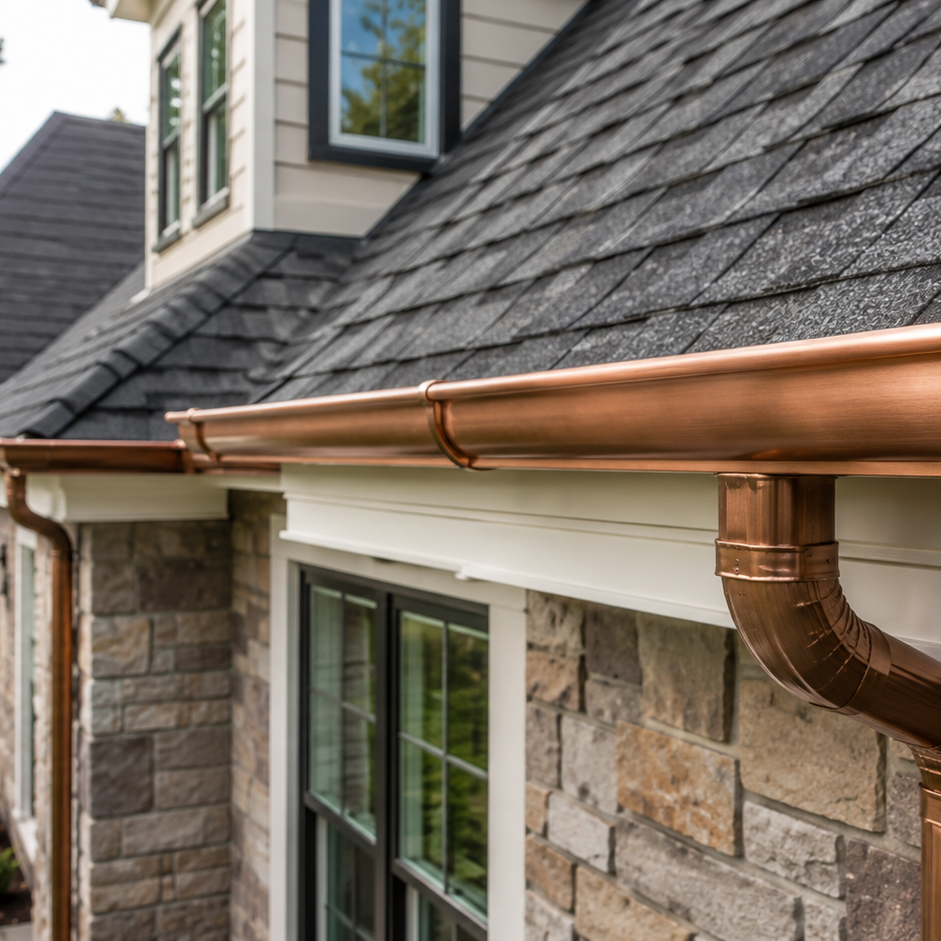
Copper and zinc are in a different league entirely. Both develop a protective patina over time instead of corroding. Copper routinely lasts 50 to 100 years. Zinc runs 50 to 80. What usually fails first on these systems isn't the gutter channel — it's the fasteners and solder joints at corners.
What Shortens Gutter Life — and Why
The numbers above assume reasonably competent installation and occasional cleaning. Several things cut that life down hard, and most of them are mechanical.
Ice and water weight. A cubic foot of ice weighs about 57 pounds. When gutters fill with meltwater that refreezes during a cold snap, a 20-foot gutter run holding 3 or 4 inches of ice can carry 150 to 200 pounds of load that the system was never built for. The hangers pull out of the fascia, the pitch shifts, and what started as a drainage system becomes a trough that holds standing water in spring. Ice formation also forces metal to expand; repeated freeze-thaw cycles work sealant loose at the seams the way a screw backs out of a hole when you keep turning it back and forth.
Improper pitch. Gutters should slope toward the downspout at roughly 1/4 inch per 10 feet of run. If the original installer missed that — or frost-heave over several winters shifted the hangers — water pools in the low spots instead of draining. Standing water is destructive. It accelerates rust in steel, holds moisture against every joint, and shortens gutter life by 30 to 40 percent compared to a properly draining system.
Clogged downspouts. A clogged downspout in winter is like a blocked drain in a bathtub: the tub fills. When that tub is your gutters and the temperature drops below freezing, all that standing water turns solid. A single blocked downspout can turn an entire gutter run into an ice tray, stressing every hanger, seam, and connector along the way.
Debris and organic buildup. Leaves, seed pods, and granules washing off asphalt shingles collect in gutters and hold moisture against metal or vinyl long after rain stops. That persistent wet layer, combined with tannins from decomposing leaves, accelerates aluminum oxidation and eats through galvanized coatings faster than weather alone would.
Overhanging trees. Physical abrasion from branches dropping during wind events adds up over the years. And trees that hang over the roofline deliver constant organic debris. Homes with heavy tree cover lose roughly 5 to 7 years from their gutter lifespan compared to open-lot homes.
Signs That Point to Replacement, Not Just Cleaning
Gutters that need maintenance and gutters that need replacement look different. The confusion happens because homeowners aren't sure which column they're in.
Seam failures. Sectional gutters fail at their joints. If you see daylight through a joint, find water streaking down the wall directly below a seam, or notice rust staining at multiple connection points along the same run, those failures will keep coming. Each repair buys one to three years at most before the next seam goes. Replacing sectional gutters with seamless gutters eliminates the failure point entirely.
Rust or holes. Surface rust on steel can sometimes be treated and painted, adding two to five years. Rust that has eaten through the metal — test it by pressing a screwdriver into the rusted spot — means replacement. And a hole in a gutter isn't a repair situation. The metal surrounding the hole is already compromised, and more failures are imminent.
Pulling away from the fascia. Gutters that have separated from the roofline aren't draining toward the house — they're draining away from it, which sends water directly against the foundation and siding below. The cause is usually hanger failure: screws pulling out of fascia boards that have softened from water infiltration. Resetting hangers into soft wood is a temporary patch. If the fascia shows rot — soft to the touch, dark discoloration, spongy when you press it — the fascia itself needs replacement before new gutters can go up.
Sagging sections. A section that sags in the middle has lost its pitch. Water pools there, deterioration accelerates, and eventually the section overflows at the low point rather than draining. A single failed hanger causing an isolated sag can be fixed. Gutters that sag across multiple sections or have settled into a visible belly along the entire run are telling you the system is done.
Peeling paint or stains on fascia and siding. Gutters do their job invisibly when they work. When they start showing up as water stains on your siding or peeling paint on your fascia boards, the overflow has been consistent long enough to saturate the wood. By the time you see fascia rot, the gutters have been failing for at least one full winter — often two or three.
Multiple repairs in a short window. Two or more repair calls in three years means you're spending money on a system that has outlived itself. The repair cost over the next five years will exceed the replacement cost.
How Wisconsin Winters Change the Timeline
National average lifespan numbers assume a moderate climate — temperate winters, light snow, maybe 10 to 15 freeze-thaw cycles per year. Wisconsin isn't that.
The Madison area gets 40 inches of snow annually and more than 100 freeze-thaw cycles between November and April. Snow load on a sloped roof regularly hits 30 to 40 pounds per square foot during heavy accumulation. When that snow starts melting all at once and hits the gutter system in a rush, gutters that were marginal going into winter fail at the spring thaw.
The freeze-thaw cycle is the single most destructive force on a gutter system in this region. Every freeze-and-thaw, metal or vinyl expands slightly and then contracts. Aluminum's thermal expansion means a 20-foot gutter section changes length by roughly 3/8 inch across a 100°F temperature swing. At 100 cycles per season, that's 100 repetitions of the same stress on every hanger and seam. Hangers installed with wood screws into the fascia — rather than spikes into the rafter tails — back out over time. The gutter drops, loses its pitch, and the cascade follows.
Here's the adjusted math for this region: subtract three to five years from national estimates for aluminum, three to seven years for vinyl, and five years for galvanized steel. Copper and zinc hold their national numbers because the patina protection isn't affected by temperature cycling, the way coated metals are.
What Maintenance Can — and Can't — Do
Regular cleaning extends gutter life.
Clean gutters twice a year — once in late October or November after leaves drop, once in April after spring debris. Apply fresh sealant at the corner joints every five years. Those two habits can add 5+ years to an aluminum gutter system's useful life.
Small things, but they add years. But maintenance can't reverse metal that has corroded through. It can't reseal joints that have failed because the metal itself fatigued. And it can't restore pitch that was never correct in the first place.
Cleaning a gutter that has lost its slope or cracked vinyl sections is like changing the oil in an engine with a cracked block. You're maintaining something past the point where maintenance works. The other thing maintenance can't replace is inspection. Every cleaning visit should include checking hanger points for screws that are backing out, checking seams for separation, and running a hand along the fascia boards for soft spots. Catching a failing hanger in October is a $30 fix. The fascia replacement it eventually causes is not.
How to Gauge Whether Your Gutters Have Life Left
This takes about 20 minutes and a ladder.
Check the seams on sectional gutters with a flat-head screwdriver — pop the tip into any suspect joint and see whether the sealant still grips. Press along the joint edges. If the tip sinks in without resistance, the sealant is gone.
Tap the gutter body with a knuckle. Solid aluminum sounds like a dull thud. Thin or compromised metal sounds hollow and rings slightly. Vinyl that has UV-degraded sounds drier and crisper than new vinyl — more like tapping a plastic bottle than a softer hollow tube.
Check the fascia at every hanger point. Look for dark streaks, paint failure, or soft wood. A soft fascia board means water has been getting in behind the gutter — through a backing-out hanger or a failed drip edge — long enough to saturate the wood.
Look at the downspout connections. Where the elbow meets the gutter outlet, check for separation, rust staining, or sealant that has cracked away. That connection fails frequently and gets skipped on visual inspections. Worth a close look every time.
Frequently Asked Questions
Cleaning fixes clogs. Replacement addresses structural failures — pulled-away sections, cracked seams, rust holes, or sagging runs with lost pitch. If your gutters drain correctly after cleaning and the hangers are still tight, they probably don't need replacement yet. If they still overflow, sag, or leak after cleaning, that's a replacement indicator.
Depends on the age and material. A single failed hanger or one cracked seam on a 10-year-old aluminum system is worth repairing. Multiple failures on a 25-year-old sectional system, or any significant rust on galvanized steel, typically make replacement more cost-effective than ongoing repairs.
Seamless aluminum can reach 30 years with reasonable maintenance and no major installation problems. Sectional aluminum rarely makes it that far because the joints fail first. Vinyl lasts for less than 30 years in cold climates. Copper and zinc exceed it easily.
Seamless gutters are roll-formed from a single piece of aluminum on-site to fit the exact length of your roofline — no joints except at corners and downspout outlets. Sectional gutters come pre-cut in 10-foot pieces connected with lap joints. Every joint is a potential leak point, which is why seamless gutters typically outlast sectional systems by 5 to 10 years in practical terms.
Not inherently — gauge (thickness) matters more than width. Standard residential gutters use .027-inch aluminum; heavier .032-inch aluminum costs more but resists denting better, particularly with heavy ice load. Wider 6-inch gutters handle more water volume from larger roof areas without overflowing, which reduces the overflow-induced damage to fascia and siding over time.
Not automatically. If your gutters are 10 to 15 years old and structurally sound, they can stay. If they're 20-plus years old or showing the failure signs above, replacing them while the roofing crew is on-site makes sense — the labor and staging are already there.
Schedule an inspection — Craftsman Exteriors handles gutter replacement and installation across Madison, Verona, Fitchburg, Middleton, Sun Prairie, and southern Wisconsin. If your gutters are pulling away from the fascia, sagging mid-run, or have been repaired more than once in the last few years, we'll get on the ladder, check the hangers and seams, and tell you honestly whether you're looking at a repair or a full replacement. Call (608) 975-5747.
