
Seamless vs Sectional Gutters: Which Is Better?
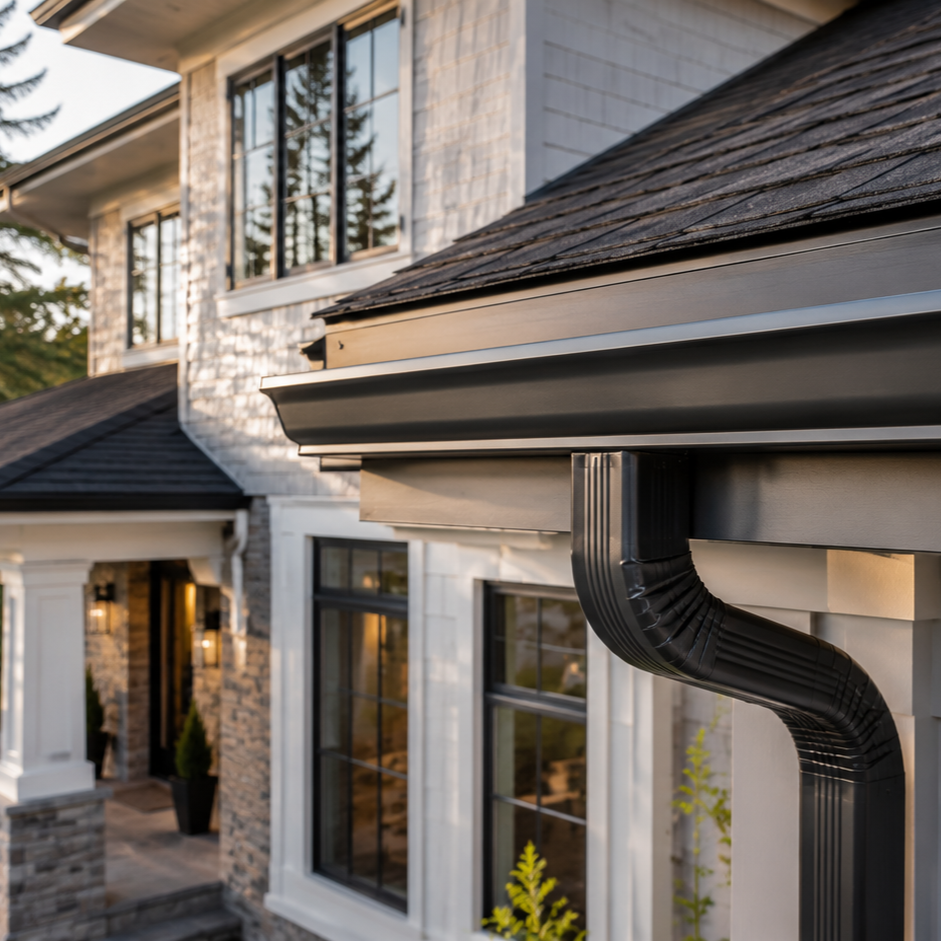
Walk the perimeter after heavy rain and look for the soft, dark stripe along your foundation wall. Usually three to four feet wide. Soil that feels almost spongy. That's not splash-off from the ground — that's water draining out of a split gutter joint all winter, running down the siding every storm while you were inside. By the time you notice it, the foundation's been soaking it up for a couple of seasons.
Whether that joint is even there depends on the type of gutter on your house: sectional or seamless.
How Sectional and Seamless Gutters Are Actually Built
Sectional gutters come in standard 10-foot lengths assembled end-to-end around the roofline. Every joint is a connection point — two sections overlapping, sealed with gutter caulk or a clip. A 40-foot run of sectional guttering has three or four of those joints. More joints mean more places for water to eventually find its way out.
Seamless gutters are cut on-site from a continuous coil of aluminum. A roll-forming machine on a contractor's trailer shapes the metal into a gutter profile and cuts each run to the exact length of your roofline. That 40-foot run? Zero mid-run joints. The only connections are at corners, downspout outlets, and end caps — still sealed, still needing some attention, but far fewer of them.
Most seamless aluminum systems come in K-style (flat bottom, decorative front — the profile you see on most modern homes) or half-round (the older half-pipe shape common on craftsman-era and historic houses). If your home has half-round gutters and you want to go seamless, the contractor needs the right die for their machine. Most carry it. Worth confirming up front.
That's really the whole difference. Sectional gutters have joints everywhere. Seamless gutters almost don't.
Why Gutter Joints Fail — and Why Cold Climates Make It Worse
A fresh joint with new caulk doesn't leak. The problem is what happens over the next five to seven years.
Water expands about 9% when it freezes. In winter, water sitting in a gutter joint freezes and pries the connection slightly apart. Then it thaws, contracts, and the sealant settles back — a little cracked, a little weaker than before. A climate that runs gutters through 100 or more freeze-thaw cycles in a single winter doesn't let those joints recover. Each cycle adds a bit more stress. By year five or six, enough joints have cracked or pulled apart that the gutters aren't doing their job anymore.
Think about caulk around bathroom tile. It doesn't fail all at once — it fails from the slow repetition of wet and dry, expand and contract. The caulk looks fine until you notice the grout behind it has gone black, and the wall behind the tile is soft. Gutter joints are the same deal. The failure is invisible until you see the stain on the siding or that wet stripe along the foundation.
Steel sectional gutters have an extra problem beyond sealant cracking. The joint area traps moisture and rusts from the inside out. Aluminum and vinyl don't rust, but aluminum sealant still deteriorates at the seams, and vinyl gets brittle in cold temperatures — often cracking at the connector before the rest of the panel shows any wear.
But seamless gutters don't eliminate all failure. Corners and end caps still have sealed joints. What they do is cut the number of potential failure points by 70 to 80% on a typical residential run. That matters.
The Real Cost Comparison
Sectional gutters are cheaper upfront. The full picture is more complicated.
| Factor | Sectional Gutters | Seamless Gutters |
|---|---|---|
| Material cost (per linear foot) | $3–$5 | $6–$12 |
| Labor cost (per linear foot) | $1–$3 (DIY possible) | $3–$6 (pro install required) |
| Typical total for 150 linear feet | $600–$1,200 | $1,350–$2,700 |
| Joint count on a 150 ft run | 12–18 joints | 4–6 (corners/outlets only) |
| Average lifespan | 10–15 years | 20–30 years |
| Resealing frequency | Every 3–5 years | Every 8–10 years (corners only) |
The lifespan gap is where things shift. A $1,000 sectional system lasting 12 years runs you about $83 per year. A $2,000 seamless system lasting 25 years is $80 per year. Nearly the same — before you count the joint repairs and resealing calls in between.
On a full gutter replacement, seamless aluminum is the better long-term value for most people. Sectional makes more sense in a few specific situations, covered below.
Key Attributes Side by Side
| Attribute | Sectional | Seamless |
|---|---|---|
| Leak risk | Higher — multiple joints per run | Lower — joints only at corners/outlets |
| DIY-friendly | Yes — available at home improvement stores | No — requires a roll-forming machine |
| Appearance | Visible seams every 10 feet | Clean, continuous profile |
| Material options | Aluminum, vinyl, steel, copper | Primarily aluminum; copper available |
| Repair ease | Easy — individual sections replaceable | Corner/outlet repairs require a contractor |
| Upfront cost | Lower | Higher |
| Ongoing maintenance | Joint resealing every 3–5 years | Minimal between corner inspections |
| Performance in freeze-thaw climates | Joints vulnerable to repeated cycling | Significantly better |
When Sectional Gutters Make Sense
They're not always the wrong call.
Tight budgets on a short timeline. If a gutter run is failing and the money isn't there for seamless, replacing the worst sections with matching sectional material buys time. Not forever. But it works.
Partial replacement. Three damaged sections out of 12? Replace those three. Pulling out functioning gutters to go seamless everywhere isn't always justified — especially if the rest of the system is in decent shape.
Unusual profiles. Older homes sometimes have gutter profiles that aren't standard K-style or half-round. If a contractor's machine doesn't carry the right die, sectional material from a specialty supplier may be the only option that fits.
Small runs in protected spots. A short gutter on a covered porch or under a sheltered overhang sees minimal stress. Sectional gutters hold up fine in those locations.
And on an exposed roofline in a climate that delivers 100 or more freeze-thaw cycles every winter? Seamless aluminum is what experienced contractors will recommend. Not because sectional can't work — because keeping it working takes constant attention.
What Seamless Gutters Still Can't Fix
Fewer leaks at mid-run joints — that's the real benefit of seamless. It doesn't solve clogging. And it doesn't touch ice dams.
Ice dams form when heat escapes through the roof deck, melts snow from the inside out, and the meltwater runs to the cold eave and refreezes. The dam grows backward, liquid water backs up behind it, and eventually pushes under shingles. That's a roof ventilation and insulation problem — not a gutter problem. Gutters don't cause ice dams and they don't prevent them. What gutters do affect is what happens when an ice dam melts: a clear, properly pitched gutter moves that water away from the foundation instead of letting it pool against the house.
Gutter guards come up a lot alongside seamless gutters, often as a package deal. They're worth evaluating separately — some guard systems handle heavy snow load well, others trap ice and create a different set of problems entirely.
What a Proper Installation Looks Like
Seamless installation requires a contractor with a roll-forming machine. There's no workaround — the machine fabricates the gutter at the job site, cut to the exact length of each run. On a standard single-story home, plan on four to six hours. Complex rooflines with multiple corners add time.
Hanger spacing matters more than most people realize. Hidden hangers screwed through the gutter into the fascia should sit every 24 to 36 inches. Gutters hung too far apart sag, and a sagging gutter pools water instead of draining it. That's not a gutter doing its job.
Downspout placement is just as important as the gutter itself. A properly designed system puts a downspout every 30 to 40 linear feet, with extensions moving water at least six feet from the foundation. The gutter is only as effective as the drainage path it feeds into.
On gauge: most contractors install .027-inch aluminum stock, which is standard. In areas with heavy snow load, .032-inch gauge holds shape better under the weight. The cost difference is modest — worth asking which your contractor is quoting.
Frequently Asked Questions
Seamless aluminum gutters typically last 20 to 30 years with proper installation and maintenance. Sectional aluminum gutters usually hold up 10 to 15 years before joints start failing regularly. Vinyl sectional gutters tend to fail faster — often within 8 to 10 years in cold climates where vinyl becomes brittle below about 10°F and can crack under impact.
No. Seamless gutters require a roll-forming machine to fabricate on-site — equipment that runs $15,000 to $30,000 and isn't available at any home improvement store. The installation also goes faster and cleaner with two people who know the machine. This is a job for a contractor with the right equipment.
For most people replacing a full gutter system, yes. The upfront difference on a typical home runs $600 to $1,500. Spread over 25 years of service versus 12, and accounting for periodic joint resealing on the sectional side, the long-term cost works out roughly the same — and seamless gutters require less attention to stay functional.
Standard seamless aluminum is .027-inch gauge, which meets the minimum for most residential applications. For homes in areas with significant snow load, .032-inch gauge is stiffer and holds shape better under weight. Ask your contractor which gauge they're quoting — the material cost difference is small, and the performance difference on a heavy snow year is real.
Yes. Seamless gutters don't clog less than sectional — leaves, maple seeds, and debris still collect in the trough. The advantage of seamless is fewer leaks, not less cleaning. Plan on clearing gutters at least twice a year: once after leaves drop in fall and once in spring after maple seeds blow in.
Most residential gutters are 5-inch K-style, which handles drainage for the majority of homes. Homes with steep pitches, large roof surface areas, or locations with heavy rainfall may benefit from 6-inch gutters, which move about 40% more water per linear foot. A contractor can look at your roof pitch and square footage and give you a recommendation grounded in actual drainage math.
What You're Really Deciding
Sectional gutters fail at the joints. That's what happens to sealed connections that go through hundreds of freeze-thaw cycles — not a design flaw, just physics. If you're doing a full gutter replacement, seamless aluminum installed by someone with the right equipment is the call for most homes. More upfront. Less work over the next 20 years.
If the budget requires sectional, plan for joint inspection and resealing every three to five years. It's not a set-and-forget situation, especially on a roofline that gets worked hard every winter.
Schedule an estimate — Craftsman Exteriors handles gutter installation and replacement across Madison, Verona, Fitchburg, Middleton, Sun Prairie, and southern Wisconsin. We fabricate seamless gutters on-site, cut to the exact length of your roofline. Call (608) 975-5747.
