
Sliding Glass Door vs French Doors: Which Is Better for a Patio?
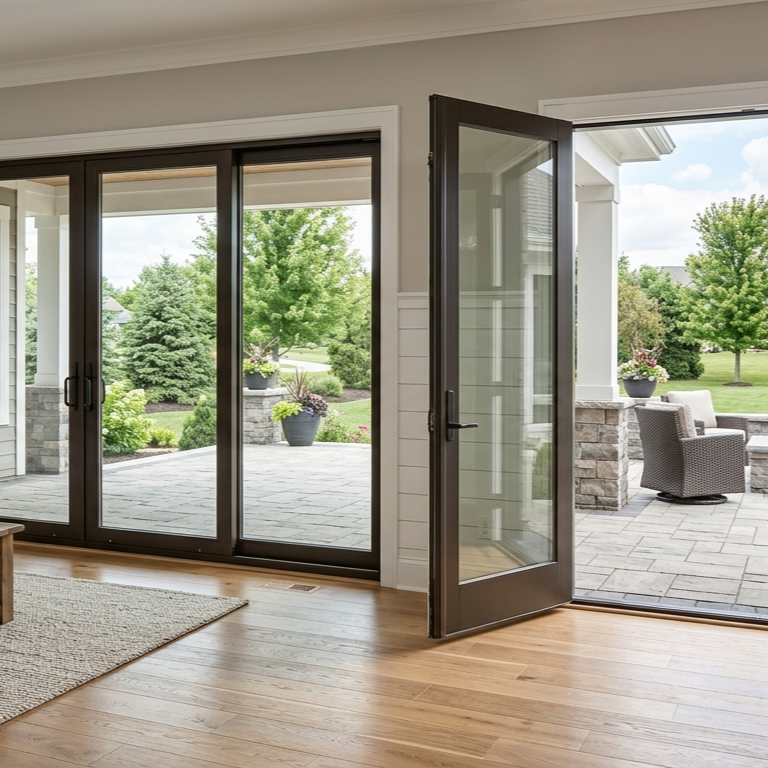
Your patio door is grinding in a track full of grit, or it's swinging into your arm because you misjudged the arc, or it's bleeding cold air through a gap that three rounds of caulk haven't touched. You are done with it and ready to replace. The first real question: slider or French doors? They both look like patio doors on a spec sheet. Besides that, almost nothing about them is the same.
How Sliding Glass Doors and French Doors Actually Work
A sliding glass door runs on a horizontal track — one panel is fixed, the other rolls along it. Simple hardware. That simplicity is both the appeal and the main failure point.
French doors are hinged at the sides. Two panels swing open — typically outward on exterior installations, though inswing versions exist. Each panel is framed like a standard entry door, with full weatherstripping around all four edges when it's closed.
That distinction matters more than it sounds. A slider needs zero interior clearance — the panel disappears behind the fixed one. A French door sweeps a full arc, roughly 36 to 42 inches per panel, either inside or out. In a kitchen with a table close to the back wall, that's not a hypothetical. It's a problem every time someone opens the door with their hands full.
Space Efficiency: Where Sliding Doors Have the Clear Edge
If your patio door opens into a tight space — kitchen, dining room, a family room where furniture sits close to the back wall — a slider almost always makes more sense. No arc to clear, no chairs to rearrange, no moment where the door swings into someone carrying a plate.
French doors are usually installed as outswing on exterior applications. That solves the interior clearance issue, but creates a new one outside. Anything within about 36 to 42 inches of the swing path — a grill, a side table, a planter — becomes something you're moving every time you open up.
And in compact outdoor spaces, that adds up fast. A slider disappears into the frame. Done.
Glass Area and Natural Light
A standard 6-foot sliding door has two panels — one fixed, one moving. The moving panel carries the hardware and frame, which eats more width than a hinged door's stile. A 6-foot French door has two panels with narrower frame rails relative to the glass area.
French doors typically give you 10 to 15% more visible glass than a slider of the same rough opening width. If natural light and an unobstructed view matter most, that gap is real. The vertical orientation of the glass also changes how you see the yard — taller, narrower panes versus the wide, horizontal feel of a slider.
Neither is wrong. It depends on what's outside and how your room sits.
Thermal Performance and Air Sealing in Cold Climates
Wisconsin winters put this decision in sharp focus.
Sliding doors seal along the top and bottom track. The moving panel has a vertical weatherstrip at the meeting rail, and pile seals — rows of fiber compressed into the track channels — at the top and bottom. But those tracks collect everything: dirt, grit, pet hair, and snow melt. In a climate with 100 or more freeze-thaw cycles per winter, track seals wear faster than they do in mild climates. Condensation forms in the channel, freezes, and works the seal loose. Five-year-old sliders in Wisconsin can leak cold air at the base and along the meeting rail in a way that surprises people — until they realize nothing's been cleaned or lubricated since installation.
Think of it like a sliding barn door on a track that's never been wiped down — it still moves, but it doesn't close tight anymore.
French doors seal differently. Four edges of compression weatherstripping on each panel press against the frame when the door's latched. A quality multi-point locking system — top bolt, center latch, and bottom bolt — pulls both panels tight at once. That creates a more consistent perimeter seal, especially at the top corners where sliders commonly let cold air through.
But French doors have a center astragal — the vertical strip where the two panels meet. That's the weak point. If the astragal isn't perfectly aligned, or if the frame shifts seasonally (wood frames do this under Wisconsin moisture conditions), you'll feel the draft right down the middle. Every time.
For both types, look for insulated glass units with low-e coating and argon or krypton gas fill. For Wisconsin, a U-factor of 0.27 or lower is a solid target for energy performance.
Ventilation: One Area Where French Doors Pull Ahead
Once summer hits and you want air moving through the house, the door type actually matters.
Sliders open roughly half the rough opening — one panel slides behind the other, so a 6-foot door gives you about 35 inches of actual airflow width. French doors, when both panels swing fully open, clear the entire opening. That's a real difference on a warm August evening when you're counting on cross-ventilation.
In summer, French doors allow more air. Full stop. If you position furniture so the swing path stays clear, they work like a proper pass-through to the patio. Sliders ventilate — just not as well.
Side-by-Side Comparison
| Factor | Sliding Glass Door | French Doors |
|---|---|---|
| Typical unit cost (6 ft, mid-range) | $1,000–$2,000 | $1,500–$3,500 |
| Typical installed cost (mid-range) | $1,500–$3,000 | $2,500–$5,000 |
| Premium units (aluminum-clad, fiberglass) | $2,500–$5,000+ | $3,000–$7,000+ |
| Installation labor | $300–$600 | $400–$900 |
| Glass area (same rough opening) | Standard | 10–15% more |
| Interior clearance needed | None | 36–42 in. per panel |
| Air-sealing method | Track pile + meeting rail | Perimeter compression + astragal |
| Maintenance demand | Higher (track cleaning) | Lower (hinge checks) |
| Security (with quality hardware) | Comparable | Comparable |
| Best rough opening size | 5 ft–12 ft | 5 ft–6 ft (wider = multi-panel system) |
| Freeze risk in Wisconsin | Track icing, seal wear | Threshold freeze-shut |
Hardware, Maintenance, and What Breaks First
Sliding door hardware lives on the floor and takes everything the floor sees — grit, pet hair, water tracked in from the patio, and snow melt. The rollers sit in a track that faces upward. After a few Wisconsin winters, rollers flatten, tracks bend from repetitive lateral loading, and the door starts dragging. Replacing rollers runs $50 to $150 in parts. A bent or corroded track means pulling the panel — more time, more money.
French door hardware is simpler in concept: hinges and a latch. But French doors are heavier, especially with large glass lites. If hinge screws pull loose from a frame that's absorbed moisture, the door sags. A sagging French door won't latch cleanly, and the weatherstripping won't compress evenly across the frame. Hinge reinforcement is cheap. Ignoring the sag isn't.
Both need annual attention. Vacuum and lubricate sliding door tracks every spring — use a dry or silicone-based product, not WD-40, which attracts grit. Check French door hinges and weatherstripping every fall before freeze-up.
Security: What Actually Matters
Sliders earned their bad reputation from aluminum doors made in the 1970s and '80s that could be lifted out of the track from the outside. Modern sliders have anti-lift blocks built into the top frame and multi-point locking mechanisms. That old weakness is gone. The current weak point is the glass — same as any other door.
French doors have a different exposure: the center seam between the two panels. A single-point knob lock at the center can be pried apart with moderate force. Multi-point hardware — bolts at the top, center, and bottom — solves that.
Both types, with quality hardware and reinforced frames, are comparable. Skip the hardware upgrade on either one, and you've made the job easier for someone who shouldn't be coming through.
How Wisconsin Winters Affect This Choice
Here's what the standard comparison misses about Wisconsin.
First: wind. Spring storms here push sustained gusts above 40 mph several times a season. An outswing French door that isn't latched can catch a gust and swing hard against the frame — or against whoever's standing near it. You get used to latching French doors when they're not actively in use, and you don't prop them open during a storm. Sliders don't have that problem.
Sliding doors are vulnerable to track freeze. In an exposed doorway — north- or west-facing, catching drifting snow and wind — moisture in the track channel freezes and expands, sometimes enough to bind the panel or crack the pile seal. Not structural damage, but a real maintenance issue that speeds up wear on rollers and seals. A slider on a sheltered, south-facing patio holds up considerably better than one facing a northwest winter wind.
French doors installed as outswing can freeze shut after a freezing rain event. Meltwater collects at the threshold and refreezes overnight. A door that latched fine at 9 p.m. won't open at 7 a.m. A properly sloped threshold and a good door sweep cut how often this happens — but in Wisconsin's February thaw-and-refreeze cycles, you'll run into it. Keep the threshold shoveled and salted.
Thermal performance edge goes to French doors with multi-point locking, when the installation is right. But that gap narrows a lot when both doors carry Energy Star ratings and comparable glass packages. At that point, you're comparing installation quality, not door type.
For north- or west-facing patios with real wind exposure: French doors with a covered overhead. For sheltered south-facing patios or layouts where clearance is tight: sliders work fine and cost less.
Which One Fits Your Patio?
Sliding glass doors make more sense when:
- Interior space is tight, and you can't accommodate a full swing arc
- Your patio is compact, and items sit close to the house
- Budget is a significant factor
- You want a simpler installation without rough opening modification
- The door faces a sheltered location away from the prevailing winter wind
French doors make more sense when:
- Natural light and glass area are priorities
- You want a more traditional exterior appearance
- The patio is spacious enough to accommodate the full swing path outside
- You're prepared to invest in multi-point hardware and quality weatherstripping
- Thermal performance in a cold climate is the top priority
Neither is wrong for a patio. Pick based on your space, your budget, and what that door's going to face every Wisconsin winter.
Frequently Asked Questions
It depends on the existing rough opening. If the width is already right, the conversion involves a framing upgrade and header work. If the opening needs to be widened or the existing support isn't sized for a larger header span, it's a bigger project. Get the opening measured and assessed before assuming it's a simple swap.
Modern versions of both are comparable in security when installed with quality multi-point hardware. Older sliding doors with single-point locks are easier to defeat, as are older French doors without top and bottom bolt hardware. The multi-point locking upgrade is worth the cost on either.
Older or worn sliders often do, because track seals wear faster than compression weatherstripping on French doors. A new, well-installed slider with quality seals performs comparably to a new French door. The gap opens up as both age — and sliders need more maintenance to stay tight over time.
Yes, particularly after freezing rain. Meltwater collects at the threshold and refreezes overnight. A properly sloped threshold and a quality door sweep cut the frequency, but it happens in Wisconsin winters — especially during February freeze-thaw cycles. Keep the threshold area clear of snow and ice.
Sliding door parts — rollers, tracks, meeting rail, and weatherstripping — are generally cheaper to replace. French door repairs involving hardware or hinges tend to cost more. But sliders need more frequent maintenance in a tough track environment, so repair costs tend to even out over time.
Yes — it's called a sliding French door. It has the wider frame profile and glass-to-frame ratio of a French door but operates on a track, so there's no swing path to manage. These come in two-, three-, and four-panel configurations spanning up to 16 feet. The trade-off is cost: a sliding French door typically runs $500 to $1,500 more than a standard slider of the same width. Worth considering if you want the aesthetics without the clearance commitment.
Sliding doors come in standard widths of 5, 6, 8, 9, and 12 feet. Multi-panel stacking systems go wider. French doors are typically 60 to 72 inches wide total. For wider openings, a three- or four-panel folding or stacking system is necessary, and the cost increases considerably. Larger openings also require heavier structural headers.
Schedule an estimate — Craftsman Exteriors handles sliding glass door and French door installation across Madison, Verona, Fitchburg, Middleton, Sun Prairie, and southern Wisconsin. We measure your rough opening, assess the structural situation, and help you choose the door that fits your patio layout and holds up through Wisconsin winters. Call (608) 975-5747.
