
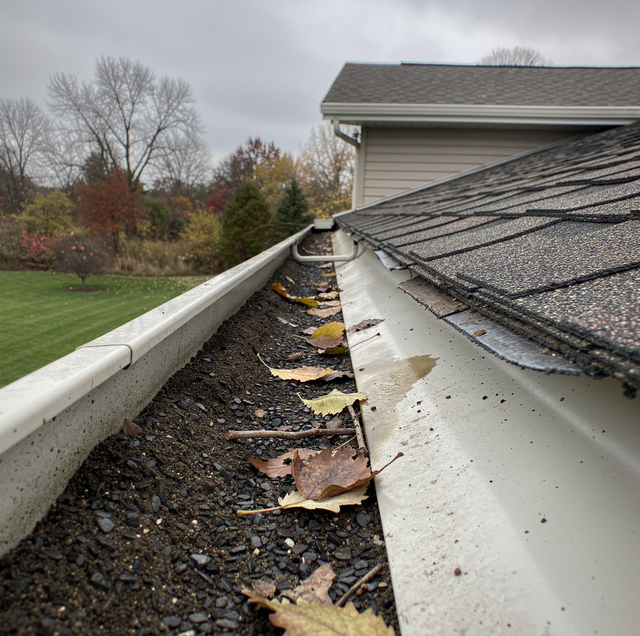
Asphalt shingles are coated in a layer of small mineral granules for a reason: the granules shield the asphalt underneath from ultraviolet light and give the shingle its fire rating, and both jobs depend on that coating staying in place. So when granules start turning up in the gutter, the shingle has lost part of its protective layer, and the question worth answering is why. A light, even scattering means little on its own. A lot, or the wrong pattern of it, is the shingle telling you something about its age, the storms it has taken, or how it has been treated.
The pattern of loss matters as much as the amount:
| What you find | What it points to |
|---|---|
| A handful of granules soon after a new roof goes on | Normal manufacturing residue washing off |
| A steady trickle that grows over several years | Age and UV wear on the shingle coating |
| A sudden, heavy load right after a storm | Hail impact, or a heavy rain flushing built-up granules |
| Bare patches or dark spots on the shingles themselves | Coating already stripped, asphalt exposed |
| Granule loss paired with curling or lifted edges | Advanced wear, likely nearing the end of service life |
Normal Shedding on a New Roof
A brand-new roof sheds granules too. During manufacturing, granules are pressed into the asphalt coating while it's still soft, and a portion of them never fully seat. That loose surplus rides along on the shingle until the first few hard rains wash it free, so a scattering of granules in the gutter in the weeks after installation is the shingle shedding what was never going to stay anyway. It's a one-time event tied to how the shingle was made, not a sign the roof is wearing out.
What matters is whether the amount keeps shrinking or holds steady. A new roof's shedding should fall off quickly as the loose surplus works its way clear. If instead you're still collecting a noticeable amount well after the roof has weathered its first few storms, something other than manufacturing residue is at work, and one of the causes below explains it.
Age and UV Wear
Every asphalt shingle loses granules over its life, and this is the slow, background cause behind a steady trickle in the gutter over the years. Sunlight breaks down the asphalt that holds the granules in place, and each heating-and-cooling cycle the roof goes through works the bond a little looser. As the shingles age, more granules shed with less provocation, so a roof well into its service life sheds more than it did when new.
This kind of loss is gradual and roof-wide rather than sudden or patchy. You'll notice it as a slowly increasing amount in the gutters year over year, sometimes alongside a shingle surface that looks slightly duller or grayer than it used to, since the exposed asphalt underneath a thinning granule coat doesn't reflect light the way a fully coated shingle does. Once the coating is thin enough that bare asphalt patches are visible to the eye rather than just a general dulling, the shingle has lost real protection from the sun, and the wear underneath speeds up from there rather than leveling off.
Hail and Impact
A hailstone hits a shingle hard enough to fracture the mineral coating right where it lands, knocking a cluster of granules loose in that one spot and leaving a darker spot where the asphalt shows. Hail that falls across a roof can do this across the whole slope at once, which is why hail produces the opposite pattern from age: instead of a slow trickle building over years, a hailstorm can fill a stretch of gutter with granules in a single afternoon. That sudden timing, tied to a specific storm, is the clue that separates impact loss from ordinary wear.
Where hail is uncommon, the granules it knocks off add up to little over a roof's life, so a gutter that fills steadily with no storm to point to is reading age and UV wear, or wear from foot traffic or branches, instead. Where hail does fall, a heavy load of granules showing up right after a storm is the pattern that calls for a roof inspection rather than another season of watching the gutters.
Foot Traffic, Pressure Washing, and Branches
Not every cause traces back to weather or age. Anyone walking across a shingle roof, whether for a satellite dish, a holiday light install, or a curiosity check after a storm, grinds granules loose under their boots with every step, and that shows up as a loss concentrated along a path rather than spread evenly across the roof. Overhanging branches do something similar in slow motion: a limb that sweeps the surface in the wind abrades the same strip of shingles over and over, stripping granules in a line that traces the branch's reach.
A pressure washer aimed at shingles does the same damage by force. The force required to blast off algae streaks or dirt is well beyond what the granule bond can withstand, and even a wide fan tip can strip granules from the shingle it is aimed at. Roof cleaning is done with a soft, low-pressure chemical wash applied from the eaves or the ground, never a pressure washer worked directly against the shingle surface, precisely because the pressure that cleans also erases the coating the shingle depends on.
Do not climb onto the roof or lean from a ladder at the gutter line to check granule loss; a fall from the eave causes serious injury. A roofer carries fall-protection gear for that look, so check from the ground with binoculars.
When Granule Loss Means Repair vs Replacement
Once you know why the granules are showing up, the next question is what to do about it. A handful tied to a new roof, on shingles that otherwise look sound, means keeping an eye on the gutters for a season. Granules tied to a storm are different, since impact damage is hard to judge from the ground and calls for a roof inspection. A steady, growing amount tied to age is a separate case: it's the shingle's coating thinning in real time, and once bare patches or dark spots show up alongside curling edges, the shingle has lost enough of its protective layer that a patch repair addresses one spot while the same wear continues elsewhere on the roof.
Where the loss falls changes the answer too. Granule loss confined to one path or one strip under a branch points to a repair, since the surrounding roof hasn't been touched the same way. Granule loss spread evenly across every slope, especially paired with a shingle color that looks flatter or grayer than it used to, points toward a roof approaching the end of what its coating can protect, or a storm that struck every slope, which an inspection separates. That's a conversation about the roof's overall age and remaining service life rather than one bad section. An inspection that looks at the gutters, the shingle surface, and the distribution of the loss is what turns a pile of granules into a clear answer.
Frequently Asked Questions
No. Loose granules cannot be reattached to a shingle, and a coating sprayed over a worn roof does not restore the granule layer that was bonded in during manufacturing. Bare spots are dealt with by replacing the affected shingles or, where the loss is roof-wide, the roof.
There's a simple gut check: if a small handful washes out of the downspout's bottom outlet after a single storm on a roof that has already weathered its first few storms, that's more than the light dusting that counts as ordinary shedding. An occasional scattering that rinses away with the next rain is unremarkable. A load heavy enough to leave a visible layer of grit at the bottom of the downspout warrants a closer look at the roof itself.
Not entirely, and the reason depends on the guard style. A fine-mesh guard traps granules on top of the screen, along with other debris, where they can still wash toward the downspout opening when it rains hard enough. A reverse-curve-style guard sheds water and fine grit over its lip while keeping larger debris out, but neither style entirely prevents granules from reaching the gutter system.
Not by itself. The granules protect the asphalt from the sun, and the asphalt is what sheds water; the mat inside it gives the shingle strength. Granule loss leaves that asphalt to dry out and crack under UV, and a leak starts once cracks or wear open a path through the shingle and the underlayment beneath it. Granule loss is the early warning, not the leak itself, which is exactly why it's worth acting on before it gets there.
Not by themselves. The dark streaks that spread down a roof are algae growing on the granules, and the granules are still in place beneath the stain. A bare spot looks different: the surface there is smooth and black because the granule layer is gone and the asphalt shows through.
They can, and differently from leaves. Granules are heavy and settle rather than float, so instead of catching on a screen the way leaf litter does, they sink and collect at bends and elbows in the downspout, where they can compact into a dense, sediment-like plug that a quick rinse will not clear. A downspout that drains slowly even when the gutter above it looks clear is worth checking for exactly this kind of buildup.
Order a roof inspection for the granules collecting in your gutters — a roofer reads the shingle surface, the pattern of loss, and the roof's age, and tells you whether it calls for a repair or a replacement plan. Craftsman Exteriors serves Madison, Verona, and Fitchburg. Call (608) 843-5007.