
What Does It Mean When Your Roof Is Losing Granules?
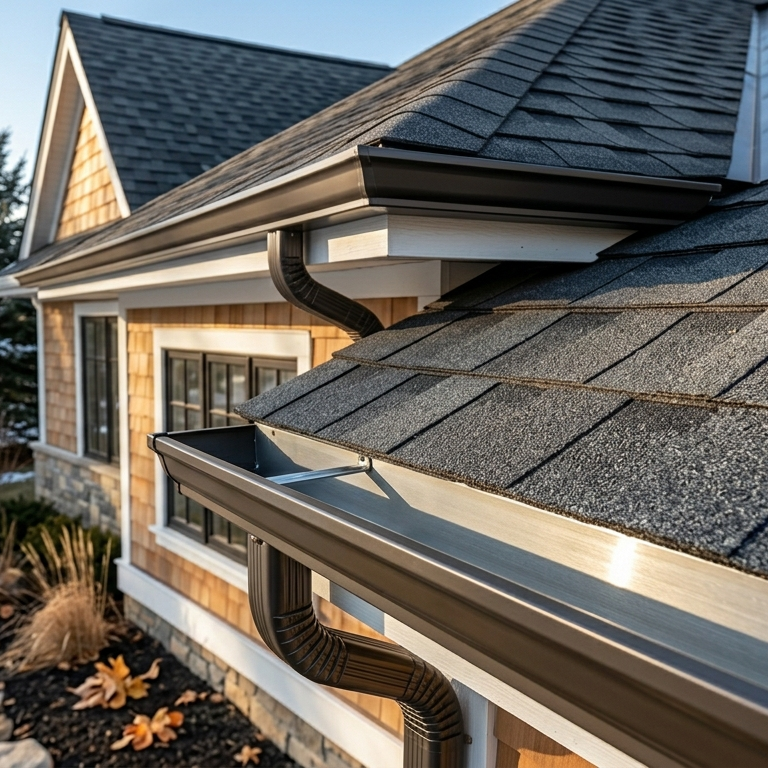
You're cleaning out your gutters in October, and the downspout is clogged with what looks like coarse sand—gray-black grit that pours out into your palm like the inside of an ashtray. That's not dirt. Those are the granules from your asphalt shingles, and a gutterful of them means something is going wrong with your roof.
Asphalt shingles aren't solid all the way through. They're a multi-layer sandwich: a fiberglass mat in the middle, coated on both sides with asphalt, with a dense layer of ceramic-coated mineral granules pressed into the top surface before the shingle sets at the factory. Those granules do two things. They give the shingles their color and texture. More importantly, they are the shingle's armor against ultraviolet radiation.
UV light is what actually destroys asphalt. Left unprotected, the asphalt coating degrades in a single season. It hardens, cracks, and the fiberglass mat underneath starts to break down. The granules block UV before it ever reaches the asphalt—take enough of them away, and the clock starts ticking. How fast the clock runs depends on what caused the granules to leave in the first place.
Why Granules Come Off—The Four Causes and What They Mean
Not all granule loss signals the same problem. The cause matters as much as the quantity, because two roofs shedding equal amounts of grit can be in completely different situations.
New Shingles Shedding: Usually Normal
If your roof was installed in the last 12 months and you're finding grit in the gutters, this is likely factory bead-off. The manufacturer presses more granules into each shingle than will permanently stick, so loose granules work off during the first several rainstorms. A gutter can look alarming—cups of grit after a heavy rain—but check the shingles themselves. If the surface looks uniform and dense, the roof is fine. Bead-off slows down and stops within the first full season.
Hail Impact: The Hidden One
This is the cause that hides best. A hailstone hits a shingle and dislodges granules in a circular zone around the impact point—the shingle surface looks intact from the driveway. No cracks visible. Nothing obviously wrong. But get on the roof and look straight down at an angle, and you'll find small round bare spots, each roughly one-quarter to one-half inch across, where granules used to be. Those spots are now exposed asphalt cooking in the sun.
After one hail season, the damage is mostly cosmetic. After two or three seasons of UV exposure on those bare circles, the asphalt hardens and cracks. Water starts getting through. The storm that caused this might have been three springs ago—one you figured wasn't serious because you didn't see any obvious damage at the time.
Age and Weathering: The Gradual Fade
A 25-year architectural shingle doesn't age uniformly across the whole roof. South-facing and west-facing slopes take more sun and more weathering than north-facing ones. After 15 to 20 years, heavily exposed sections start shedding granules because the asphalt matrix holding them in place has softened and degraded. You'll notice a color change first—areas that look darker or more mottled than the surrounding shingles, where the granule coverage has thinned. By the time the color difference is obvious from the ground, the granule layer is already significantly depleted.
Physical Abrasion: Foot Traffic and Overhanging Branches
Walking on shingles without proper technique knocks granules off. Certain installation mistakes—dragging shingles across the roof deck instead of placing them—can strip granule coverage before the shingle is even nailed down. This shows up as streaky, directional bare patches rather than the random pattern you'd see from hail or the gradual thinning from age. Overhanging tree branches do the same kind of damage—a branch that scrapes across the surface with every windstorm can wear through the granule layer in a specific line, sometimes straight through to the asphalt below.
Quick-Reference: What You're Seeing and What It Means
| What You're Seeing | Likely Cause | Urgency |
|---|---|---|
| Grit in gutters, shingles look uniform and dense | New-shingle bead-off | Low—monitor for 12 months |
| Round bare spots after a recent storm | Hail impact | Moderate—inspect within 30 days; check insurance eligibility |
| Mottled color, dark patches on an older roof | Age-related granule loss | Moderate-High—get a professional assessment |
| Bare fiberglass mat visible, shingles feel thin or brittle | Advanced UV degradation | High—roof is near the end of its life |
| Streaky directional bare patches on a newer roof | Installation damage or foot traffic | Moderate—inspect for coverage gaps |
What Happens Inside the Shingle Once Granules Are Gone
Think of a car's clear coat. The paint underneath looks completely fine for months after the clear coat is scratched—no rust, no fading. Then over a season or two, UV exposure starts oxidizing the paint. The color goes dull. Then the paint itself starts flaking. The damage was invisible until it wasn't, and by the time you could see it, you'd passed the cheap fix.
Asphalt shingles work exactly the same way. After granule loss, UV starts degrading the asphalt coating. Technically, it's called thermal oxidation, but in practice, it means the asphalt loses its flexibility. A flexible shingle can expand and contract through freeze-thaw cycles without cracking. A brittle one can't. In a climate with 100+ freeze-thaw cycles per winter, that flexibility matters enormously. Shingles that started losing granules three years ago from a hail storm you wrote off as minor can be cracking and splitting by winter—not because they're old, but because they've been baking without protection.
The timeline from significant granule loss to active leaks runs roughly 18 to 36 months under normal sun exposure. That shortens fast on south- and west-facing slopes, which take the most direct UV load.
Poor attic ventilation accelerates this whole process. When an attic traps heat instead of venting it, the roof deck can run 20 to 30 degrees hotter than it should. That extra heat softens the asphalt matrix from below, which weakens the bond holding granules in place. You get faster granule loss even on shingles that haven't taken a direct hit. It's why two roofs on the same block—same age, same shingle brand, same sun exposure—can shed at completely different rates.
How to Inspect for Granule Loss Without Getting on the Roof
You can gather a lot of useful information from the ground.
Clean your gutters or check the downspouts after a significant rain. A small amount of grit is normal after any storm. A cup or more—especially on a roof older than five years—warrants a closer look. If the grit concentrates at one downspout and not others, you can often narrow down which slope is shedding.
From the ground, use binoculars. Look at each slope individually. You're looking for color variation—patches that look darker, more mottled, or visibly different from the surrounding shingles. Healthy shingles have a dense, consistent granule surface that reflects light evenly. Areas with significant granule loss look darker because you're seeing the asphalt base instead of the granule layer. In more advanced cases, the exposed asphalt goes slightly shiny or reflective—a flat shingle surface shouldn't glisten in sunlight, and when it does, the granule layer is mostly gone in that spot.
Take photos. Date them. Check twice a year—once in spring after hail season wraps up, once in fall after summer UV exposure. A steady low level of grit isn't necessarily an emergency. A sudden spike after a storm, or clear acceleration between two inspections six months apart, means it's time to have someone who can actually get on the roof take a look.
When Granule Loss Means Repair vs. Replacement
The answer mostly comes down to the age of the roof and how widespread the loss is.
Localized granule loss—hail damage on one slope, a few impact zones from foot traffic—can often be addressed by replacing the affected shingles. Replacement shingles rarely match the color of weathered originals exactly, so there's usually a visible patch. But functionally, it works. If the rest of the roof has good life remaining, spot repairs make sense.
When granule loss is widespread across multiple slopes, or when the shingles showing loss are already 18 to 20 years old, spot repairs mostly just delay the conversation. You're adding new shingles onto an aging deck where the originals are degrading too. For a roof that's 20 years old with significant granule loss across both sunny slopes, full roof replacement is usually the more honest answer—the granule-depleted sections aren't the only ones failing.
One thing worth knowing about hail damage specifically: most homeowner insurance policies cover it, and the window to file a claim is typically 12 months from the storm. If you're finding fresh granule loss after a hailstorm, a professional roof inspection before that window closes matters. A contractor who can document the damage pattern properly makes a real difference in how smoothly a claim goes.
Frequently Asked Questions
Normal wear produces a relatively steady, low amount of grit over time—usually less than a tablespoon in the downspout after a moderate rain. After hail, you'll often see a sudden spike, sometimes an inch or more of material concentrated in the 24 hours after the storm. Up close on the shingles, hail leaves circular bare spots roughly the size of a quarter. Normal wear shows as gradual thinning across the whole surface rather than discrete impact zones.
Localized granule loss from a recent hail storm or specific impact can often be repaired by replacing the affected shingles. Widespread granule loss on an aging roof is a different situation—the shingles are likely near the end of their service life across the board, and spot repairs just push the replacement conversation back a year or two. The age of the roof matters more than the granule loss itself.
Yes. Granule loss is a slow degradation process, not an immediate structural failure. But you're on a timeline. A roof shedding significant granules has a reduced remaining lifespan, and waiting on the assessment makes it more likely you'll go from granule loss to active leaks without much warning. Get a professional look within a season.
No, not really. Eight years is too early for significant age-related granule loss on a standard architectural shingle. The most likely explanations are hail damage from a storm you might not have noticed, installation errors, or a manufacturing defect. Have a contractor document the damage before the manufacturer's workmanship warranty window closes.
There's no single answer, because it depends on how much coverage is left, how much sun exposure the slope gets, and your climate. Significant granule loss on a south-facing slope in a high-UV area can lead to shingle cracking in 18 to 24 months. Moderate loss on a north-facing slope might give you three to four years. Once you can see bare asphalt mat from the ground, you're already well into the degradation timeline.
It depends on the cause. Hail-related granule loss is typically covered under standard homeowner policies as storm damage. Age-related granule loss—normal end-of-life wear—is not covered, because that's considered maintenance rather than a sudden event. If you've had any significant hailstorms in the past year, have a roofer inspect and document the damage pattern before assuming it's just old age.
What Granule Loss Is Actually Telling You
A handful of grit in a gutter after a rain isn't a crisis. But a significant amount—consistently, or suddenly spiking after a storm—means the protective layer between sunlight and your shingle structure is thinning out. The shingles underneath are working fine right now. They won't forever. Getting eyes on the roof while there's still time to assess puts you in control of the timeline instead of reacting to a ceiling stain in February.
Schedule an estimate — Craftsman Exteriors handles roof inspections and roof repair across Madison, Verona, Fitchburg, Middleton, Sun Prairie, and southern Wisconsin. If you're finding granules in your gutters or seeing color changes on your shingles, we can tell you exactly what you're dealing with and what it will take to fix it. Call (608) 975-5747.
